Category Archives: Speakers

Video replay of presentations

Relive the ISS Symposium and watch the presentations you may have missed.

In addition to the speaker slides all presentations and round tables discussions can be now be seen on video.

Highlights include the round table discussion with ISS partner heads, presentations on AMS-02, plasma healing, space clocks, biotechnology and the closing remarks by NASA administrator Charles Bolden or ESA Director of Human Spaceflight and Operations Thomas Reiter.

A complete list of videos is available here or search the ISS symposium 2012 site by subject or speaker. 

ISS Symposium 2012 summary

Three days were devoted to research benefits of the International Space Station (ISS) and its future at the first ISS symposium in Berlin 2-4 May. Many impressive results were presented and the message was clear:  scientific research on the Space Station is increasing our knowledge of the world and creating tangible benefits for humankind - right now. This is only the beginning because the Space Station will continue to operate for at least eight more years as the only permanent weightless laboratory available to scientists. Nobody knows exactly what results the Station will produce but the future is promising.

ISS director for NASA Mark Uhran said in his presentation that many people underestimate building and maintaining a large Space Station. “It is surely as big a challenge as building the pyramids in Egypt but fortunately it did not take as long” he said. Space Station construction completed in 2010 allowing more time to be spent on research. In only two years of normal operation the results are remarkable.

Highlights of the symposium and research results cover fundamental science as well as industrial, medical and consumer applications.

Science for the benefit of humankind

(more...)

ISS Symposium 2012: Day 3 highlights

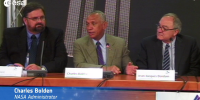
The ISS Symposium 2012 is finished. The third and last day of the ISS Symposium 2012 ended with wrap-up sessions, followed by a press conference in which the Heads (or delegates) of the five International Space Station partner agencies discussed the future of the Station and the challenges ahead.

It was an amazing conference with much to reflect on.

Presentation slides of most speakers on day 3 will be online next week.

Press conference with Heads of Agencies/representatives

Heads or top representatives from ISS agencies respond to press

  • Jean-Jacques Dordain, ESA Director General
  • Charles F. Bolden, Jr., NASA Administrator
  • Alexey Krasnov, Director of Human Spaceflight Programme, Roscosmos
  • Kiyoshi Higuchi, Vice President JAXA
  • Gilles Leclerc, Director General for Space Exploration, CSA
  • Thomas Reiter, ESA Director of Human Spaceflight & Operations

Thomas Reiter: It was a very successful conference with fantastic achievements shown. Having been involved in some of the experiments it is very rewarding to see the results. The transition from the assembly phase to the operational phase is complete and we are now operating in 'routine' mode. (more...)

Post-symposium press conference now in progress

Symposium participants meet the press in Berlin.

Closing remarks

Editor’s note: These brief extracts are paraphrased from live webcast and may not be fully correct.

Closing Session: ‘Future Perspectives and Closing Remarks’

Thomas Reiter, ESA Director of Human Spaceflight & Operations

  • This symposium has once more highlighted the success of ISS.
  • There is every possibility to continue research on ISS.
  • Our research objectives are interrelated. The science on ISS addresses issues for astronauts but the main focus is definitely for people on Earth.
  • We will see an increased scientific return in the coming years.
  • Research on the ISS is institutionally funded. We should engage industry to use ISS for research.
  • Investment in space is recognised as having economic benefits and this is even more important in times of financial stress.
  • All the best in the future, the ISS symposium 2012 is now concluded.


Thomas Reiter in closing address

ESA’s future science and technology

Editor’s note: These brief extracts are paraphrased from live webcast and may not be fully correct.

Future ISS Perspectives: ‘The ISS and ESA’s future Science and Technology’
             Michael Longair, ESA HISPAC Chair

Download the full presentation slides: The ISS and ESA’s Future Science and Technology

  • There is a fine line between science, applied science and technology in ESA activities.
  • HISPAC (High-level Science Policy Advisory Committee) was set up to think about interdisciplinary  science and technology without considering financial or political restraints.
  • The HISPAC team is made up of star scientists.
  • ESA reorganised the structure of its science advisory.
  • In preparation for the ESA ministerial council meeting HISPAC was asked to prepare long-term grand science themes across all ESA programmes.
  • The director general himself has not seen these themes:
  • 1. Cosmic climate: Earth observation and studying exo-planets.
  • 2. Understanding gravity: gravity influences everything
  • 3. Life in the universe
  • 4. Cosmic magnetism and high energy particles in space.
  • We need to look at space research horizontally across broad scientific themes.

Future benefits for you

Future ISS Perspectives: ‘ISS and beyond: What is in there for you?’

Berndt Feuerbacher, ESA-HESAC Chair

Download the full presentation slides: ISS and beyond: What is in there for you?

Editor’s note: These brief extracts are paraphrased from live webcast and may not be fully correct. 

  • We saw great examples over the past days but there is more to the ISS.
  • By expanding ISS utilisation we add 'three further generations of PhD students' [worth]' of research possibilities.
  • ISS utilisation is at a turning point
  • We are seeing industrial applications from space research such as turbine blades and plasma therapy.
  • Quantum physics research is comeing to the ISS. The ACES space clock is the first step but more research is possible.
  • These are not just toys for scientists but promise radically new technologies and will have economic impact.
  • When I was young we had a laser in our research lab. Nobody imagined that they would be in everyone's homes as CD players were a few years later.
  • I wish that partners: reduce mission costs, shorten access times & lessen paperwork, include the private sector and enlarge ISS to more international partners.
  • Beyond 2020 we need to involve private companies, but actions need to be taken now to prepare for this.
  • The most fascinating destination for humans is Mars.
  • To get to Mars we will need major technology changes, such as new propulsion systems, self-supporting life systems and changes in communication.
  • Future exploration requires huge efforts and is a task for humanity as a whole.
  • A tool exists to coordinate a global exploration effort: the International Space Exploration Group.
  • Human exploration is starting today, global cooperation, economic progress, innovation, inspiration and increase in knowledge await all who join in the endeavour.
  • The ISS is available now: let's use it!


Super cool! Alpha Magenetic Spectrometer video as seen at ISS Symposium Berlin

The **excellent** video shown as part of Dr. Stefan Schael's presentation on the AMS-02 experiment at the symposium. Credits: widlab More info via the AMS02 Collaboration site.

Editor's note: Was also screened at the New York - Imagine Science Film Festival - http://imaginesciencefilms.com