Mars in a Minute: What happens when the Sun blocks our signal?

Well, not 'our' signal  – this is in fact a NASA video referring to what happens when their Curiosity rover's signal gets blocked. But precisely the same thing happens with ESA's Mars Express, which happens regularly (see previous reports in ESA web here).

But we love this nifty JPL video that illustrates the situation in a fun and humours way – and wanted to make sure you saw it, too!

Mars rover gets instructions daily from NASA via a network of antennae

Nice article today in WaPo:

Brian van der Brug/AP - Activity lead Bobak Ferdowsi

Brian van der Brug/AP - Activity lead Bobak Ferdowsi, who cuts his hair differently for each mission, works inside the Spaceflight Operations Facility for NASA's Mars Science Laboratory Curiosity rover at Jet Propulsion Laboratory (JPL) in Pasadena, Calif. on Sunday, Aug. 5, 2012.

To get its messages to Earth, Curiosity first sends information to a pair of orbiters, Odyssey and Reconnaissance, that were sent in 2001 and 2005, respectively, to analyze Mars from a distance and are constantly circling the planet. (The Mars Express orbiter, operated by the European Space Agency, is also available if necessary.) The antennae on the orbiters are more than 1,300 times as powerful as the antenna on Curiosity. The rover waits for the orbiters to pass overhead to ship its messages, usually around 3 p.m. and again at 3 a.m.

Access full text via Washington Post


Mars Express to relay first science data from Mars Curiosity

This weekend is shaping up to be a big one for ESA/NASA interplanetary cooperation!

Early on Saturday morning, 6 October, central European time, ESA's Mars Express will look down as it orbits above the Red Planet, lining up its Lander Communication System (MELACOM) antenna to point at NASA's Mars Curiosity on the surface.

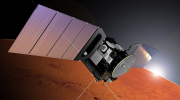
Mars Express Credit: ESA

Mars Express Credit: ESA

For 15 minutes, the NASA rover will transmit scientific data up to MEX, which will store it on board for a time. Then, two hours later, MEX will line up again, this time pointing its High Gain antenna toward Earth to downlink the precious information to the European Space Operations Centre (similar in role and function to NASA/JPL, but without the glorious California weather - Ed.), Darmstadt, Germany.

ESA's first 35-metre deep-space ground station is situated at New Norcia, 140 kilometres north of Perth in Australia. The 630 tonne antenna will be used to track Rosetta and Mars Express, the latter to be launched in 2003, as well as other missions in deep space. The ground station was officially opened on 5 March 2003 by the Premier of Western Australia, Hon Dr Geoff Gallop. Credits: ESA

ESA's first 35-metre deep-space ground station is situated at New Norcia, 140 kilometres north of Perth in Australia.
Credits: ESA

The signal will be received via ESA's 35m deep space station at New Norcia, Australia, and the data will be immediately made available to NASA/JPL for routine processing.

The inter-Agency communication relay service will send, for the first time, actual scientific data from Curiosity via Mars Express; the previous relay services provided to Curiosity have transmitted either so-called 'open-loop' signals (no data decoded but did include useful radio Doppler information) during Entry, Descent, and Landing, or only housekeeping data and other basic telemetry during early surface operations.

"The command stack to order MEX to slew and point its UHF antennas towards Mars Curiosity during the overflight, to switch the MELACOM radio ON/OFF and to later perform the data download are already programmed on board Mars Express. Our spacecraft is ready to go for this weekend," Mars Express Operations Engineer Olivier Reboud told me this earlier today.

Curiosity - Robot Geologist and Chemist in One! Credit: NASA/JPL-Caltech

This artist's concept features NASA's Mars Science Laboratory Curiosity rover, a mobile robot for investigating Mars' past or present ability to sustain microbial life. Credit: NASA/Caltech-JPL

Now here's the really interesting bit: of all the data that Curiosity might be sending up for relay via MEX (Mars Curiosity carries 10 science instruments plus a drill), it looks as though we'll be handling at least some images!

According to a note sent by NASA's Jennifer Maxwell, at JPL, yesterday, the Mars Express team are expecting to relay:

  • Two images from the Remote Micro-Imager (RMI) of the 'RockNest_3' rock acquired on Sol 57 (57 martian days since Curiosity landed, i.e. 3 October)
  • Three images acquired by the Mars Hand Lens Imager (MAHLI) system of the rock named 'Bathurst Inlet'

(See a previous view of Bathurst Inlet via the Mars Curiosity image page at JPL)

The RMI provides black-and-white images at 1024X1024 resolution in a very narrow 1.1-degree field of view. This provides images equivalent to a 1500mm lens on a 35mm camera. Wow!

'Bathurst Inlet' Rock on Curiosity's Sol 54, Close-Up View Credit: NASA/JPL-Caltech/Malin Space Science Systems

This is the highest-resolution view that the Mars Hand Lens Imager (MAHLI) on NASA's Mars rover Curiosity acquired of the top of a rock called "Bathurst Inlet." The rover's arm held the camera with the lens only about 1.6 inches (4 centimeters) from the rock. Credit: NASA/JPL-Caltech/Malin Space Science Systems

MAHLI comprises a camera mounted on a robotic arm on the Curiosity rover, which is used to acquire microscopic images of rock and soil (a typical MAHLI image resolution is a stunning 21 microns per pixel).

The weekend relay will provide further operational confirmation that Mars Express can serve as a back-up relay platform for NASA's new rover; it has already done so for NASA's other surface missions (Phoenix and the Mars Rovers, Spirit and Opportunity) in the past couple of years.

This cross-support underscores the strong cooperation between the two Agencies, who have worked diligently for a number of years to set technical and engineering standards to enable sharing data, information and telecommand links between spacecraft, networks, ground systems and ground stations, which helps reduce risk and boost back-up capabilities in both directions.

In ESA's MEX team, everyone's really looking forward to the first 'science contact' with Curiosity – which, as mentioned in a previous post by Thomas Ormston, should provide more "proof that the amazing new rover from the United States can talk with our veteran European Mars orbiter!"

Nice note from NASAs’ MSL Mission Interface Manager

Curiosity rover descending under parachute to martian surface, as seen by NASA Odyssey Credit: NASA/JPL-Caltech/Univ. of Arizona

PASADENA, Calif. – An image from the High Resolution Imaging Science Experiment (HiRISE) camera aboard NASA's Mars Reconnaissance orbiter captured the Curiosity rover still connected to its almost 16-meter-wide parachute as it descended toward Gale Crater.

This note came in last night from Susan Kurtik, NASA's MSL Mission Interface Manager at JPL and the person with whom ESA's ESTRACK team at ESOC worked to plan and conduct the tracking of MSL's arrival using New Norcia station (see our earlier post – ESA, NASA, Parkes: Big ears on Earth will listen to MSL descend – Ed.)

Susan wrote:


We want to extend our Congratulations for the incredible success of the ESA MEX and ESTRACK support of the MSL EDL!  It was flawless and exceeded everyone's expectations – great job!

Following the landing, the MSL mission manager came over to personally thank us and asked that we extend his most sincere and deep appreciation for the outstanding support of the DSN and ESA teams.  It is always an honor to be collaborating with our international partners and to be working together with such a dedicated and highly skilled team.  We have changed the world today, together.  And we have demonstrated once again the tremendous benefits of international collaboration!

Sending ENORMOUS THANKS to our ESA partners!

Best regards,

Susan C. Kurtik
Jet Propulsion Laboratory
Deep Space Network
MSL Mission Interface Manager

Commands away!

Mars Express has now been almost fully prepared for the upcoming arrival of MSL! This week's Spacecraft Operations Coordinator, James Godfrey, has confirmed that all the commands to Mars Express for the MSL tracking activities have been transmitted to Mars.

Two clicks (and a lot of background work!) was all it took to start the command file transmission to Mars Express. At 11:04 CEST our Spacecraft Controller at ESOC hit the ARM button then the GO button and the commands began their journey to Mars. Take a look at the video above to see the commands flying off our control system.

From the control system at ESOC they were sent around the world to our deep space antenna at New Norcia, Australia, and from there they were modulated onto a radio signal and blasted with 10 kilowatts (that's like 10,000 mobile phones all calling at once!) from the antenna toward Mars.

Their journey of 245,750,000 km took 13 minutes and 39 seconds. Once they arrived, Mars Express turned the radio signal back into bits and bytes and stored it on the spacecraft.

The whole command file contained all the instructions for Mars Express to follow over the next week of operations, including the critical instructions to the spacecraft to perform ESA's support of the MSL landing with Mars Express. These commands will wait on the spacecraft's on-board memory (its 'hard drive') and then execute automatically according to the schedule we created here on Earth.

NASA MSL mission communicates with ESA station

Status

This just in from Wolfgang Hell, one of our ESTRACK engineers looking after the ESA station support to MSL. ESA's 35m New Norcia (NNO) station made contact with MSL earlier this afternoon -- and the connection went fine! Wolfgang wrote:

We had a fully nominal MSL pass over NNO and NASA JPL reports that the telemetry obtained via the first communication chain at NNO was error free. I expect reports for data receipt from chains 2 and 3 during the upcoming telecon.


ESA’s New Norcia station elevating for tracking pass

Next Monday, around 12:00 local, this is how ESA's superb (may we also say beautiful?) 35m deep-space tracking station at New Norcia, Australia, will appear as it swings into position to track Mars Express and listen for NASA's Mars Science Lab.

Clip recorded in April 2012 showing ESA's 35m deep-space tracking station at New Norcia, Australia, swinging into action to conduct a communication pass. DSA-1 is designed for deep-space satellite missions and provides daily support to Mars Express, Rosetta and Venus Express for routine operations. The mechanical movable structure weighs 580 tonnes. Engineers can point it with a speed of 0.4 degrees per second in both axes (horizontal and vertical). Its Servo Control System provides the highest possible pointing accuracy under the site's environmental, wind and temperature conditions. More details via http://bit.ly/96u55A

ESA, NASA, Parkes: Big ears on Earth will listen to MSL descend

Editor's note: We're delighted to post this update on the international, behind-the-scenes cooperation to implement the MSL 'ground listening' campaign. It highlights the hard work, months of preparation and terrific cooperation between ESA, NASA and international partners on a technical, operational and interpersonal level. Thanks to NASA's Susan Kurtik and ESA's Wolfgang Hell for kindly providing information for this report.

On 6 August, ground stations and a radio telescope operated by multiple nations will be listening to signals from NASA's MSL mission as it descends through the Martian atmosphere to deliver the Curiosity rover safely onto the Red Planet's surface.

ESA's first 35-metre deep-space ground station is situated at New Norcia, 140 kilometres north of Perth in Australia. The 630 tonne antenna will be used to track Rosetta and Mars Express, the latter to be launched in 2003, as well as other missions in deep space. The ground station was officially opened on 5 March 2003 by the Premier of Western Australia, Hon Dr Geoff Gallop.  Credits: ESA

ESA's first 35-metre deep-space ground station is situated at New Norcia, 140 kilometres north of Perth in Australia.
Credits: ESA

The stations involved are all in the Land Down Under, since that's the bit of Earth that will be facing Mars at around 01:00 CEST next Monday morning, as MSL approaches its nail-biting plunge into the Mars atmosphere to touch down in Gale Crater.

During this crucial phase of the mission, MSL will transmit two radio links – one direct to Earth in X-band, which is also being used  for routine telecommanding during the cruise to Mars, and a ‘proximity link’ in the UHF band for direct communication with spacecraft orbiting Mars.

To get a good idea of the importance of the ground campaign, let's first look at the in-flight tracking efforts for the proximity link.

International fleet tracks MSL from Mars orbit

"The primary monitoring of MSL's Entry, Descent and Landing – EDL – phase will be provided by two NASA spacecraft in orbit around Mars: Mars Reconnaissance Orbiter [MRO] and Mars Odyssey. These two 'platforms' will be backed up by ESA's Mars Express [MEX]," says Michel Denis, MEX Spacecraft Operations Manager and responsible for MEX tracking support to MSL at ESOC.

(See our earlier post, 'Mars Express to track 7 minutes of terror' for details – Ed.)

Odyssey is the only one of the three that can provide the so-called 'bent-pipe' (or real-time) relaying of signals and is expected to give the first indication to NASA that Curiosity has arrived; confirmation of safe landing is expected by NASA at around 07:31 CEST.

Odyssey over Mars' South Pole: NASA's Mars Odyssey spacecraft passes above Mars' south pole in this artist's concept illustration. The spacecraft has been orbiting Mars since October 24, 2001. Credit: NASA

Odyssey over Mars' South Pole: NASA's Mars Odyssey spacecraft passes above Mars' south pole in this artist's concept illustration. The spacecraft has been orbiting Mars since October 24, 2001. Credit: NASA

In contrast, MRO and MEX can only track, store and then forward recorded signals later.

Artist's concept of the Mars Reconnaissance Orbiter. Image credit: NASA/JPL

Artist's concept of the Mars Reconnaissance Orbiter. Image credit: NASA/JPL

"Only Odyssey can receive, decode and then relay to Earth the actual telemetry data coded into the those signals. Conversely, MRO and MEX will save on board 'open-loop' recordings," says Denis.

This means they will record only the spectra of the radio signals and the related Doppler variations in signal intensity, and not the encoded telemetry.

(NASA's Susan Kurtik, MSL Mission Interface Manager at JPL, adds: In fact, we will be able to extract telemetry from the MRO open-loop recording, although it will take ~8 hours to process - Ed.)

(The variations in signal strength due to the Doppler effect are explained by the rather famous ambulance siren analogy.)

Ground tracking campaign provides crucial support

Now, let's look at the ground tracking campaign, the crucial, 'behind-the-scenes' activity in support of Curiosity's arrival at Mars provided by stations on Earth.

Continue reading

Mars Express transmits first signal to be received by new ESA station

Great news from the ESA ESTRACK team today!

The first-ever reception of signal took place at ESA's new 35m deep space station at Malargüe, Argentina, on 14 June. There's still a lot of work to be done to have the station fully commissioned, but this is an excellent achievement and an important milestone - and the signal came from our very own Mars Express, orbiting the Red Planet some 193 million km away.

First signal received by Malargüe station

First signal received by Malargüe station

Roberto Maddè, the DSA-3 project manager, wrote:

We did a test 'shadow tracking' of Mars Express last week on 14 June, around 22:30 UTC.

The signal in L-band is shown in the picture (at left). We measured a signal/noise ratio of about 56 dBHz, which matches the levels obtained by ESA's existing 35m station at Cebreros during the same pass.

Pointing still needs to be optimised (pointing correction for our test was done manually); these tests are still 'qualitative'. Some quantitative tests (less news-worthy but more useful to understand whether the station is operating within specs) are being done and look promising. Now, the teams on site are recalibrating the beam waveguide mirrors; we'll have more tests in two weeks. But we need to calibrate the pointing first.

DSA-3 is set to enter regular service later this year.

You can see DSA-3 'live' via our webcam:

MLG Webcam