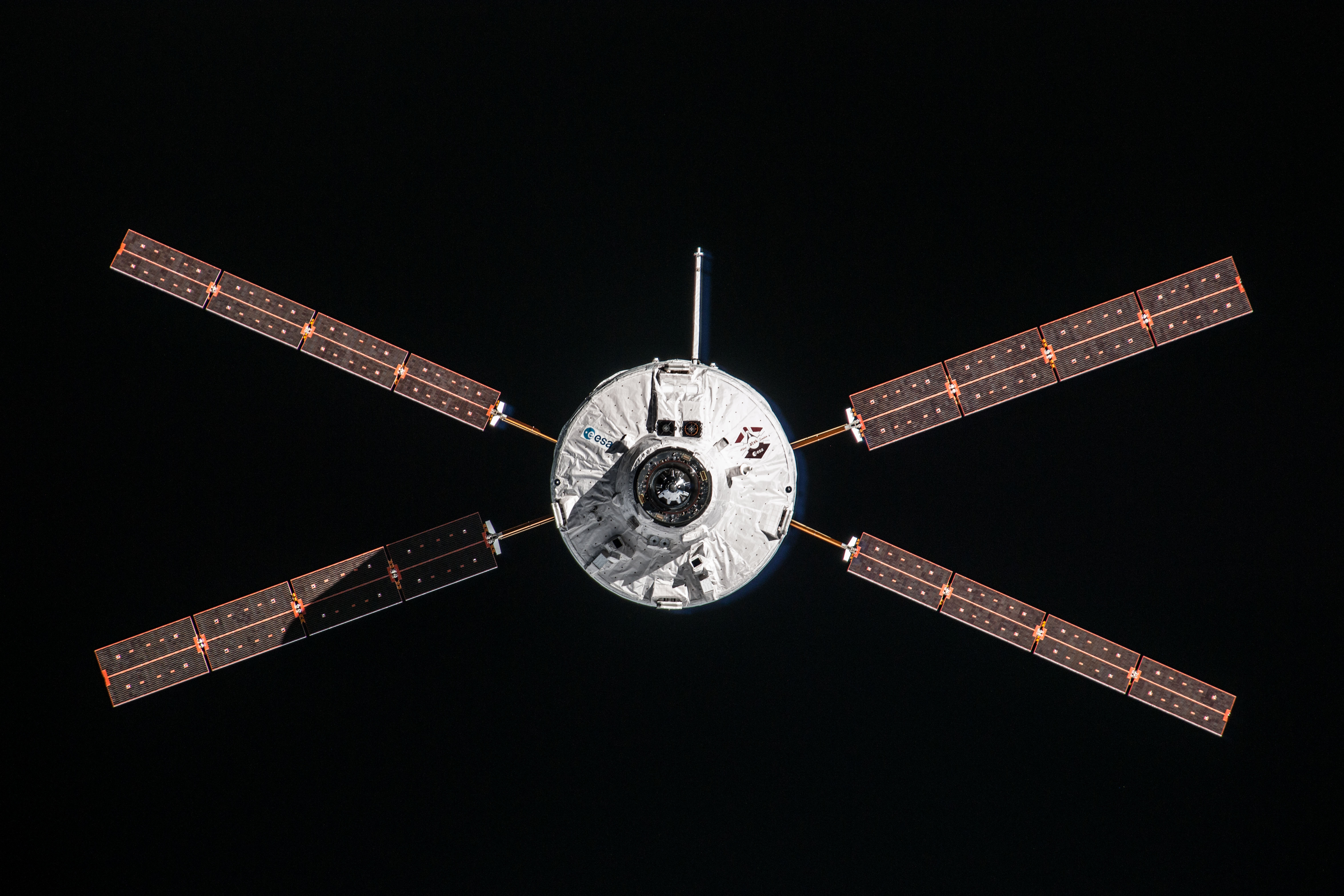
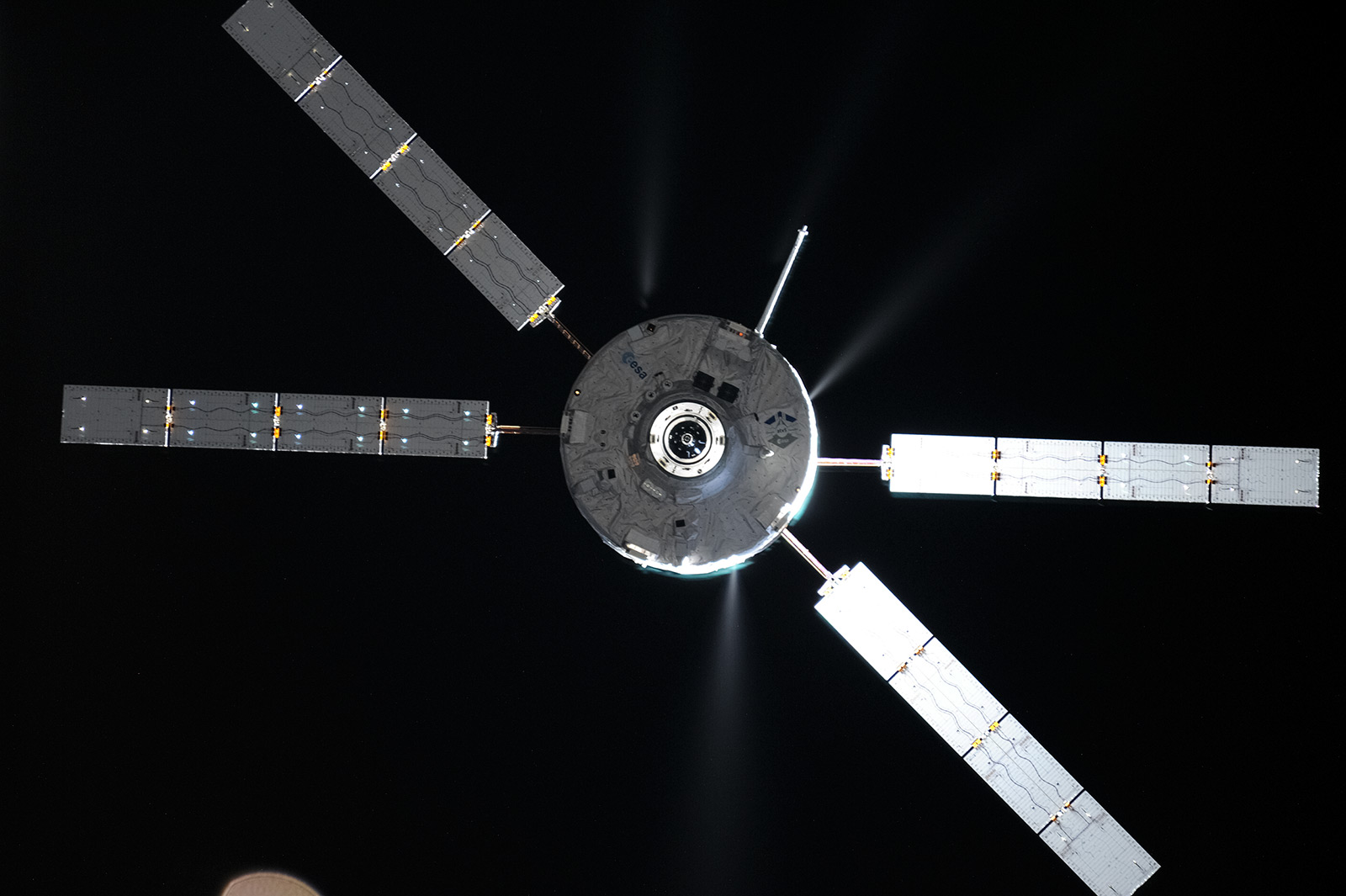
Before Europe's advanced space transporter is ready for launch on its voyage to the International Space Station, the components that make up ATV Albert Einstein have traveled quite some kilometers over sea, land and air:
ATV Albert Einstein, as all spacecraft, needs a specific launcher adapter to connect the spacecraft to its Ariane rocket. We received some great pictures of Ariane's 'crowning' in Kourou and the whole process of integrating the (black) launcher adapter and ATV itself. Precision work with a 12-tonne spacecraft! A story in images:
Update sent in earlier today from ESA's Charlotte Beskow, now in ATV-CC Toulouse – Ed.
Early May in Europe is a time with many 'holidays'. These vary from country to country, which makes for some tricky planning when you are working on a Pan-European project.
In addition it gives a false sense of having plenty of time, whereas in reality things are moving towards launch at a fast pace! Here is a short summary of where we stand since 7 May.
7 May - ATV into the container used to transport it to BAF

ATV-4 being moved into the container (CCU3) used to transport it to BAF at Kourou on 7 May 2013. Credit: ESA/C. Beskow
Transfer of ATV-4 to the 'Batiment Assemblage Finale' (BAF) by special truck in the early hours of the morning.
Later this day: RSCE General Designer Review concludes that ISS is ready to receive ATV-4.
8 May - ORB & Lifting ATV
The ESA Operations Readiness Board concludes that ATV-4 is ready to be launched (pending some normal 'open' work items). ATV Einstein is hoisted up the "chimney" in the BAF and installed on top of Ariane 5.
13 May - Go for late cargo loading
Meeting to give the OK for the final so-called 'late' cargo loading. This is done by opening the ATV hatch and having an operator descend into ATV using a specially built elevator.
The picture shows the required structure during preparation (easier to see how impressive it is!). The operator stands on the platform inside the ring, and then the elevator descends into the fully packed ATV.
Cargo loading is planned for Tue and Wed, 14 and 15 May.
In Toulouse, we hold the Test Readiness Review for the final simulations.
Wednesday is a test (JIS - Joint International Simulation – Ed.) with ATV-CC in Toulouse, the Engineering Support Team (EST) from the ATV project office at ESTEC, Moscow and Houston. All are connected via the operational communication links (via ESA's Columbus Control Center in Oberpfaffenhofen, near Munich) and all teams and engineers will be on console using their final procedures for rendezvous and docking.
Thursday is the final simulation of the Launch and Early Orbit Phase (LEOP); we take the opportunity to advance on whatever open issues remain.
In parallel to all this the NASA Stage Operations Readiness Review (SORR) concludes that ATV is ready to be launched.
The Certificate of Flight Readiness is issued: things are really moving fast!
14 May – EST arrives at ATV-CC
Engineering Support Team members arrive in Toulouse at the Control Center and are given a final briefing before the JIS simulation. This is their last chance to prepare in-situ for the flight.
For most of us, it is also the first simulation where the sim team do not inundate us with failures... so all in all it should be a good couple of days allowing us to get into the right, serene, frame of mind for the launch. In Kourou, the first part of late cargo loading is done.
15 May – JIS starts
Teams are on console at 06:45 and the sim starts at 07:30. As usual, it is impossible to know what time it is. Your body and watch tell you one thing, the wall clock, something completely different. Not only are all operations done on GMT (i.e. two hours different from local CEST) but we are simulating the real flight. Therefore, it is '26 June and about 07:00'. Of course, this is just a simulation date and does not mean that we dock on 26 June (we don't).
So, time for me to go upstairs and join my team in the control room!
– Charlotte
Arianespace marked one of the final steps in preparations for the next Ariane 5 launch as Europe’s latest Automated Transfer Vehicle (ATV) was integrated atop the heavy-lift workhorse at the Spaceport.

ATV Albert Einstein is lowered into position for integration with its Ariane 5 launcher inside the Spaceport’s Final Assembly Building as preparations near completion for next month’s mission. Credits: CNES/ESA/Arianespace/CSG Service optique
This latest ATV – named after German-born physicist Albert Einstein – was lowered by an overhead crane onto its Ariane 5 inside the 90-meter-tall Final Assembly Building in French Guiana.
The payload fairing – which will complete the launcher build up – will be mounted closer to the launch date, allowing for loading of late cargo for the ATV’s International Space Station servicing mission. This second Ariane 5 flight of 2013 is scheduled for a June 5 liftoff.
Integration of the ATV Albert Einstein for Ariane Flight VA213 is part of this month’s activities on four parallel missions involving Arianespace’s complete launcher family at the Spaceport – including the successful orbiting of three passengers by the lightweight Vega vehicle on May 7. Rounding out this month’s action in French Guiana are ongoing preparations for the medium-lift Soyuz Flight VS05, scheduled for June to loft four O3b Networks satellites; and Flight VA214, set in the second half of July with an Ariane 5 to carry the Alphasat and Insat-3D satellites.
Flight VA213’s ATV Albert Einstein will have a liftoff mass of 20,235 kg. – the heaviest payload ever lofted by any Ariane vehicle. In addition to resupply, the ATV will be used for manoeuvring the International Space Station.
Built by an Astrium-led industry team, ATV Albert Einstein will be the fourth such servicing vehicle launched by Arianespace for the European Space Agency.
Via Arianespace
Here's the correct answer to the 3rd question in our Mission Quiz ("Name the two crew members who will oversee ATV-4 docking from inside the ISS") courtesy of ESA's Lionel Ferra at EAC/Cologne.
Lionel is a regular source for the ATV blog; he works with the ESA and international partner astronauts in Cologne training them on ATV operations.

Expedition 36 crew members take a break from training at NASA's Johnson Space Center to pose for a crew portrait. Pictured on the front row are Russian cosmonauts Pavel Vinogradov (left), commander; and Fyodor Yurchikhin, flight engineer. Pictured from the left (back row) are Russian cosmonaut Alexander Misurkin, NASA astronaut Chris Cassidy, European Space Agency astronaut Luca Parmitano and NASA astronaut Karen Nyberg, all flight engineers. Photo credit: NASA
ATV 4 launch 5 June 2013: L - 1 month
ATV transfer to BAF: 6 May (postponed to Tuesday, 7 May)
Note: The latest update from Charlotte Beskow's mission diary from ESTEC and Kourou – Ed.
11-12 April - Thursday-Friday - Kourou-Paris-Toulouse
Time flies... I left French Guiana on 11 April just as the final step of fuelling the Russian tanks got under way. If felt a bit like leaving a race mid way. You stop and everyone else keeps running, cheerily waving as they speed by.
I headed back to Europe and to ATV-CC, Toulouse, where a multi-day simulation was scheduled for the following week. Like many of my colleagues, I have multiple roles. One role is to manage the day-to-day business of the launch campaign in Kourou, while another is to set up the Engineering Support Team (EST) in ATV-CC.
Upon arrival in a chilly, but sunny, Europe on Friday morning, I headed for the office in Toulouse where a Joint Control Board meeting was taking place. These serve to iron out the multitude of interface issues between what we call the ground segment, that is:
and the flight segment (who produce, assemble and launch the ATV). We hold these boards on a regular basis and people participate in person or via telephone depending on where they are.
The mission brochure for ATV Albert Einstein "On duty at the International Space Station" is available in five languages. View it online as a 3D magazine, download it for keeping as PDF, or print it out for reading outside in the Sun. Aside from English, we offer the publication in German, French, Italian and Russian.
Or browse the brochure (in English) without even leaving the ATV blog below. Fans of Slideshare can view all the brochures in all languages on the ESA operations Slideshare page.
Just in this morning from Charlotte, who was updated last week by Mark Kelly, the Astrium Test Director, on ATV-4 filling operations.
After:
I am happy to announce that the ATV-4 propellant and gas loading operations are now complete!
By Rhett Allain
(Today's post is in honour of International Star Wars Day: May the 4th be with you!)
Recently, the US government declined an online petition to build an actual Death Star. (The answer is brilliant and well worth reading! – Ed.) Yes, it’s a shocking decision in many ways, but let’s pretend for a moment that someone did want to build a Death Star. Could you use ESA's Automated Transfer Vehicle to do this? Well, of course you could – but what would that be like?

ATV nearing the Death Star! Image credits - Death Star: Lucasfilm Ltd. © & TM. All Rights Reserved. ATV: ESA
Editor's note: In addition to having a knack for science communication, Rhett Allain is Associate Professor of Physics at Southeastern Louisiana University. He writes regularly for Wired's Dot Physics blog and is a bit of a physics fanatic who spends more time than many pondering how daily life intersects with science. With the recently announced development of ATV in cooperation with NASA for Orion, we're delighted to feature a few posts from the far side of the Atlantic. Enjoy!
If you want to estimate how many ATV launches it would take to build or supply the Death Star, you first need to know something about a Death Star. I could just make some wild estimates about the Death Star, but I won’t. Instead I will look at two interesting estimations.
Editor's note: There's a great update today over at NASASpaceflight.com on our favourite cargo vessel, Albert Einstein. Pete Harding's done a great job reviewing the current state of launch preparations, and his article includes some insider gen from the ATV team at ESA. Well worth reading the entire update!
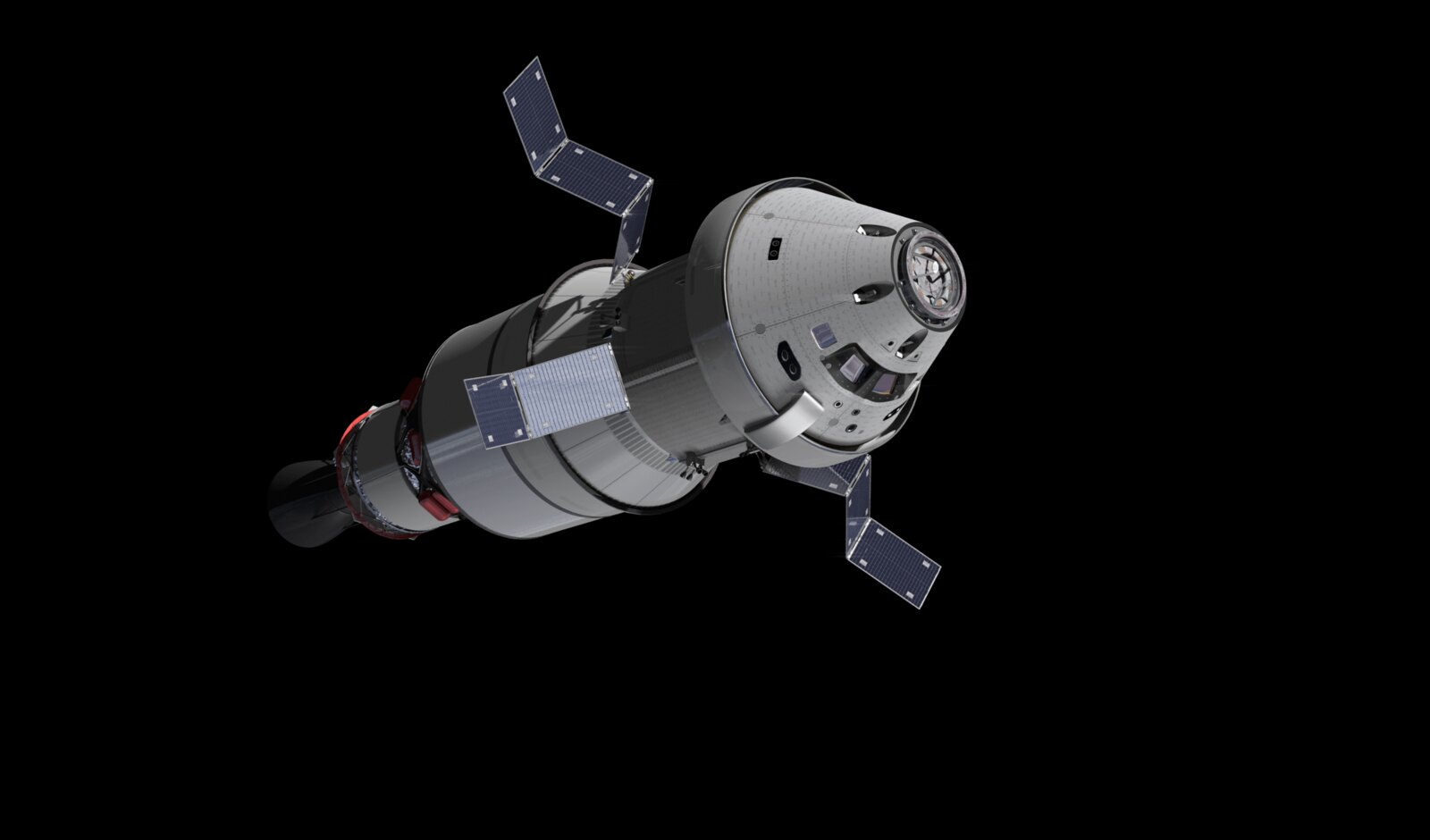
Europe’s latest space freighter, the Automated Transfer Vehicle-4 (ATV-4), is currently undergoing preparations for a realigned launch date following the replacement of a faulty unit inside the spacecraft. While the primary mission of ATV-4 will be to deliver a large load of cargo and propellants to the International Space Station, it will also help to contribute vital knowledge to the design effort for Orion’s Service Module.