
During the weekend of 14–15 February 2026, an anomaly onboard Proba-3’s Coronagraph spacecraft (CSC) triggered a chain reaction that led to the progressive loss of attitude (spacecraft orientation) and prevented its expected entry into safe mode.
Because the spacecraft’s solar panel was no longer facing the Sun, the onboard battery started to discharge quickly. This caused the spacecraft to enter survival mode, when minimal electronics stay active and data transmission to the ground is interrupted.
The anomaly also caused the Coronagraph spacecraft to drift away from the Occulter spacecraft (OSC). At the time of the incident, the two spacecraft were not performing formation flying and were about 4 km apart. As soon as the operators detected an issue, locating the spacecraft became one of their priorities.
As is typical in this kind of scenario, a ‘Tiger Team’ is operating from ESEC in Redu, Belgium, Proba-3’s mission control centre. The team includes experts from ESA’s Flight Dynamics group and Space Debris Office from ESOC, the agency’s main operations centre in Darmstadt, Germany, as well as representatives from industry.
ESA’s ground station network, Estrack, represents a valuable resource for the Tiger Team, with antennas around the globe being used during windows of visibility to try to connect to the spacecraft.
ESA’s Space Debris Office meanwhile acquired optical observation data from ground-based optical telescope networks operated by its commercial partners Neuraspace and Sybilla Technologies, as well as radar data from the TIRA system operated by Fraunhofer FHR.
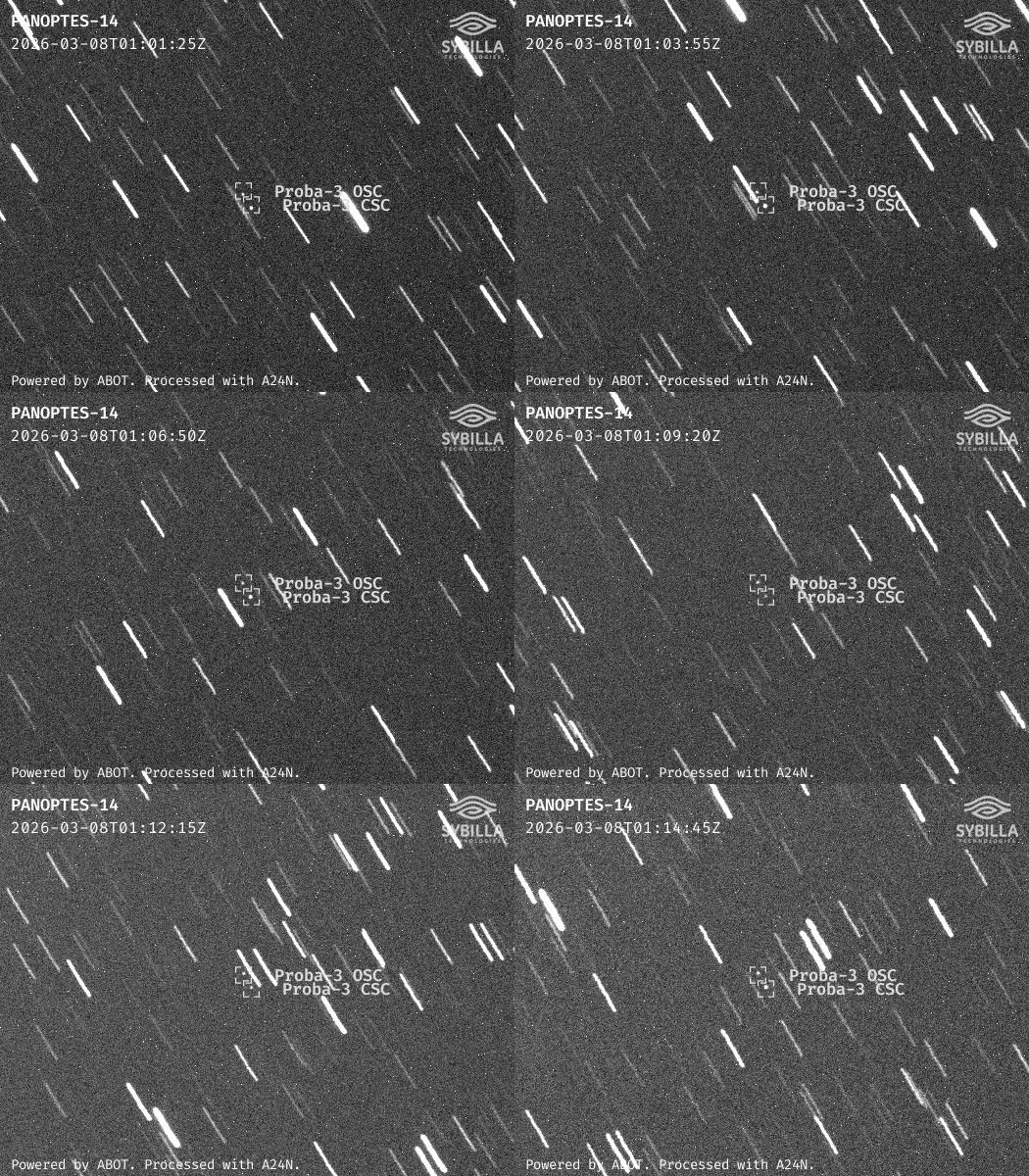
The observations are being used to determine the orbit of the CSC and the measured brightness time series provide information on the attitude motion. In the latter, the CSC appears as a bright dot getting dimmer and then brighter again in a regular pattern, suggesting that the spacecraft is slowly spinning. The engineers are now trying to figure out how fast it is spinning and in which direction, to better time their attempts at connecting with the spacecraft.
Ideally, they would send their commands to the CSC precisely at the time when its solar panel is facing the Sun, in hopes that the receiver on the spacecraft would temporarily gain enough power to receive the signal.
Why is it so tricky to find the spacecraft?
A working spacecraft orbiting the Earth regularly communicates with navigation satellites to find out its own location and then sends this information to ground stations.
Proba-3’s unique orbit is highly elliptical and takes the two spacecraft up to 60 000 km away from Earth, far beyond where navigation satellites operate. This means the spacecraft can only obtain their location information in the part of their orbit closer to Earth, the remaining far-away part of the orbit is modelled by engineers based on the known data.
Determining the exact location of a spacecraft on such elliptical orbit that is not responsive? A whole new level of difficulty. After the anomaly occurred, the CSC has not been able to connect with any navigation satellites or ground stations – leaving us in the dark as to its exact location.
Could losing the spacecraft create more space debris?
Even if the CSC is not recovered, the two spacecraft will naturally reenter the atmosphere as per their original mission plan within approximately four years, to avoid leaving harmful debris in orbit.
Follow the Proba-3 blog for regular updates.

Discussion: 3 comments
Hi,
Could run out of propellant could be the reason of attitude loss?
Ewald
Arianegroup
Hi Ewald, we discuss the reason for CSC’s attitude loss in a new post: https://blogs.esa.int/proba-3/2026/03/19/what-happened-to-the-coronagraph/ 🙂
L’espulsione di massa coronale ( tempesta solare ) può aver provocato in qualche modo un anomalia nella strumentazione di bordo?