
Around 25 hours after launch, Artemis II reaches a defining moment. Until now, Orion and its crew have been circling Earth in a highly elliptical orbit, checking that all is well with the spacecraft and practising docking operations. What happens next determines whether the astronauts remain close to home, or begin their journey to the Moon, some 380 000 kilometres away.
This moment is called trans-lunar injection, or TLI, and for Artemis II, it’s our European Service Module (ESM) that makes it happen.
“This is an exciting moment as it is when the teams decide to send the astronauts and Orion to the Moon, and it is using ESM’s main engine,” says Tobias Langener, ESM propulsion lead at ESA. “It is quite a long manoeuvre, but we are confident – we already saw a very good performance of the vehicle on the first mission.”

Tobias Langener, ESA’s ESM propulsion lead, on console in the Mission Evaluation Room at NASA’s Johnson Space Center in Houston.
Credit: ESA-T. Langener
The powerhouse
The European Service Module, built by ESA and European industry led by Airbus, is Orion’s powerhouse. It provides everything the spacecraft and its crew need in space: air, water, power, thermal control and propulsion.
The trans-lunar injection is a manoeuvre performed by ESM’s main engine – a refurbished ‘Orbital Manoeuvring System’, or OMS, engine that has already flown six times on Space Shuttle Atlantis. It is the only engine on Orion capable of delivering the powerful acceleration needed to send a crewed spacecraft from Earth orbit towards the Moon.
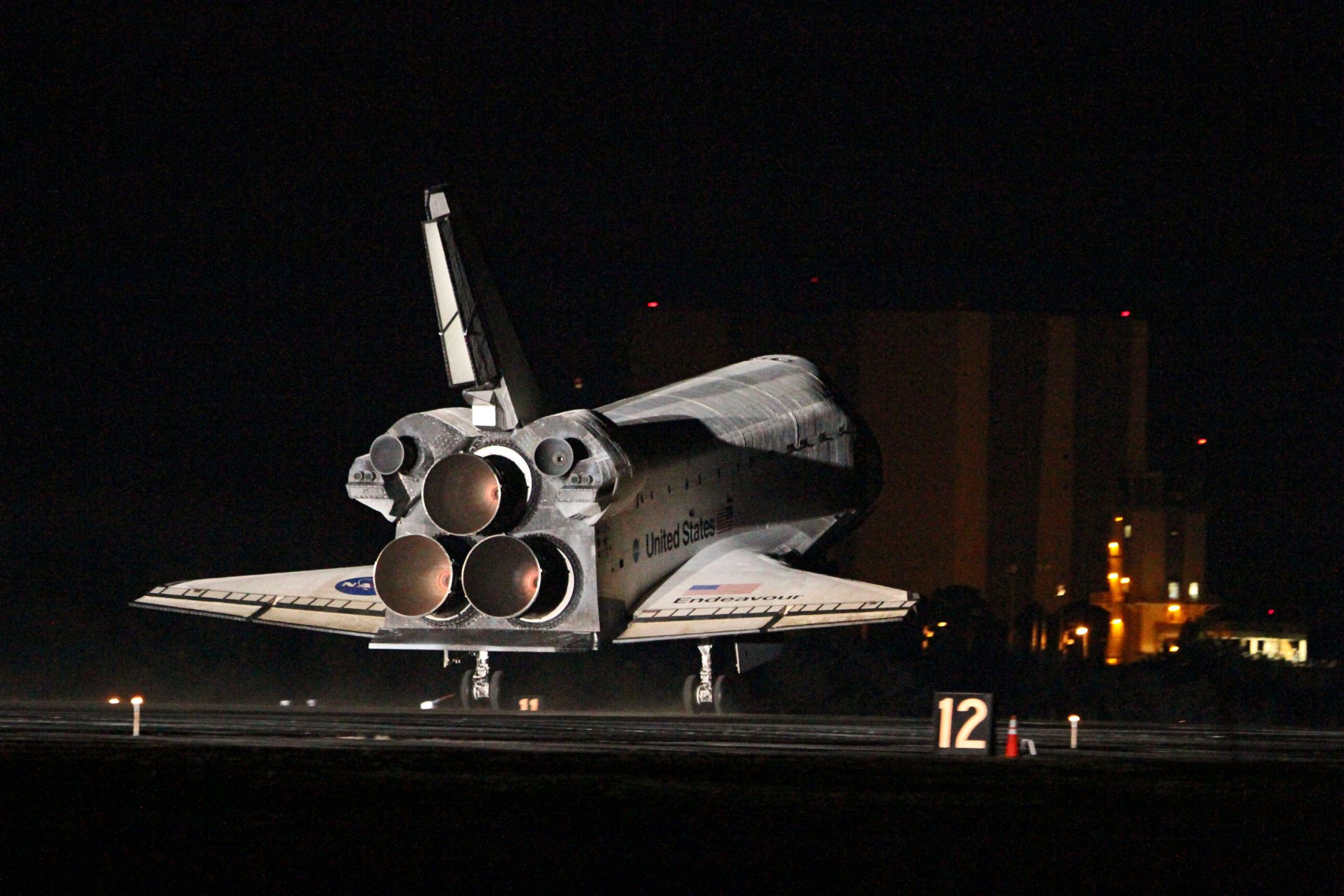
Space Shuttle engines lighting up during the STS-130 mission in 2010. The OMS engines are the two smaller ones above the larger engines. Credit: NASA
On most Artemis missions, the powerful upper stage of NASA’s rocket performs the burn towards the Moon. But Artemis II is different.
A key objective a few hours after launch was a ‘proximity operations demonstration’ while in Earth orbit. Shortly after reaching orbit, Orion separated from the rocket’s upper stage and the astronauts took manual control of the spacecraft. Using the ESM’s smaller reaction control system engines, they flew around the upper stage, practising rendezvous techniques for future Artemis missions.

Artist impression of Artemis II: Orion and its European Service Module as they separate from the second stage of NASA’s Space Launch System rocket, the Interim Cryogenic Propulsion Stage (ICPS). This will happen a little over 3 hours into the mission.
Credit: ESA-D. Ducros
Because Orion separates from the rocket’s upper stage for this demonstration, that stage is no longer available to perform the TLI burn. The good news is that the mission follows a free-return trajectory – a path shaped by the gravity of Earth and the Moon that naturally swings Orion around the Moon and back home without requiring major engine burns in lunar orbit. This makes it possible for ESM to perform the TLI burn itself.
“As no other big engine burns will be required, just small course corrections here and there, this means that the mission team can afford to use a large part of ESM’s propellant for the TLI burn,” explains Luca Fossati, ESM flight operations system engineer at ESA.

ESM mission and flight operations system engineer at ESA, Luca Fossati, in the Orion Mission Evaluation Room at NASA’s Johnson Space Center in Houston, during an Artemis II mission simulation in August 2025.
Credit: NASA-R. Sinyak
Preparing for ignition
The phase leading into the burn – known as the pre-burn segment – is a carefully-choreographed sequence.
“We have the go/no-go criteria for this burn all written out in the flight rules,” Tobias explains. “All systems have to meet those rules. A few hours before the burn, there is a call to all the stations. Everybody reports for a go or no-go, then management approves the manoeuvre and the flight controllers move to execute it.”
This is a firm commitment point. Once the burn is complete, Orion will no longer remain in Earth orbit. The spacecraft and its crew will be committed to a minimum eight-day path that leads around the Moon and only then back to Earth.
When the go is given, the propulsion system is prepared: propellant tanks are brought to the correct pressure, the thrust vector control system is tested, and the spacecraft is oriented so that the engine’s thrust will push precisely along the intended direction of travel.
When everything is ready, and at a defined time, the flight controllers send the command to open the engine valves… and the engine ignites.

The Orion spacecraft on flight day 1 of Artemis II.
Six minutes
The trans-lunar injection burn is long by spacecraft standards – roughly 350 seconds, a little over six minutes. The exact duration depends on the precise launch date and time, which dictates the velocity change required.
During those minutes, the engine steadily increases Orion’s speed to 25 000 km/h. That change in velocity – known as delta-v – allows the spacecraft to break free from its orbit around Earth and stretch its trajectory all the way around the Moon.
After shutdown, the engine is purged to clear any remaining propellant, and teams immediately begin analysing the data.
The propulsion teams check the pressure of the fuel tanks, temperatures and system performance. In parallel, the guidance and navigation specialists confirm that the required velocity change has been achieved and that Orion is precisely on its intended free-return path.
Europe has set Orion on its way.

Orion in Earth orbit on flight day 1 of Artemis II.
To the Moon and back
Although TLI is the largest propulsion manoeuvre of the mission (after launch!), it is not the last.
“There will be several small burns performed – three on the way to the Moon and three on the way back,” Tobias explains. “These trajectory correction manoeuvres are performed by ESM’s smaller engines to fine-tune Orion’s path.”
Flight rules determine which engines are used. The ESM carries eight auxiliary engines for larger adjustments and as a backup for the main engine and 24 reaction control system (RCS) thrusters for finer changes. If only a slight correction is required, a brief firing of the RCS – around 10 seconds – is enough.
“These smaller burns are pre-planned hours in advance. The teams decide how much of a burn is needed, what correction needs to be made, and accordingly which engine is required. Then we burn for about 10 seconds, and we’re good,” concludes Tobias.
On Artemis I, the trajectory was so accurate that almost no larger corrections were needed. For Artemis II things might be different.
“As there is crew on board, there might be disturbances due to the crew moving around and venting from urine disposal for example,” Luca says. “This likely won’t change Orion’s trajectory but it might alter slightly its attitude, which the RCS thrusters can easily correct.”
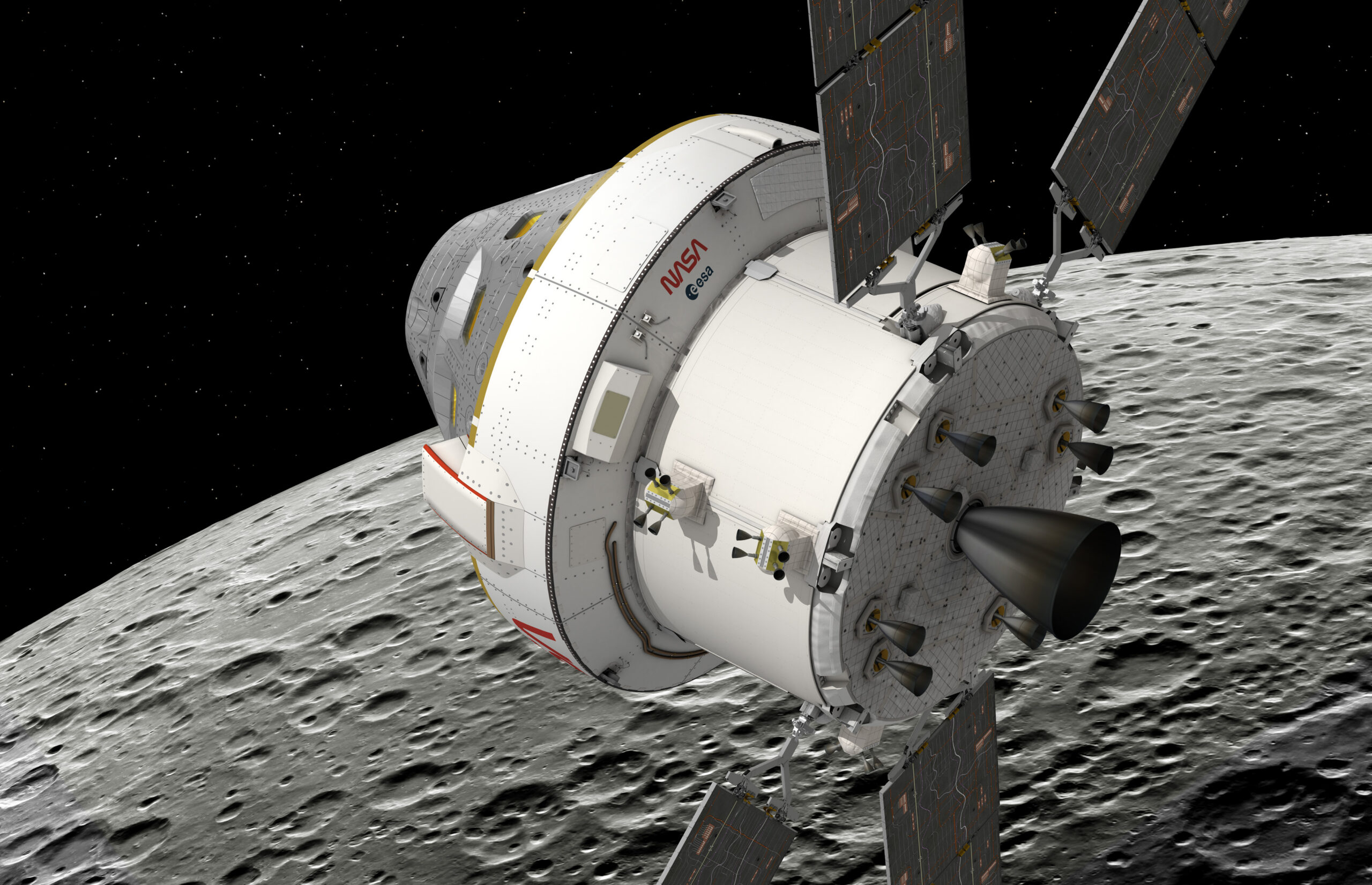
Artist impression of Artemis II: Orion and its European Service Module flying around the Moon. The lunar flyby will occur around halfway through the mission, where Orion and its crew will fly around 7500 km beyond the Moon. They will be the first humans to see the lunar far side with their own eyes in over half a century, since the Apollo 17 mission in 1972.
Credit: ESA-D. Ducros
Europe in the driving seat
Trans-lunar injection is the manoeuvre that commits the mission and its crew to the Moon. It is a deliberate acceleration away from the relative safety of Earth orbit and into deep space, hundreds of thousands of kilometres away from home.
For Artemis II, that commitment is powered by Europe. When the four astronauts become the first humans to see the far side of the Moon in more than half a century, they will have been carried there by decades of European expertise.

 Automated Transfer Vehicle page
 ATV blog archive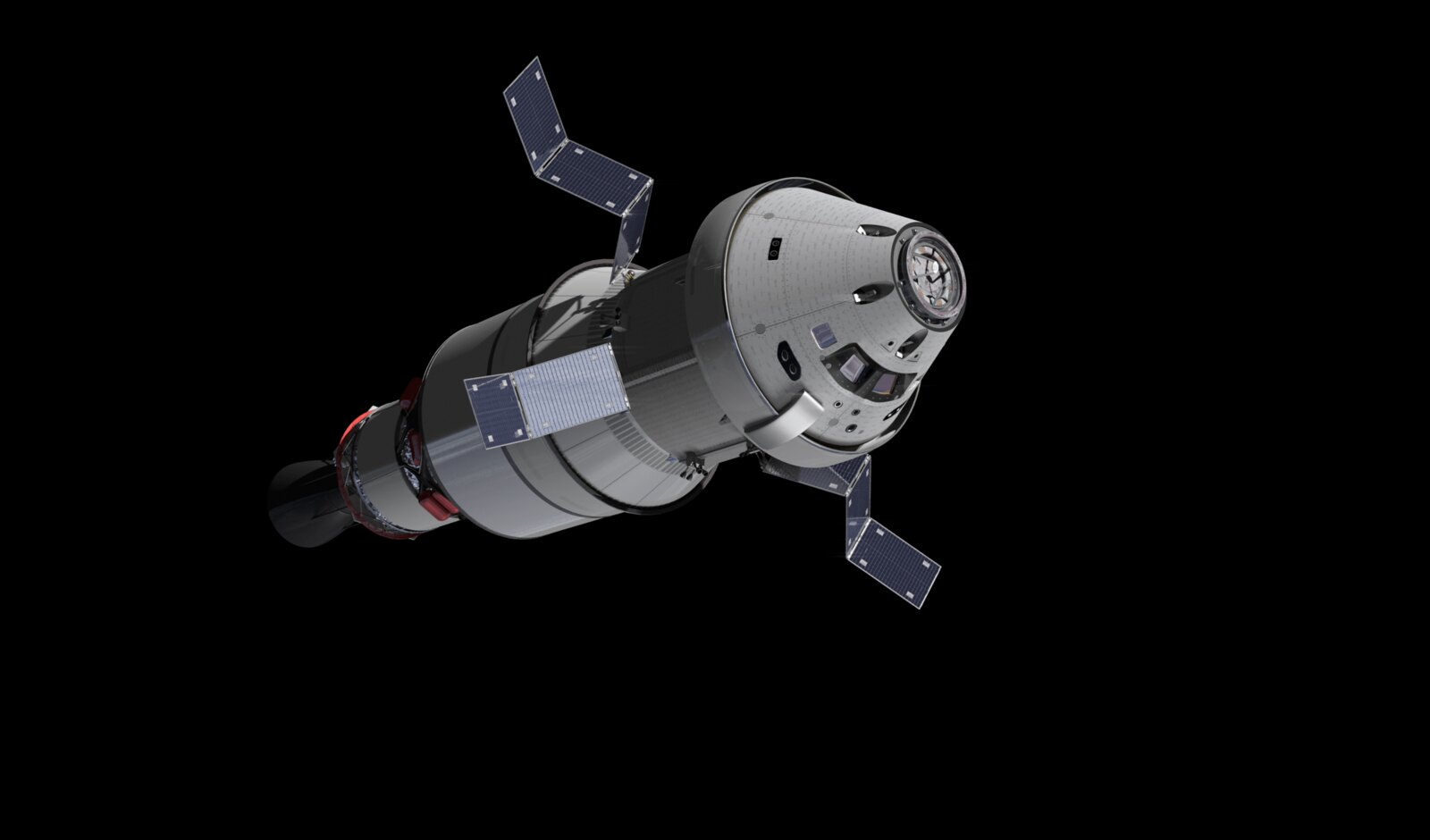
Discussion: one comment
Lovely little succint explainer, thanks.I cannot believe nobody else has commented on this.