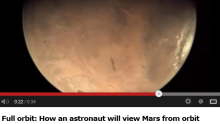
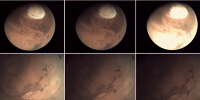
ESA’s Mars Express views Gale Crater

Quick update received on 11 March from Mars Express operations engineer Andy Johnstone - Ed.

We just made a very cool observation with VMC, that I've posted to the Flickr
account.

On 7 March, we were scheduled to perform a MELACOM pass with NASA's MSL; this involves us passing over Gale Crater with our MELACOM UHF antenna pointed towards the rover.

13-066_22.53.07_VMC_Img_No_7.png

NASA later chose not to use our pass, so we decided to use it to perform a VMC observation instead.

The images we took were then stitched together to form a short video where Gale Crater can be seen as the dark horseshoe shape midway up the left hand side of the screen. This offset is due to VMC being set at 19 degrees from MELACOM.

We are, once again, back: Mars Express VMC resumes raw data posting

With not too much fanfare, December saw the Mars Express mission operations team at ESOC bringing the VMC back online, again. You'll recall that VMC went offline in late 2011 when Mars Express suffered problems with the mass memory storage. The spacecraft and instruments were fully back in routine operation by January 2012, meaning that the team could then devote some 'time-available' time to recommissioning VMC. In addition to getting the camera itself running (marked by the first symbolic data transmission of a VMC image via Malargüe station), we also set up a new blog channel and a dedicated Flickr page to host the images (and the Twitter account – @esamarswebcam – is still running).

Over at the Planetary Society blog, Emily Lakdawalla posted an update explaining the return of the VMC and including comments from Daniel Lakey, one of our MEX engineers looking after VMC. There's little improving on her excellent report, so with no further ado, please (a) take a look at her gorgeous collage '56 views of Mars from the Mars Webcam in 2012' reproduced below, and (b) head over to her blog and read her update in full.

56 views of Mars from the Mars Webcam in 2012 Credit: E. Lakdawalla

These 56 views of Mars were taken between May 6 and December 15, 2012. The cadence was uneven -- some images are separated by only a day, others by as much as a month. Credit: E. Lakdawalla

Following the first downlink over Malargüe tonight, we will consider the Flickr page to be open for business. Unfortunately, due to the upcoming solar conjunction and associated low bit-rate season, we're unlikely to get any downlink slots for VMC for a few months, but once the Mars Webcam is taking pictures again, the images will be published for the world to see within seconds of them being received on Earth. The low priority of VMC images means that their downlink to Earth can be some time after the observation.

-- Daniel Lakey, Mars Express, 18 Dec 2012


First data via Malargüe station: Mars as seen by VMC

Marking its inauguration, ESA’s Malargüe tracking station receives Mars Webcam image.

First data via Malargüe station: Mars as seen by VMC

An image of the enigmatic Red Planet acquired by ESA’s Mars Express on 15 December 2012 was downloaded via ESA’s new tracking station in Malargüe, Argentina, symbolising ‘first data’ and recognising formal inauguration.

Details on the station's inauguration via ESA web and ESA media.

Malargüe station mosaic

A mosaic depicting ESA's new 35m deep-space tracking station at Malargüe, Argentina, composed of several hundred low-resolution Visual Monitoring Camera (VMC) images acquired by Mars Express.

Malargüe station mosaic

On 18 December 2012, the station downloaded a VMC image from Mars Express orbiting some 328 million kilometres from Earth to mark the station's formal inauguration and the symbolic transmission of 'first data'. The image was received at ESA's European Space Operations Centre, Darmstadt, Germany, and processed by the Mars Express mission operations team.

Photo mosaic generated using AndreaMosaic, an excellent piece of software!

An elegant solution – update in ESA web

Some nice news today for VMC fans: the teams at ESOC are getting closer to restoring the VMC back to operation. Imaging stopped, of course, with last autumn's anomaly, the solution of which has kept everyone in the MEX family fully occupied for several months. VMC, being last priority, was not worked on. But we're hopeful that we'll get a solution soon, and we'll post news here as soon as we hear anything.

References to our very own VMC camera activities highlighted - and note very nice comments on teamwork! Click here to read the full report.

While full science operations have now been resumed, a number of tasks remain to be completed. Most important among these is the implementation of an OBCP scheduler. This will enable the spacecraft to operate autonomously for up to a week, compared to the few days that are possible with the current FAST system. Work is also in hand to resume operation of the Visual Monitoring Camera.

Enormous team effort

Completely redesigning the way in which Mars Express is controlled has involved an enormous amount of work for the mission control team at the European Space Operations Centre (ESOC), assisted by their counterparts at the European Space Astronomy Centre (ESAC), PI-teams, other ESA experts and partners in industry. Everyone involved with the mission is extremely grateful for their hard work.

Although the 'Express' in Mars Express highlights that the mission was developed in a short time and with a relatively modest budget, the ability to resume full operations after a very serious failure shows that the resulting design is both robust and flexible.

Mars Express has now been restored to full operational capability and its potential mission lifetime remains unchanged.

Support to the CO2 Cloud Observations by Mars Express with the VMC Visual Monitoring Camera

This paper discusses the possibilities for using the non-scientific Visual Monitoring Camera (VMC) to contribute to this scientific objective of the Mars Express mission, complementing and supporting the data obtained from the scientific payload. The contribution of VMC is that it can image the planet with a large field of view, providing the context for the other experiments which operate at lower altitudes, close to the pericenter. The VMC data would also allow providing useful information such as cloud altitude (thanks to the shadow) morphology, relative reflectivity and dynamics. These are important parameters in the characterization of the CO2 cloud population.

Mars Express flying through the blackout – Solar Conjunction 2011

You might have noticed that VMC – the Mars Webcam – has been quiet recently. Don't worry: it's all expected – it's just further proof of the challenges and excitement of planetary spaceflight!

Today, Mars is at the worst point of a period known as 'solar conjunction', which means that Mars is on the exact opposite side of the Sun from Earth. Seen from the Earth at around 16:00 today, Mars appears only 0.7658 degrees from the Sun – less than the width of your finger held at arm's length!

This results in major disturbances in our communications from Earth to Mars Express and back; as a result the spacecraft has been put into an autonomous operations mode, with all activities on hold until we come out the other side.

The video above shows the Sun from the start of this year until today – with the streamer-like tendrils of its atmosphere, the corona. Coming in from the left of the video is a bright speck – Mars! Invisible here is the tiny dot of Mars Express orbiting the red planet. Our problem communicating with Mars Express comes from the fact that the radio beam from the spacecraft has to pass through this atmosphere, getting distorted on the way.

On top of that, our dish antennas on Earth have problems picking out the weak signal from Mars Express from the 'noise' of the Sun. All of this makes this period, about a month long, especially challenging for communications with all Mars missions.

To keep the spacecraft safe, we have to give it enough information for it to look after itself for the month when we are passing behind the Sun. There's simply not enough memory on the spacecraft to also include instructions on how to carry out its normal activities (including VMC imaging!) – all the space is used up with our commands on how to look after itself for a month alone, out of contact with Earth!

The video above was produced using the excellent JHelioViewer tool, developed with funding from ESA and NASA.

It shows in blue and red the view from the LASCO instrument on the ESA/NASA SOHO solar observatory mission. This instrument puts a disc in front of the Sun to block the direct light, and what can be seen is the corona, and in this case, Mars passing behind it. In the centre are images from the NASA Solar Dynamics Observatory AIA instrument, showing the blazing Sun in the middle of our solar system.  – Thomas

Update: Peter Wellmann creates three views of Mars!

We would like to make a correction on our last blog update from Wednesday; Peter Wellmann had in fact submitted three versions of Mars' North Polar Regions. The corrected versions are all below. To read more about how Peter did his processing, check out the footnotes at the bottom of the page (after the jump..). Enjoy! And thanks, Peter for these impressive results. -- Daniel

The first picture shows almost all of the North Pole, surrounded in a dense cloudy haze. Craters Korolev and Alba Mons have been located easily.

Peter wrote:  “This very interesting VMC-material shows the almost complete North Polar Region and its surrounding area covered with clouds and haze. Identifying the surface details is impossible. Only Korolev crater and Alba Mons could be found. The stunning details below Alba Mons could be high reaching and dense clouds with their shadows. These gigantic clouds extend roughly over 150km. Sometimes sand storms cover the whole planet with dust, but never before have I seen Mars with such a large cloudy and hazy area. The surface structure is clearly visible only in small areas around Alba Mons, even the North Polar Cap is not detected safely, even though the pole is situated right on the terminator. The clouds show an interesting spiral structure, probably induced by coriolis force acting on air streaming out of a high pressure area on the northern hemisphere of a left spinning planet. Although there is little sharp detail in the raw-material I decided to give it a try.”

The second edit shows a similar situation as the first picture, the only difference being that they are on different sides of the hemisphere. This picture shows the complete polar region and the craters Acidalia Planitia, Lyot and Lomonosov could be clearly detected. The entire pole is covered with nicely structured clouds and haze.

Peter wrote: “This very interesting VMC-picture should be seen as supplement to my previous submitted image 2010/11/13. It shows the part of the polar region not visible on the 2010/11/13 image. Almost the entire North Pole and surrounding area is covered with nicely structured clouds and haze. Identifying surface details is not easily accomplished. Only Acidalia Planitia is partly free of clouds, and Lomonosov crater can be easily detected. On a second look the large crater Lyot is seen full size inside a semicircle of clouds. Some other structures are easily detected by comparing with the Celestia image, but we do not know their names. Surface structure is clearly visible only in small areas, even the north polar cap is not detected safely, although the pole is situated right below the terminator. The clouds show an interesting spiral structure, in a large stripe to the left very fine structure is visible. Although there is little sharp detail in the raw-material I decided to give it a try.”

The final image is of the complete North Pole covered in a nicely structured haze. The two pictures of Mars were taken about 4 days apart. Some landmarks were identified under the cloud haze.

Peter wrote: “This picture combines two VMC-operations; the first took place on 2010/11/23, the second only four days later on 2010/11/27. Both operations meet a time with strong cloud and haze-activity on the northern part of Mars. By comparing these images, my idea was to show the rapid change in cloud-structure. Due to the hidden surface it is not easy to identify landmarks, but I was able to locate some prominent craters for better orientation comparing the two images.

Processing colour from the original raw-frames by using the supplied flat-field, the atmospheric structures come out gray/white and not yellow/brown, so I assume they mainly are clouds and haze, not sandstorms. It is amazing how different these structures look, in some areas they look rather smooth, and in other areas they show very fine details. There also seems to be a difference between dawn and dusk, just compare the left (dusk) and right (dawn) terminator in the region of the “horn”. Also it seems that surface conditions affect cloud structure above. Processing these pictures was not easy and time consuming, but looking at the result I think time was not wasted. I do like this picture.”

Tech details

1 Our pictures taken 2010/11/13 were used:
10-317_00.33.20_VMC_Img_No_19.raw
10-317_00.34.03_VMC_Img_No_20.raw
10-317_00.34.46_VMC_Img_No_21.raw
10-317_00.35.29_VMC_Img_No_22.raw

The supplied dark frame “vmc_flat.raw” was used to extract png-files form the raw-material. Then we sharpened and stacked Pictures No 19/21 and 20/22 in order to reduce noise. The remaining noise was reduced further by utilizing Neat Image software. After cutting out the overexposed part of the stack 19/21 it was combined with the stack 20/22. The colour saturation was adjusted and the background was cleaned. Finally for better viewing the result was resized to 125%. For detailed information on processing see our work done with the astronomy group of Gymnasium Vaterstetten.
2 our pictures taken 2010/11/27 were used:

10-331_00.15.34_VMC_Img_No_19.raw
10-331_00.16.17_VMC_Img_No_20.raw
10-331_00.17.00_VMC_Img_No_21.raw
10-331_00.17.43_VMC_Img_No_22.raw

The supplied dark frame “vmc_flat.raw” was used to extract png-files form the raw-material. Then we sharpened and stacked Pictures No 19/21 and 20/22 in order to reduce noise. The remaining noise was reduced further by utilizing Neat Image software. After cutting out the overexposed part of the stack 19/21 it was combined with the stack 20/22. The colour saturation was adjusted and the background was cleaned. Finally for better viewing the result was resized to 125%. For detailed information on processing see our work done with the astronomy group of Gymnasium Vaterstetten.

3 For picture 2010/11/23 these pictures were used:

10-327_19.19.47_VMC_Img_No_19.raw
10-327_19.20.29_VMC_Img_No_20.raw
10-327_19.21.13_VMC_Img_No_21.raw
10-327_19.21.56_VMC_Img_No_22.raw

For picture 2010/11/27 these pictures were used:

10-331_00.15.34_VMC_Img_No_19.raw
10-331_00.16.17_VMC_Img_No_20.raw
10-331_00.17.00_VMC_Img_No_21.raw
10-331_00.17.43_VMC_Img_No_22.raw

Processing is sometimes not easy, and quite a bit of practice is helpful. Everybody may use his favourite software and try out what he can do with it. We use Photoshop, Giotto “Mexican Hat” for sharpening and Neat Image for noise reduction. Information on processing is found in the Gymnasium Vaterstetten report and on their astronomy homepage. Here I want to show the single steps I used processing the actual picture:

  •   Choose 2/2 high/low exposed frames, artefacts not same position
  •   Extract files by ”vmc2rgb.exe” utilizing flat-field “vmc_flat.raw”
  •   Sharpen all four pictures, a bit of noise is no problem
  •   Clean out known artefacts, do not alter same region in all frames
  •   Align carefully(!) and stack frames with same exposure time
  •   Place terminator-region from high exposed stack into low exposed stack
  •   Clean background using feathered selections
  •   Resize 125% and reduce noise with professional filter
  •   Adjust colour saturation carefully and moderately
  •   Split to luminance and colour, and reduce noise in colour only
  •   Make nice “fine tuning” but do not destroy original content

Remarks: We do not use the library-png because we want to see the colour of the raw-material and adjust it so that for example white clouds stay something ear white. We sharpen every single picture, doing this a bit of noise is no roblem because later two frames are stacked, and a professional noise filter s applied. Artefacts must be cleaned from each picture before stacking; hoosing pictures with artefacts not in the same place will preserves some riginal information for all parts. We align two frames in order to reduce oise, for this usually one image must be rotated a bit. We stack separately for igh and low exposure. Fitting the high exposure section to the low exposure icture is done by feathered selection and must be tried out very carefully.

Cleaning the background is done by a 2px feathered circle-selection very lose to the rim of Mars; then a 15-20px feathered oval selection is used at he terminator. This must be done carefully not to alter the original picture ore than necessary. If adjustment of colour saturation results in a bad colour oise, this may be reduced by applying a noise filter to the colour information nly (definitely not affecting the luminance). For this we separate luminance nd colour by Photoshop. At the end some 'fine-tuning' may be favourable for example feathered selection on a cloud patch to enhance white colour and o on). We do this carefully and moderately in order to preserve the original content of the picture.


Public Submission – Glowing North Pole by Mike Malaska


Regular VMC contributor Mike Malaska has submitted another outstanding image edit for the Mars Webcam blog, shown above. His work is based on an image of the North Pole of Mars from a VMC observation on the 30th September. The polar cap of the planet can just be seen in the middle of this image, with low sunlight glinting off the patches of snow and ice surrounding it. As Earth heads into Northern hemisphere autumn, Mars is also in Northern autumn at the moment and this view captures beautifully the impression of low sunlight in the Northern parts of Mars, with ice and snow signalling the coming winter.

Mike wrote the following to us about his work on this image:

"The main reason I initially got excited about this image was (1) North Pole of Mars and (2) taken at apoapsis (maximum height above Mars, about 10,000 km) of the Mars Express orbit. I was hoping for several pictures with very little change that could be used to make a 'super-resolution' image. Unfortunately, there was a 1-pixel-per-image rotation counter-clockwise (in this orientation) of the surface that messed up my plans.

This image was created by making an average of several images: Nos. 2, 4, 6, 8, 10, 12, 14, and 16, then Gaussian blurring this by 1 pixel to make a smooth color background. Next, Image No. 12 was used as a luminosity layer. It was also used as a HiPass layer to enhance subtle details. Finally it was blended with some of the original Image No. 12. Contrast enhancement and rotation (to put the North Pole at the top) and cropping gave the final image."

As always, excellent work Mike — and thank you for the submission and for showing us the beauty of Mars.

We'd love to see what other visitors can make of VMC images, too — just check out the Help us with VMC link at right to get started! -- Thomas


Mars Webcam presentation at IAC Prague 2010

Our colleague Thomas Ormston, who leads VMC activities for the Mars Express team here at ESOC, recently presented a paper at the 61st International Astronautical Congress (IAC) in Prague, Czech Republic.

The paper, "An Ordinary Camera In An Extraordinary Location: Outreach With The Mars Webcam," covered the history of the VMC project and provided details on camera operations and our results to date in publishing results to this blog. It also described the outreach successes of the project, highlighted some of the contributions from the Mars Webcam community, explained opportunities to use and work with the Mars Webcam and plans for future camera activities.

The paper was the product of a joint effort and made use of input from the entire Mars Express team (thanks guys!) – it's an excellent review of VMC activities to date. You can click on 'Full story' below.

We'd like to thank everyone who attended Thomas' presentation at IAC and, in particular, we'd like to give a big shout out to Beth Beck, who posted the following note in her blog:

"My fav presentation was European Space Agency's Mars WebCam project. You'll just have to check it out. The best example of 'participatory exploration' that I've seen. They turned an unused mission camera back on to take photos of Mars. They offer the data to the public to process. The Mars WebCam folks post the "processed" images back on their site. Quite wonderful. They've created an amazing, enthusiastic community of Mars-watchers, who participate in the mission voluntarily with hundreds of hours of processing time to their credit."


Thanks, Beth, for your kind words! – Daniel

Our IAC 2010 paper