Mars Express — Celebrating 10 Years

by Olivier Witasse, Daniel Scuka, and Emily Baldwin

Mars Express celebrates a decade of orbital observations of the Red Planet

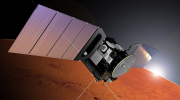
Mars Express 10 year highlightsOn June 2, 2003, the European Space Agency’s (ESA) Mars Express orbiter was launched toward the red planet, entering into orbit just six months later. Though the accompanying Beagle 2 lander failed to establish radio contact from Mars’s surface, the orbiter is still swinging around Mars ten years on. Mars Express orbits roughly every 8 hours to collect data on Mars, its moons, and even the Sun.

Via Sky & Telescope

Mars Express: 10 years mission highlights graphic

A super-nice graphic showing operations and science highlights from ESA’s Mars Express mission, which celebrated 10 years since launch on 2 June 2013.

The central image of Mars is composed of images taken by the High Resolution Stereo Camera (HRSC), which has mapped around 95% of the planet’s surface. The images of Phobos and Deimos were also taken by the HRSC.

Access the original hi-res TIFF file in the ESA website

Mars Express mission highlights. Images of Mars, Phobos & Deimos: ESA/DLR/FU Berlin (G. Neukum)

Mars Express mission highlights. Images of Mars, Phobos & Deimos: ESA/DLR/FU Berlin (G. Neukum)


10 years of imaging Mars

Today's post – part of a series of reports marking the MEX 10th anniversary – was submitted by the Mars Express imaging team at Freie Universität Berlin - Ed.

Who would have thought, 10 years ago, that the brave MEX spacecraft would be still alive today?

For 10 years, the High Resolution Stereo Camera (HRSC) onboard Mars Express has provided astonishing images of the surface of Mars in colour and in 3D. From the beginning on, the breathtaking colour images from Mars delighted both the public and the scientists.

For scientists, the Digital Elevation Models (DEMs) derived from the stereo images provided a major step forward in the precise analysis of the martian surface, and the wide and long image swaths give excellent overviews of the terrain and its geological context.

HRSC image of Valles Marineris, the Solar System's grandest canyon!
Credits: ESA/DLR/FU Berlin (G. Neukum)

The public also made use of the HRSC data, not only from our Press Archive where the best images of the returned data are presented, but for example also using HRSC data in the Google Earth-Mars interface. Bit by bit, Mars turns into HRSC colour. Very much appreciated were also the HRSC-movies, created with the Digital Elevation Models and including, for example, a fly-through of the "Grand Canyon" of Mars, Valles Marineris.

Throughout the last decade the HRSC team has recorded 95.5% of the martian surface at a resolution of 60 m/pixel or better and 66.8% with a resolution of 12.5-20 m/pixel.

Due to the elliptical orbit of Mars Express, major challenges had to be mastered concerning the processing of the data and the photogrammetry. Furthermore, much patience was required due to dust-storms and clouds in the atmosphere, which reduced the data quality. Therefore, several regions were targeted multiple times.

Comparing the first images recorded by HRSC with those acquired today, there is no question that with improved image processing techniques the quality of image and DEM products have very much improved over the past 10 years .

The success story of Mars Express continues and we look forward to fully image the Red Planet with HRSC at highest resolution.

Happy Birthday Mars Express!!

We are at Maaaaaaaars!

Today's post – part of a series of reports marking the MEX 10th anniversary – was submitted by Mars Express Operations Manager Michel Denis, who was in the Main Control Room at ESOC during the night of 24/25 December 2003 when Europe arrived at Mars - Ed.

It was 25 December 2003, in the very early morning hours. As Spacecraft Operations Manager, I was invited from the Main Control Room to the large Conference Centre (where the main event at ESOC was happening - Ed.) to report on the ongoing Mars orbit injection manoeuvre. We know it has started, but we didn't yet know whether it had completed successfully.

Team in ESOC Main Control Room 24 Dec 2003 (pana, left) Credit: ESA/M. Denis

Team in ESOC Main Control Room 24/25 Dec 2003 (panorama, left) Credit: ESA/M. Denis

Whatever my innermost emotions and questions, I talked to the officials and the journalists in the tone you need for these circumstances. I told them that the 39 commands that perform the 'now or never' orbit-injection manoeuvre have been verified innumerable times down to the last bit by the best experts; I repeated that the manoeuvre had been rehearsed exhaustively, using extreme simulations of the software and harsh tests of the spacecraft's main engine by the manufacturer.

As a rational engineer I know that 100% certainty is impossible to achieve.

I pointed out that, if required, the small thrusters can automatically step in to help reduce our speed by almost 3000 km/h to help us get 'caught' by the Red Planet's gravity.

Team in ESOC Main Control Room 24 Dec 2003 (pana, right) Credit: ESA/M. Denis

Team in ESOC Main Control Room 24 Dec 2003 (panorama, right) Credit: ESA/M. Denis

As a rational engineer, I know that 100% certainty is impossible to achieve, and that much can happen in such a 40-minute-long manoeuvre...

Now I had to return back on console, and went back down to the Main Control Room, where my deputy, Alan Moorhouse, was in charge – mainly of waiting at that particular moment.

If you know ESOC, you certainly know the rotunda – a large spiral staircase leading to the Conference Centre (it's in the H Building; the MCR is in the E Building - Ed.).

Michel Denis Credit: ESA/J. Mai

Michel Denis Credit: ESA/J. Mai

I start going down the steps, floating between two worlds equally tense; from the glossy world of the public event to the protected world of the Main Control Room – a busy cocoon where we had lived already ten days and nights, where the entry manoeuvre has been prepared based on the computations by Flight Dynamics, where all critical commands have finally been assembled and up loaded to our little spaceship 150 million kilometres away.

Flight Dynamics confirm capture, within 0.5% accuracy.

In the middle of the stairs, between the floor of talks and the floor of acts, the mobile phone wiggles in my pocket. A message from Alan: "Flight Dynamics confirm capture, within 0.5% accuracy.”

In everyone's private or professional life there are turning points which, however planned and expected, represent 'a giant leap', to paraphrase a glorious quote. A point with a Before and an After; 'after',  our existence is changed, irreversibly.

In these instants, the present is more intense; more present than ever. Overwhelming.

Rotunda staircase at ESOC. Yelling is normally not permitted. Credit: ESA/J. Mai

Rotunda staircase at ESOC. Yelling is normally not permitted. Credit: ESA/J. Mai

So overwhelming, that when you remember this moment years or decades later, you revive it as it were the first time again.

I am overwhelmed, alone in the huge rotunda, perfectly empty, everyone at ESOC is either sitting in the Conference Centre or standing in the control rooms, waiting for the news. Alone, for a few seconds, in this resonant space that makes sounds impressive, where I often sang Christmas carols with the ESOC Choir. Today is Christmas day; whether child or adult, whether you believe or not, in our lives a special date, very emotional.

"We are at Maaaaaaaars!" I could not refrain from yelling, with my loudest voice, to expel from my chest all the emotions of the night and the years of preparation and the last-minute doubts and angst and the incredible joy that seizes me now, just like Mars has seized Mars Express, just like Europe has seized Mars. We are at Mars: now it is true, and nothing can make this not to have happened.

Merry Christmas Europe!  Welcome to Mars!

Mars in a Minute: What happens when the Sun blocks our signal?

Well, not 'our' signal  – this is in fact a NASA video referring to what happens when their Curiosity rover's signal gets blocked. But precisely the same thing happens with ESA's Mars Express, which happens regularly (see previous reports in ESA web here).

But we love this nifty JPL video that illustrates the situation in a fun and humours way – and wanted to make sure you saw it, too!

Fostering Curiosity: Mars Express relays first science data

The data are finally here!

You'll recall our blog posting early in October (see Mars Express to relay first science data from Mars Curiosity) when we got word that Mars Express would, for the first time, relay actual science data from NASA's Curiosity. Now, after a bit of a wait, we've got the the images transferred by Mars Express plus some nice context images showing the rocky target, thanks to Roger Wiens, PI on ChemCam, and several of the colleagues at NASA.

Colour image of Rockenest3, about as big as a shoebox Credit: NASA/JPL-Caltech/Malin Space Science Systems

Colour image of Rockenest3, about as big as a shoebox Credit: NASA/JPL-Caltech/Malin Space Science Systems

There's a full report in ESA web today (see Fostering Curiosity: Mars Express relays rocky images to NASA), which is well worth a quick read.

To summarise, MEX relayed a set of two close-up images of target 'Rocknest3' acquired by the the Remote Micro-Imager (RMI) on the ChemCam on 4 October 2012 (Sol 57). ChemCam is more than only a 'cam(era)'; it actually comprises two units – the RMI plus the Laser-Induced Breakdown Spectrometer (LIBS). (See the ChemCam instrument page here). LIBS works by firing a laser at targets and analysing the chemical composition of the vaporised material. Is that cool, or what?

Our web report (and this blog post!) includes the two close-up RMI images plus two more: an RMI mosaic (combination of several images) showing the LIBS targets on Rocknest3, as well as a wider angle view of Rocknest3, acquired separately by Curiosity's MastCam.

Without further ado – voilà! The images relayed by MEX:

ChemCam image of Rocknest3 relayed by Mars Express Credit: NASA/JPL-Caltech/LANL/CNES/IRAP

ChemCam image of Rocknest3 relayed by Mars Express Credit: NASA/JPL-Caltech/LANL/CNES/IRAP

ChemCam image of Rocknest3 relayed by Mars Express Credit: NASA/JPL-Caltech/LANL/CNES/IRAP

ChemCam image of Rocknest3 relayed by Mars Express Credit: NASA/JPL-Caltech/LANL/CNES/IRAP

These two images were taken on sol 57 (4 October 2012) of target Rocknest3 using the ChemCam Remote Micro-Imager (RMI) on the NASA Curiosity rover at a distance of 3.7 m. The images were downlinked to Earth using ESA’s Mars Express orbiting spacecraft. The first image above was taken before a series of five ChemCam Laser-Induced Breakdown Spectrometer (LIBS) observations and the second image was taken after. The first image is centred on the fifth LIBS observation point. Rocknest is the name of the area where Curiosity stopped for a month to perform its first mobile laboratory analyses on soil scooped from a small sand dune. Rocknest3 was a convenient nearby target of which ChemCam made more than 30 observations overall consisting of 1500 laser shots; it was also interrogated by the arm-mounted Alpha Particle X-ray Spectrometer (APXS)  instrument. Credits: NASA/JPL–Caltech/LANL/CNES/IRAP

The two processed RMI images were sent to us here at ESOC by Roger Wiens, ChemCam PI (principal investigator) at the Los Alamos National Laboratory, New Mexico, USA. Thanks, Roger, for the images and caption above!

The RMI mosaic image – showing the LIBs targets on Rocknest3 – was produced by Stéphane Le Mouélic, a research engineer at France's Université de Nantes and one of the collaborators on ChemCam (access the team bios here).

Mosaic: ChemCam laser targets on Rocknest3 Credit: NASA/JPL-Caltech/LANL/CNES/IRAP/LPGN/CNRS

Mosaic: ChemCam laser targets on Rocknest3 Credit: NASA/JPL-Caltech/LANL/CNES/IRAP/LPGN/CNRS

Stéphane is also co-investigator on the Visible and Infrared Mineralogical Mapping Spectrometer (OMEGA) on Mars Express.

The MastCam image was processed courtesy of Mike Malin of Malin Space Science Systems (as far as we've heard at ESOC, all these images will also go into the NASA/JPL website).

In a mail sent in earlier, Stéphane wrote:

I can just tell you that several of us in the ChemCam team are also involved in the Mars Express mission, and, as such, this successful communication of data between the two spacecraft also takes a sentimental value. Mars Express has provided a wealth of information and has paved the way for a new generation of explorers such as Curiosity. Making the two spacecraft work together is not only scientifically and technologically interesting, but also representative of how the collaboration of agencies is advancing science.

The Deputy PI for ChemCam is also French; Sylvestre Maurice is based in Toulouse, at France's Institut de recherche en Astrophysique et Planétologie (IRAP). Along with PI Roger Wiens, he was responsible for the design, construction, testing and delivery of the LIBS instrument on ChemCam ("ChemCam is the greatest of all instruments, the 'Jedi light-saber' of the MSL mission!").

Sylvestre wrote:

To me, the cooperation between ESA and NASA extends even further: the RMI camera is a spare of a series of cameras on ESA's Rosetta mission, scheduled to arrive at the comet 67P/Churyumov-Gerasimenko in 2014. ESA-NASA and MSL-Rosetta – a spirit of collaboration!

Finally, we also heard from Brigitte Gondet, who is also a collaborator on both ChemCam and Mars Express at Institut d'Astrophysique Spatiale (IAS):

The quality of the images provided by the RMI camera (the head was developed at France's IAS and optics developed at IRAP) is outstanding. The context information for the LIBS analyses has proved essential for the scientific interpretation of the data. This combination of imaging and analysis has demonstrated its potential for future missions.

ESA–NASA cooperation at Mars is a continuing success, and, in this case, there is also tremendous involvement of the co-PIs and collaborators on the ChemCam science team from France!

Notes:

IAS - Institut d’Astrophysique Spatiale

IRAP - The Research Institute in Astrophysics and Planetology - opened in 2011. IRAP is a new mixed research unit of the CNRS (National Centre for Scientific Research) and University Paul Sabatier, Toulouse.

Mars Express to relay first science data from Mars Curiosity

This weekend is shaping up to be a big one for ESA/NASA interplanetary cooperation!

Early on Saturday morning, 6 October, central European time, ESA's Mars Express will look down as it orbits above the Red Planet, lining up its Lander Communication System (MELACOM) antenna to point at NASA's Mars Curiosity on the surface.

Mars Express Credit: ESA

Mars Express Credit: ESA

For 15 minutes, the NASA rover will transmit scientific data up to MEX, which will store it on board for a time. Then, two hours later, MEX will line up again, this time pointing its High Gain antenna toward Earth to downlink the precious information to the European Space Operations Centre (similar in role and function to NASA/JPL, but without the glorious California weather - Ed.), Darmstadt, Germany.

ESA's first 35-metre deep-space ground station is situated at New Norcia, 140 kilometres north of Perth in Australia. The 630 tonne antenna will be used to track Rosetta and Mars Express, the latter to be launched in 2003, as well as other missions in deep space. The ground station was officially opened on 5 March 2003 by the Premier of Western Australia, Hon Dr Geoff Gallop. Credits: ESA

ESA's first 35-metre deep-space ground station is situated at New Norcia, 140 kilometres north of Perth in Australia.
Credits: ESA

The signal will be received via ESA's 35m deep space station at New Norcia, Australia, and the data will be immediately made available to NASA/JPL for routine processing.

The inter-Agency communication relay service will send, for the first time, actual scientific data from Curiosity via Mars Express; the previous relay services provided to Curiosity have transmitted either so-called 'open-loop' signals (no data decoded but did include useful radio Doppler information) during Entry, Descent, and Landing, or only housekeeping data and other basic telemetry during early surface operations.

"The command stack to order MEX to slew and point its UHF antennas towards Mars Curiosity during the overflight, to switch the MELACOM radio ON/OFF and to later perform the data download are already programmed on board Mars Express. Our spacecraft is ready to go for this weekend," Mars Express Operations Engineer Olivier Reboud told me this earlier today.

Curiosity - Robot Geologist and Chemist in One! Credit: NASA/JPL-Caltech

This artist's concept features NASA's Mars Science Laboratory Curiosity rover, a mobile robot for investigating Mars' past or present ability to sustain microbial life. Credit: NASA/Caltech-JPL

Now here's the really interesting bit: of all the data that Curiosity might be sending up for relay via MEX (Mars Curiosity carries 10 science instruments plus a drill), it looks as though we'll be handling at least some images!

According to a note sent by NASA's Jennifer Maxwell, at JPL, yesterday, the Mars Express team are expecting to relay:

  • Two images from the Remote Micro-Imager (RMI) of the 'RockNest_3' rock acquired on Sol 57 (57 martian days since Curiosity landed, i.e. 3 October)
  • Three images acquired by the Mars Hand Lens Imager (MAHLI) system of the rock named 'Bathurst Inlet'

(See a previous view of Bathurst Inlet via the Mars Curiosity image page at JPL)

The RMI provides black-and-white images at 1024X1024 resolution in a very narrow 1.1-degree field of view. This provides images equivalent to a 1500mm lens on a 35mm camera. Wow!

'Bathurst Inlet' Rock on Curiosity's Sol 54, Close-Up View Credit: NASA/JPL-Caltech/Malin Space Science Systems

This is the highest-resolution view that the Mars Hand Lens Imager (MAHLI) on NASA's Mars rover Curiosity acquired of the top of a rock called "Bathurst Inlet." The rover's arm held the camera with the lens only about 1.6 inches (4 centimeters) from the rock. Credit: NASA/JPL-Caltech/Malin Space Science Systems

MAHLI comprises a camera mounted on a robotic arm on the Curiosity rover, which is used to acquire microscopic images of rock and soil (a typical MAHLI image resolution is a stunning 21 microns per pixel).

The weekend relay will provide further operational confirmation that Mars Express can serve as a back-up relay platform for NASA's new rover; it has already done so for NASA's other surface missions (Phoenix and the Mars Rovers, Spirit and Opportunity) in the past couple of years.

This cross-support underscores the strong cooperation between the two Agencies, who have worked diligently for a number of years to set technical and engineering standards to enable sharing data, information and telecommand links between spacecraft, networks, ground systems and ground stations, which helps reduce risk and boost back-up capabilities in both directions.

In ESA's MEX team, everyone's really looking forward to the first 'science contact' with Curiosity – which, as mentioned in a previous post by Thomas Ormston, should provide more "proof that the amazing new rover from the United States can talk with our veteran European Mars orbiter!"

First Contact! Mars Express’ first ‘conversation’ with Curiosity

As we reported yesterday, Mars Express had a busy Sunday evening, pointing first at NASA's Curiosity rover on the surface of Mars and then swinging around to do another relay pass with Opportunity. We received the data from both of these passes this morning over ESA's New Norcia ground station and, on first look, it seems that both relays were very successful.

First Laser-Zapped Rock on Mars

First Laser-Zapped Rock on Mars. This composite image, with magnified insets, depicts the first laser test by the Chemistry and Camera, or ChemCam, instrument aboard NASA's Curiosity Mars rover. The composite incorporates a Navigation Camera image taken prior to the test, with insets taken by the camera in ChemCam. The circular insert highlights the rock before the laser test. The square inset is further magnified and processed to show the difference between images taken before and after the laser interrogation of the rock. The test took place on Aug. 19, 2012. Credit: NASA/JPL-Caltech/LANL/CNES/IRAP

In ESA's MEX team, we're particularly excited to have had our first contact with Curiosity – proof that the amazing new rover from the United States can talk with our veteran European Mars orbiter!

At the start of the contact, Mars Express was over 3600 km from Curiosity's landing site in Gale Crater and closed in to only 1300 km by the end of the contact – streaking across the sky as seen from Curiosity.

During this overflight by Mars Express, it 'hailed' Curiosity in Gale Crater and the rover responded. The two spacecraft then autonomously established a link with each other and Curiosity flowed data back to Mars Express for nearly 15 minutes. This international chat between two spacecraft in deep space is proof of all our preparation, standardisation and cooperation work in action – so it's something both agencies can be proud of.

ESA's first 35-metre deep-space ground station is situated at New Norcia, 140 kilometres north of Perth in Australia. The 630 tonne antenna will be used to track Rosetta and Mars Express, the latter to be launched in 2003, as well as other missions in deep space. The ground station was officially opened on 5 March 2003 by the Premier of Western Australia, Hon Dr Geoff Gallop. Credits: ESA

ESA's first 35-metre deep-space ground station is situated at New Norcia, 140 kilometres north of Perth in Australia. The 630 tonne antenna will be used to track Rosetta and Mars Express, the latter to be launched in 2003, as well as other missions in deep space. The ground station was officially opened on 5 March 2003 by the Premier of Western Australia, Hon Dr Geoff Gallop.
Credits: ESA

The actual data that flowed back was made available to NASA earlier today, who will now retrieve and process the data.

Hopefully we'll have some info from them in the next couple of days about what exactly was contained within. We'll also receive (within Tuesday) the 'housekeeping' telemetry of Melacom – information on how our radio performed. This will allow us to double-check the performance of this first important contact with Curiosity.

The data was sent at a rate of only 8 kbps – 125 times slower than the 1-Mbit/second Internet connection you might have at home!

We wanted to take things easy to start with, though, and test the performance of the link. Nonetheless, we received 955 data packets from Curiosity, totalling 867 kilobytes of data.

This will be the first of several contacts with Curiosity in the future, as we better learn how to use and optimise this relay link between the two craft and the two space agencies. Watch this space for more details as we get them on this pass and the future contacts between Mars Express and Curiosity.


Mars Express rocking and rolling with NASA’s Curiosity & Opportunity

On 19 August, Sunday evening (European time), Mars Express will start its first data relay with NASA's Mars Curiosity rover in style by fitting in not just our first pass with Curiosity but also by 'rolling away' afterwards to talk with NASA's veteran Mars rover, Opportunity.

Still Life with Rover This full-resolution self-portrait shows the deck of NASA's Curiosity rover from the rover's Navigation camera. The back of the rover can be seen at the top left of the image, and two of the rover's right side wheels can be seen on the left. The undulating rim of Gale Crater forms the lighter color strip in the background. Bits of gravel, about 0.4 inches (1 centimeter) in size, are visible on the deck of the rover. Credit: NASA

Still Life with Rover This full-resolution self-portrait shows the deck of NASA's Curiosity rover from the rover's Navigation camera. The back of the rover can be seen at the top left of the image, and two of the rover's right side wheels can be seen on the left. The undulating rim of Gale Crater forms the lighter color strip in the background. Bits of gravel, about 0.4 inches (1 centimeter) in size, are visible on the deck of the rover. Credit: NASA

This will be the first time in the history of the Mars Express mission where this double lander contact has been attempted within a single orbit of the spacecraft (1 orbit around Mars for Mars Express lasts around 7 hours).

As the spacecraft approaches the planet it will turn away from Earth and 'roll' over the top of Curiosity's new home in Gale Crater, keeping the Melacom antennas pointed directly at the new rover.

After this contact, Mars Express will turn back to Earth briefly and then spin away again, performing the same 'Spot Pointing' manoeuvre for Opportunity as Mars Express flies over its location in Endeavour Crater. This double relay will be an exciting test of the capabilities of Mars Express, both in relay terms and in pointing, and to not only prove our communication capability with the new (and fantastic!) Curiosity rover but also to continue our commitment to its predecessor – the venerable Opportunity rover.

A Digital Opportunity Rover on Mars Credit: Mars Exploration Rover Mission, Cornell, JPL, NASA Rover Model: D. Maas - Synthetic Image: Z. Gorjian, K. Kuramura, M. Stetson, E. De Jong.

A Digital Opportunity Rover on Mars Credit: Mars Exploration Rover Mission, Cornell, JPL, NASA Rover Model: D. Maas - Synthetic Image: Z. Gorjian, K. Kuramura, M. Stetson, E. De Jong. Via http://apod.nasa.gov/apod/ap051214.html

The past weeks have seen intense cooperation between NASA and ESA to coordinate and plan these activities, which are intended as demonstrations of the relay capabilities of Mars Express. The overflight of Opportunity will be part of a long-standing activity to periodically check the ability of Mars Express to relay data from Opportunity, if ever needed.

Many of these overflights were done leading up to the landing of Curiosity to cement the technical ability of the two agencies to work together on planning routine relay operations. The overflight of Curiosity will be the first time that Mars Express and Curiosity have actually 'talked' to each other.

During the landing of Curiosity, Mars Express only listened in and recording the radio signal of Curiosity, but Sunday evening, 19 August, the two spacecraft will actually have a 'conversation' and for the first time Mars Express will receive and decode actual data from the lander.

We're confident in the ability of the two spacecraft to be able to communicate for several reasons – the main one being that both implement an international standard called Proximity-1 [this is mentioned in our earlier Melacom post - Ed].

This standard was designed to make sure that even though the spacecraft come from different manufacturers and different agencies, the way they talk to each other is still the same – it can be thought of like an 'agreed common language'.

On top of this, is our extensive experience relaying data for Phoenix, Spirit and Opportunity and the fact that a team from QinetiQ (who built our Melacom radio) travelled to JPL to test a copy of it with a copy of the Curiosity radio. However, any new activity in space is challenging and we stand ready at ESOC to investigate, analyse and improve – optimising our ability to support the Curiosity mission for NASA.

All of this will allow Mars Express to make a call to Curiosity in Gale Crater and between the spacecraft agree autonomously to exchange data. Curiosity will send back data that will be decoded by Mars Express and stored ready for forwarding to Earth; then we'll quickly reset and prepare a very similar activity for Opportunity in Endeavour Crater.

Next, on Monday morning, Mars Express will send the data to ESA's 35m New Norcia (Australia) ground station and then from there it will make its way to ESOC and on to the control room at JPL.

The data's journey will be long (Gale Crater/Endeavour Crater -> Mars Express -> New Norcia, Australia -> ESOC, Germany -> JPL, USA) but we'll make sure it arrives safe and sound – proving the ability of Mars Express to support communications with both Curiosity and Opportunity whenever needed.

We'll post more details when we know the results of the test and can hopefully announce on Monday that Mars Express has been 'qualified' as a really-long-distance relay for Curiosity – expanding the network of spacecraft and cooperation at Mars in spectacular style!

Nice note from NASAs’ MSL Mission Interface Manager

Curiosity rover descending under parachute to martian surface, as seen by NASA Odyssey Credit: NASA/JPL-Caltech/Univ. of Arizona

PASADENA, Calif. – An image from the High Resolution Imaging Science Experiment (HiRISE) camera aboard NASA's Mars Reconnaissance orbiter captured the Curiosity rover still connected to its almost 16-meter-wide parachute as it descended toward Gale Crater.

This note came in last night from Susan Kurtik, NASA's MSL Mission Interface Manager at JPL and the person with whom ESA's ESTRACK team at ESOC worked to plan and conduct the tracking of MSL's arrival using New Norcia station (see our earlier post – ESA, NASA, Parkes: Big ears on Earth will listen to MSL descend – Ed.)

Susan wrote:


We want to extend our Congratulations for the incredible success of the ESA MEX and ESTRACK support of the MSL EDL!  It was flawless and exceeded everyone's expectations – great job!

Following the landing, the MSL mission manager came over to personally thank us and asked that we extend his most sincere and deep appreciation for the outstanding support of the DSN and ESA teams.  It is always an honor to be collaborating with our international partners and to be working together with such a dedicated and highly skilled team.  We have changed the world today, together.  And we have demonstrated once again the tremendous benefits of international collaboration!

Sending ENORMOUS THANKS to our ESA partners!

Best regards,

Susan C. Kurtik
Jet Propulsion Laboratory
Deep Space Network
MSL Mission Interface Manager