We are, once again, back: Mars Express VMC resumes raw data posting

With not too much fanfare, December saw the Mars Express mission operations team at ESOC bringing the VMC back online, again. You'll recall that VMC went offline in late 2011 when Mars Express suffered problems with the mass memory storage. The spacecraft and instruments were fully back in routine operation by January 2012, meaning that the team could then devote some 'time-available' time to recommissioning VMC. In addition to getting the camera itself running (marked by the first symbolic data transmission of a VMC image via Malargüe station), we also set up a new blog channel and a dedicated Flickr page to host the images (and the Twitter account – @esamarswebcam – is still running).

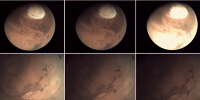
Over at the Planetary Society blog, Emily Lakdawalla posted an update explaining the return of the VMC and including comments from Daniel Lakey, one of our MEX engineers looking after VMC. There's little improving on her excellent report, so with no further ado, please (a) take a look at her gorgeous collage '56 views of Mars from the Mars Webcam in 2012' reproduced below, and (b) head over to her blog and read her update in full.

56 views of Mars from the Mars Webcam in 2012 Credit: E. Lakdawalla

These 56 views of Mars were taken between May 6 and December 15, 2012. The cadence was uneven -- some images are separated by only a day, others by as much as a month. Credit: E. Lakdawalla

Following the first downlink over Malargüe tonight, we will consider the Flickr page to be open for business. Unfortunately, due to the upcoming solar conjunction and associated low bit-rate season, we're unlikely to get any downlink slots for VMC for a few months, but once the Mars Webcam is taking pictures again, the images will be published for the world to see within seconds of them being received on Earth. The low priority of VMC images means that their downlink to Earth can be some time after the observation.

-- Daniel Lakey, Mars Express, 18 Dec 2012


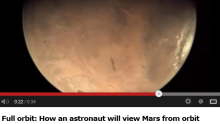
Astronaut-eye view of Mars from orbit: A unique video tour of the Red Planet

Our famous full-orbit video is now available in YouTube.

The original 2010 description:

The Mars Express VMC team here at ESOC are delighted to publish today's special treat: a movie carefully compiled from 600 VMC images snapped during a single, complete 7-hour orbit on 27 May 2010. This video shows what future astronauts would likely see from their cockpit window: Mars turning below them as they sweep in orbit around the Red Planet, our beautiful planetary neighbour!

Recent Mars Webcam image sets: Why are some corrupted?

If you look closely at the image set captured on 8 August, you might notice that images 7-9 are corrupted and images 10-12 are missing completely. Nothing to worry about - VMC is performing perfectly! What you're seeing is, in fact, the affect our own planet can have on our exploration of Mars!

These images were sent back from Mars early in the afternoon of 10 August and received via ESA's 35m deep space station in Cebreros, near Madrid. At that time, Cebreros was experiencing severe, heavy rain which caused problems with the reception of the Mars Express signal containing the VMC images - just as you may have noticed degradation on your satellite television at home during a storm.

So nothing to worry about, but a nice reminder that while we can operate a spacecraft flying around another planet, we are still at the mercy of mother nature! -- Thomas

Animation & comparison: two excellent creations based on Mars Webcam images

Long-time VMC supporter Emily Lakdawalla at the Planetary Society has created an excellent animation from the image set acquired 8 August by Mars Express as it soared over the Red Planet's northern ice cap.

Emily writes:

 Yesterday, I found a really nice set that I just had to animate, taken from a relatively low altitude over the picturesque swirls of Mars' north polar cap, which is brightly lit now by round-the-clock summer sun. This animation is composed of 23 photos taken by the 'Mars Webcam' aboard Mars Express, spanning a little more than half an hour on August 9, 2010. During the animation, Mars Express recedes from an altitude of about 4100 kilometers to about 7000 kilometers above the planet. The twisted canyons of Mars' north polar cap occupy the center of the view. Click here for a version at the camera's full resolution.

We were delighted to see such a quick and well-done response to this image set - good work and thanks, Emily!

Another long-time friend of the VMC, Mike Malaska, also posted a very nice comparison between two VMC images taken some six weeks apart, on 27 May and 8 August.

Mike wrote:

"The north pole is at center in the two images, the 300 longitude line is approximately at top. Large differences in ice cover can be seen near Chasma Boreale (the deep chasm at lower center). The triangle shaped region at upper right is Olympia Mensae. Interestingly, while the August 8th image generally seems to have more ice overall, the region just poleward of Olympia Undae (which is the darker region poleward of Olympia Mensae) seems less ice covered than in the May 27th image."

Well done, Mike - and thanks to you also!

With two strong creations based on the excellent 8 August VMC image set, we thought it would be interesting to provide some background info on how the Mars Webcam acquired these frosty polar pictures. Hannes Griebel, Mars Express Spacecraft Operations Engineer and multiple past contributor to our VMC Blog, works on the mission planning system, and he provided this description.

Mars Express primary scientific observations are always prioritised ahead of VMC operations. This usually leaves only small VMC picture-taking opportunities at the maximum distance from Mars (apocentre), since conditions at this point in the the spacecraft's orbit are often not usable for science operations (due to the large distance to the planet and firings from the Mars Express thrusters). Occasionally, an observation slot is available at a lower altitude, allowing VMC to operate much closer to the planet and take spectacular, and for such a simple device, quite detailed, images - such as the recent polar images from 8 August. When such a slot occurs, the Mars Express Flight Control Team at ESOC do all they can to make the most of the opportunity, while still maintaining the primary science operations required by the Mars Express mission.

Images from any VMC observation, routine or special, are uploaded and made available via the VMC Blog immediately after they are received on the ground from Mars Express. However, their real potential is often revealed only after members of the public turn them into stunning compositions and animations - which we are delighted to receive and share via posting in the VMC Blog from here at ESOC! If you want to submit any work based on raw VMC image sets - be it processed images, animations, a poem, an artistic interpretation, an analysis of the image content or (more or less) anything else - then please feel free to contact us (you can find more details under Help us with VMC in the links to the right of this page).

Thanks, Hannes, for this background report - and from all of us on the VMC team, thanks to everyone who has submitted results to the VMC Blog.

Keep up the great work!

-- Daniel Scuka