Tag Archives: ocs

Amaldi’s propulsion system is performing perfectly!

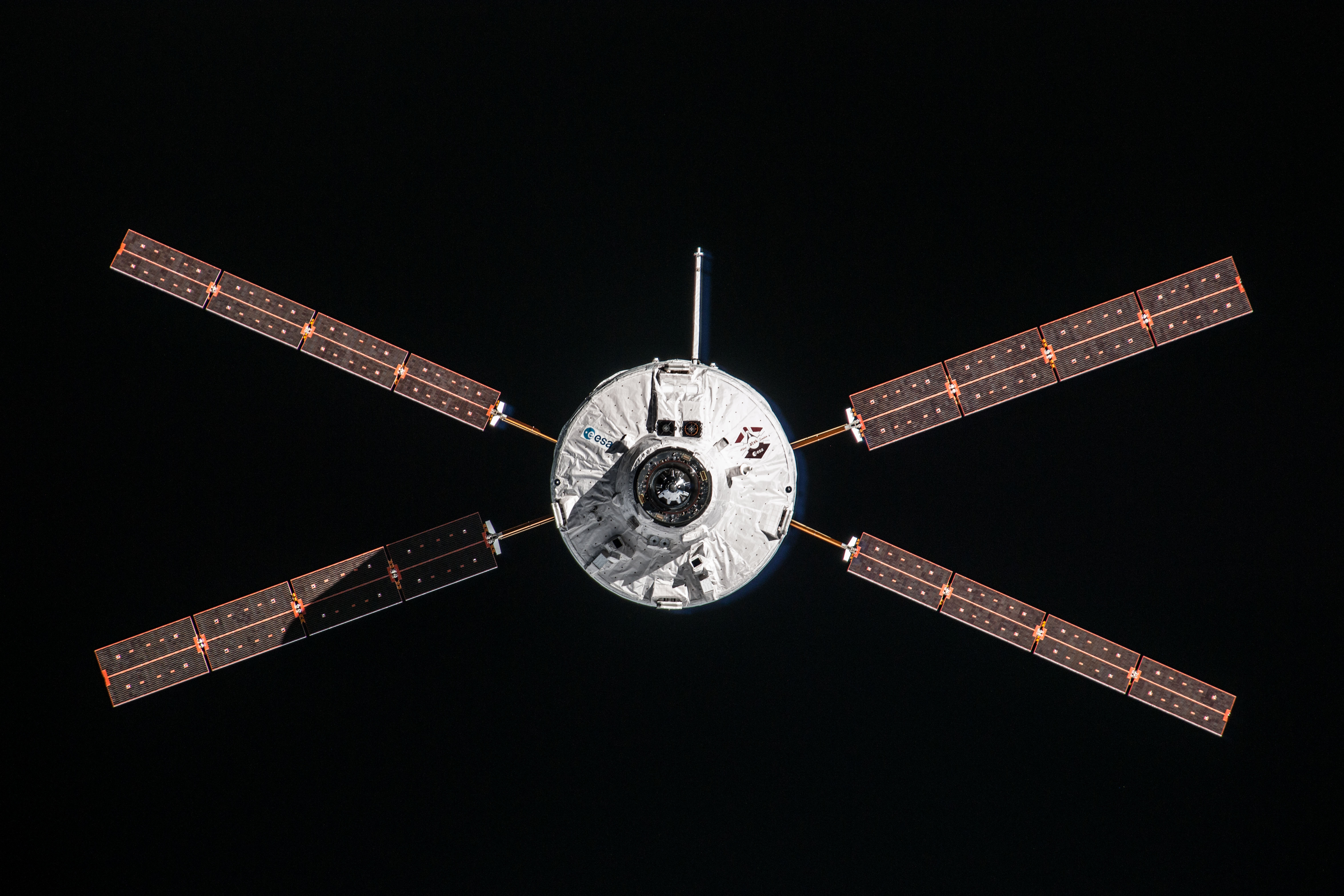
Yesterday, in a dual-burn reboost, ATV Edoardo Amaldi boosted the ISS, for the first time, into an orbit entirely above 400 km altitude. The burns took place at 11:45 and 15:17 CEST; the former ran for under 7 minutes while the latter ran for almost 35 minutes.

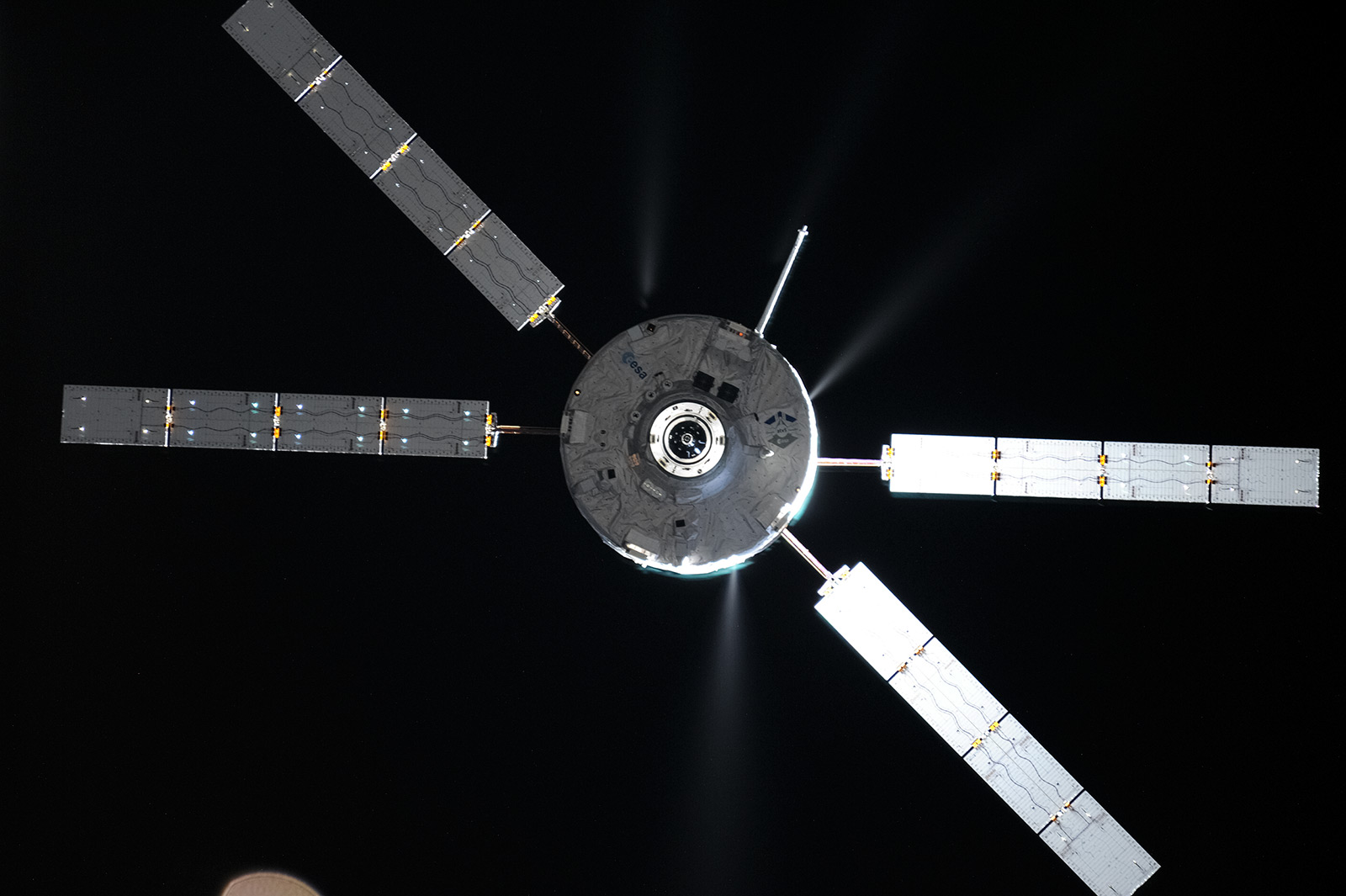
A Needed Boost - By astronaut Don Pettit 3 Apr 2012: Here is my attempt to capture a Station re-boost last weekend using the ATV (Automated Transfer Vehicle). Notice that as the burn progresses, a halo of exhaust accumulates that is visible when the thrusters fire for thrust corrections.

An engineering analysis of the European vessel's propulsion system performance showed the first burn achieved its planned propulsive push (that is, the planned increase in Station speed, measured in metres/second) within 1% of the target, while the second achieved an enviable 0.5%!

As a result, there will be no need to use the back-up boost slot available on 24 August.

Amaldi's propulsion is performing perfectly!

News from ATV-CC Toulouse: Today’s two-part ISS reboost continues

A quick update on today's dual-burn reboost from ATV-CC; ESA's Daniel Firre is on console at the Mission Director's position:

Today's reboost is split into two separate thruster ignitions. The purpose of the reboost is to set up the ISS phasing conditions for the Soyuz 30 landing in mid-September and Progress 49 accelerated rendezvous on 31 October.

Hot! Video showing how a 220N ATV thruster appears when firing. More details

The details of each part of the reboost are:

  1. Time of ignition (TIG) 11:45:00 CEST. Burn duration (planned) is 6:24 min:secs providing a delta-V (change in velocity) of 0.9 m/s
  2. TIG 15:17:00 GMT. Burn duration (planned) is 34:49 min:secs for a delta-V of 4.9 m/s

The total delta-V will be 5.8 m/s, which corresponds roughly to an increase in ISS altitude of 10 km.

Daniel Firre (right) in ESOC Main Control Room during Cryosat launch 8 April 2010

Daniel Firre (right) in ESOC Main Control Room during Cryosat launch 8 April 2010

The propellant consumption for this reboost will be in the order of 780 kg.

The boost had to be split in two parts because the remaining propellant in one of the two tank systems of ATV-3 is not enough for the planned delta-V; therefore, it is necessary to switch tanks in between the two burns.

So far today, the first burn took place exactly as planned and ATV-CC has just performed the tank switching. Waiting now for the thruster temperatures to lower to the nominal value before starting the second burn.

... update after the second boost!

Cheers from Toulouse,

-- Daniel

Update on ATV reboost anomaly

Editor's note: Yesterday's Station reboost resulted in an incomplete burn, which is explained below in an email received from ESA's Jean-Michel Bois, Head of Mission Operations at ATV-CC.

One ATV function is to maintain the ISS altitude by performing regular reboosts, raising the Station's altitude. This manoeuvre uses the ATV propulsion system, and is commanded by ISS software.

The regularly planned ISS reboost conducted by ATV-3 on 15 August stopped prematurely. The thruster burn was set to run for 1876 seconds to increase orbital speed by 4.4 m/s and raise the Station's orbit by 7.7 km to 414.4 km altitude.

The boost began as scheduled at 18:00 CEST using the No. 1 & 3 thrusters of the ATV vessel's Orbital Control System (OCS).

However, after achieving a 2.9 m/s speed increase, the boost was stopped by the ISS. A temperature alarm had been triggered by ATV on a thruster of the propulsion system (which was not used for this boost), but that is nevertheless permanently monitored.

This (correctly) generated an isolation of the suspect thruster from the rest of the vessel.

A signal was sent from ATV to the ISS to highlight this 'partial reconfiguration' (with ATV continuing to be available for the boost). But the ISS software stopped the boost, which was not the excepted reaction to this kind of anomaly.

Engineers at ATV-CC and their counterparts in Moscow and Houston are studying the cause of the initial ATV issue and of the unforeseen ISS reaction.

In order to give time to the ground experts to complete their investigation, it has been jointly agreed with the ISS control centres to perform the remainder of the yesterday's reboost during the next scheduled reboost slot, set for 22 August; this manoeuvre is compatible with the next vehicle (HTV and Soyuz) movements.

ATV remains in a safe configuration and is fully capable of performing any necessary operations, such as reboosting the Station or performing a debris avoidance manoeuvre if so commanded.


The ATV-3 Mission Manager, Massimo Cislaghi, said he was pleased with the skilled work of the joint ESA/CNES operations team in Toulouse together with the essential support of ESA Moscow in reacting to the issue and investigating the cause:

"While the results of the boost were 'outside routine business', the team reacted with skill to manage the issues that arose during the reboost, which are always delicate operations," said Massimo.

ATV-3 reboosts ISS: view from ‘on console’ at ATV-CC

ATV-3 conducted its 6th ISS reboost manoeuvre early this morning, and ESA Mission Director Adam Williams oversaw the activity at ATV-CC, Toulouse. He's sent in a detailed timeline of how it went -- giving a rare, 'on console' look behind the scenes of ATV operations.

ATV fires its thrusters to reboost ISS to higher orbit

Adam wrote:

With high solar activity, there is an increased risk of highly charged particles affecting ATV, at worst causing a reset of the Fault Tolerant Computer. If this occurred during the reboost it would terminate the boost before it was fully completed.

However, the Houston space weather forecast was more positive [than that of CNES, nominally responsible for space weather monitoring for ATV - Ed.], and the trilateral [i.e. Houston, Moscow, Toulouse - Ed.] conclusion was that the reboost could continue. Moscow and Houston both agreed it was better to attempt a reboost, and deal with the consequences of any underboost if and when it happened.

Wednesday, 18 July 2012 - All times Toulouse local - CEST

02:00 - All teams are on console preparing ATV for the reboost. Everything is calm.

03:40 - Successful transition of ATV to 'ISS Attitude Control' mode.

05:15 - Successful transition of ATV to 'ISS Reboost' mode.

05:16 - Start of reboost...

05:35 - Successful end of reboost and transition back to 'ISS Attitude Control' mode. Delta-V (change in velocity) achieved was around 2.8 m/s, which raised the ISS approximately 5 km.

06:15 - ATV back in 'Dormant' mode. Time for an early breakfast!

ATV-3 reboost update – Station orbits higher

Using its Orbit Correction System thrusters, ATV-3 performed a one-burn reboost of the ISS on 26 May at 02:10 CEST with a burn duration of 6 min, 17 sec. The burn achieved a 'delta-V' (change in orbital velocity) of 0.84 m/s (planned: 0.9 m/s), and increased the average Station altitude by 1.55 km (planned: 1.66 km).

Back in April, NASA astronaut Don Pettit, Expedition 30 flight engineer, captured this video of engines of the Automated Transfer Vehicle being fired to reboost the International Space Station. Credit: NASA

After the burn, the ISS was orbiting at 399.0 km average altitude, with 407.5 km apogee height and 390.6 km perigee height.  The reboost was a slight underburn, providing about 7% less than expected delta-V and altitude gain. 

This reboost -- together with the next one in June -- will set up orbit phasing for Soyuz 29S departure and landing, set for 1 July (the flight that will bring astronaut André Kuipers back home -- Ed.).

ATV-3: Wrap up on a busy week

(Note: Updated 6 May with comment on water transfer from Mike Steinkopf) ESA's Daniel Firre sent in a note after lunch today (see our post immediately below - Ed.) with a summary/wrap up on some of the activities at ATV-CC this week.

The big event was today's ISS reboost, which left the Station orbiting 3 m/second faster and over 5 km higher.

(more...)

ATV performs ISS reboost

Yesterday at 14:13 CEST, ATV-3 performed a one-burn ISS reboost using the vessel's Orbit Correction System (OCS) thrusters. The burn ran 16:08 min:sec and provided an increase in Station orbital velocity by 2.3 m/second. This was expected to result in a mean altitude increase of 4.1 km.

The burn set up the Station's orbit ('phased') for the launch of Soyuz 30S, set for mid-May.

Prior to the burn, ESA astronaut André Kuipers closed the protective shutters of the US orbital segment (the Lab, Node-3/Cupola and Kibo module) windows.

Details via NASA

First test ISS reboost complete

ESA Mission Director Jean-Michel Bois sent in a short update after last night's 'test' reboost. The successful burn using the ATV's thrusters means that the vessel is ready for a series of larger planned reboosts (the first expected on 5 April) and to conduct debris avoidance manoeuvres when necessary (scroll down below the animation for Jean-Michel's note).


Animation of reboost performed by ATV Jules Verne

After the successful power/electrical reconnection of ATV with the ISS in the afternoon, the test of the ATV reboost capability was performed on 31 March at 21:54 UT/GMT.

The goal was to ensure that the ATV was correctly integrated with Station and that its thrusters were able to perform the foreseen orbital altitude boost manoeuvres and support at any time a debris avoidance manoeuvre (DAM) if necessary.

The test demonstrated the good coordination between ATV-CC (Toulouse), MCC-M (Moscow Control Centre) and MCC-H (Houston Control Center), and that activation of the ATV propulsion system can be directly commanded by the ISS computers.

A small change in velocity of 1m/s was delivered to the Station via two main thrusters (OCS - orbital control system) of the ATV.

Note that while the thruster burn was controlled from ground, ESA astronaut André Kuipers helped prepare the Station for the 351-second burn: he closed the protective external shutters of the Lab, Node-3/Cupola & 'Kibo' Japanese Experiment Module windows to prevent their contamination from thruster effluents during and after the test burn.

It takes a team!

ATV boosts ISS orbit

This morning, ATV Johannes Kepler boosted the Station's orbit, which was about 342 km, by approximately 4 km.

The one-burn reboost was powered by ATV's Orbit Correction System (OCS) thrusters, which burned for about 17 mins, used about 340 kg of fuel and provided an increase in orbital velocity of 2.5 m/s.

More reboosts are planned later in June prior to undocking, now set for 20 June.