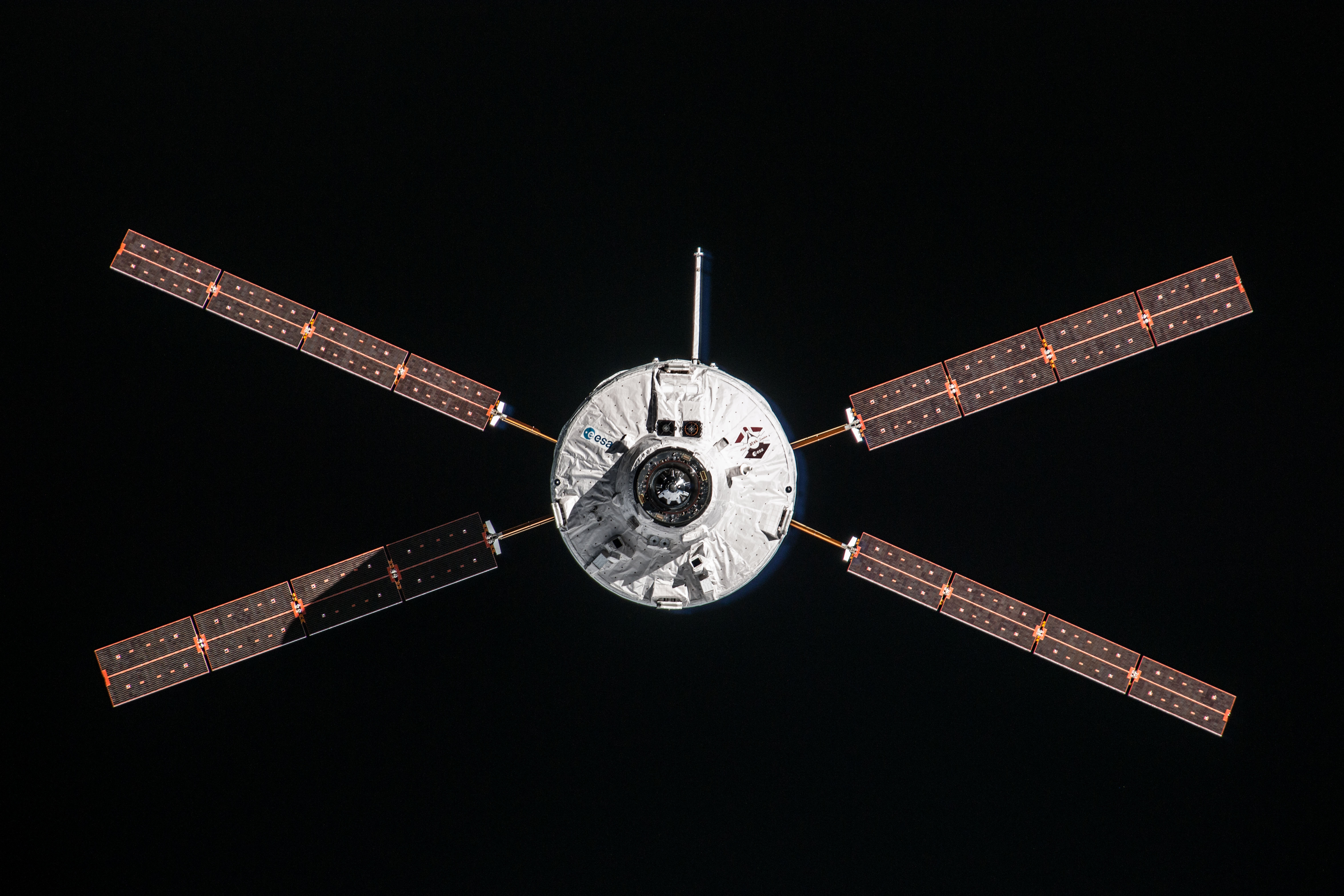
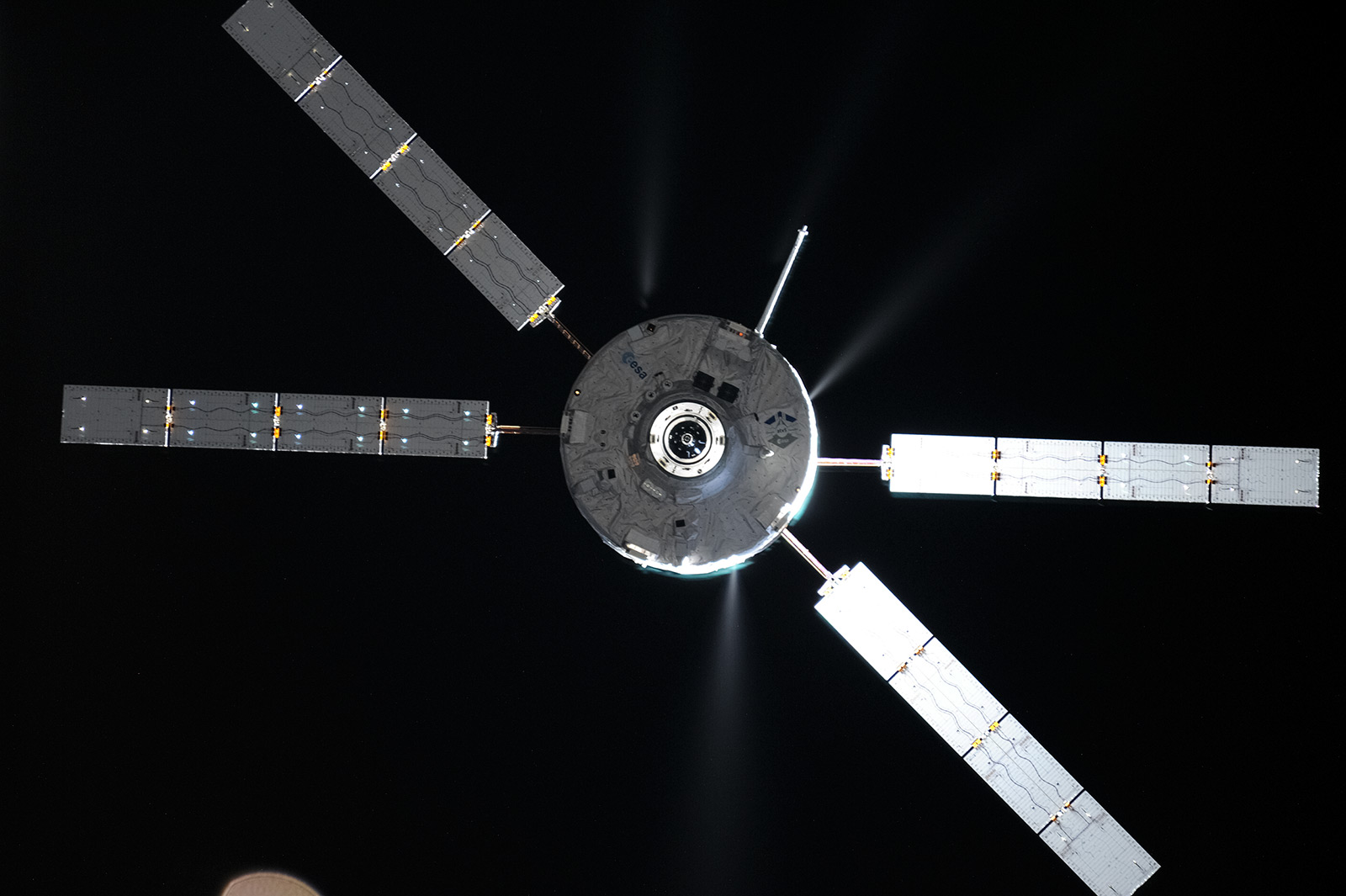
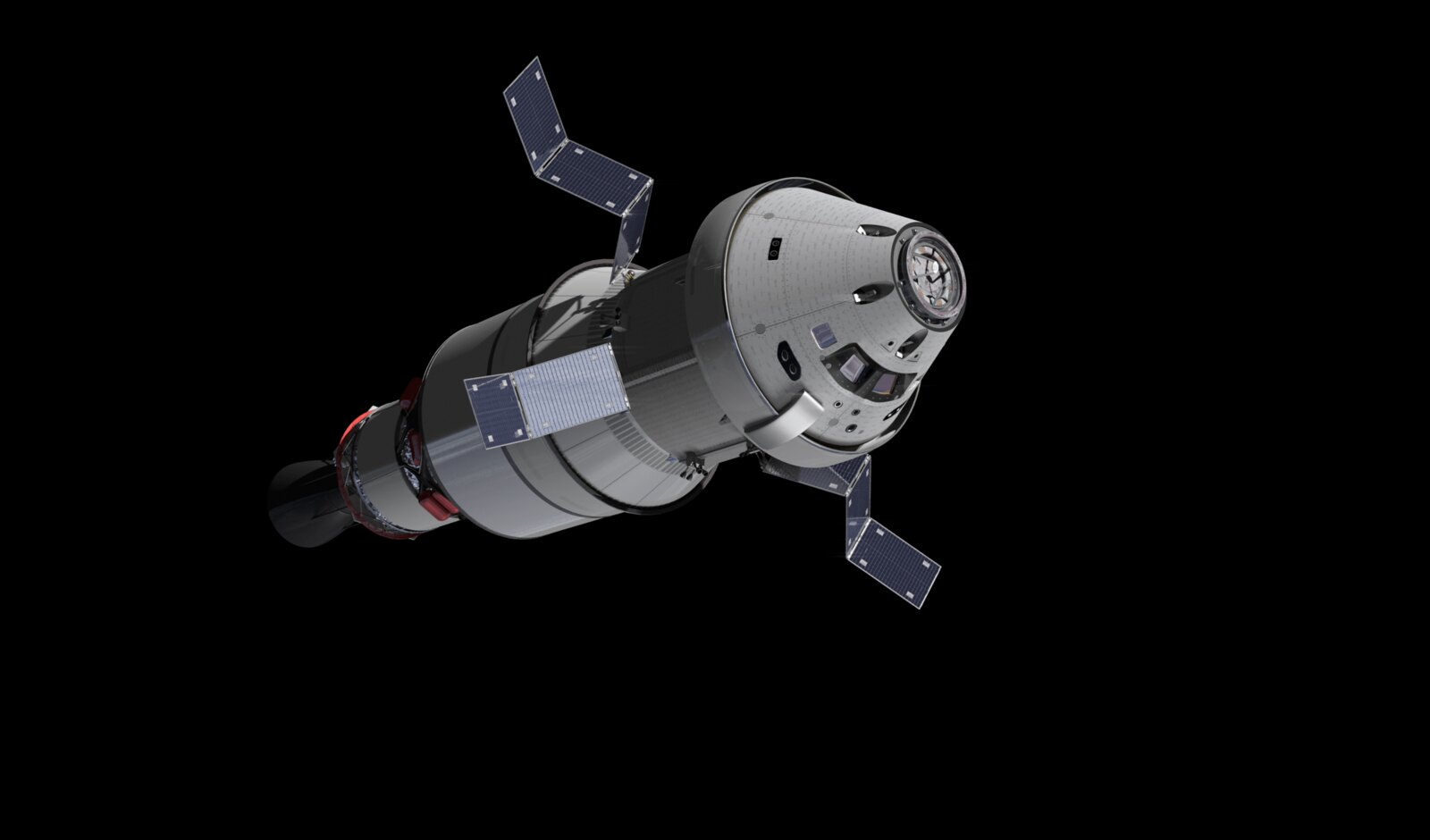
Before Europe's advanced space transporter is ready for launch on its voyage to the International Space Station, the components that make up ATV Albert Einstein have traveled quite some kilometers over sea, land and air:
ATV Albert Einstein, as all spacecraft, needs a specific launcher adapter to connect the spacecraft to its Ariane rocket. We received some great pictures of Ariane's 'crowning' in Kourou and the whole process of integrating the (black) launcher adapter and ATV itself. Precision work with a 12-tonne spacecraft! A story in images:
Arianespace marked one of the final steps in preparations for the next Ariane 5 launch as Europe’s latest Automated Transfer Vehicle (ATV) was integrated atop the heavy-lift workhorse at the Spaceport.

ATV Albert Einstein is lowered into position for integration with its Ariane 5 launcher inside the Spaceport’s Final Assembly Building as preparations near completion for next month’s mission. Credits: CNES/ESA/Arianespace/CSG Service optique
This latest ATV – named after German-born physicist Albert Einstein – was lowered by an overhead crane onto its Ariane 5 inside the 90-meter-tall Final Assembly Building in French Guiana.
The payload fairing – which will complete the launcher build up – will be mounted closer to the launch date, allowing for loading of late cargo for the ATV’s International Space Station servicing mission. This second Ariane 5 flight of 2013 is scheduled for a June 5 liftoff.
Integration of the ATV Albert Einstein for Ariane Flight VA213 is part of this month’s activities on four parallel missions involving Arianespace’s complete launcher family at the Spaceport – including the successful orbiting of three passengers by the lightweight Vega vehicle on May 7. Rounding out this month’s action in French Guiana are ongoing preparations for the medium-lift Soyuz Flight VS05, scheduled for June to loft four O3b Networks satellites; and Flight VA214, set in the second half of July with an Ariane 5 to carry the Alphasat and Insat-3D satellites.
Flight VA213’s ATV Albert Einstein will have a liftoff mass of 20,235 kg. – the heaviest payload ever lofted by any Ariane vehicle. In addition to resupply, the ATV will be used for manoeuvring the International Space Station.
Built by an Astrium-led industry team, ATV Albert Einstein will be the fourth such servicing vehicle launched by Arianespace for the European Space Agency.
Via Arianespace
Kirsten MacDonell, ESA's Cargo Integration Engineer who oversees cargo activities on ATV sent us this update from Kourou:
The ATV-4 team finished a dress rehearsal for the new Late Cargo Access Means (LCAM) in Kourou. The new LCAM will allow larger and heavier last-minute cargo to be loaded, 75 kg Triple Cargo Transfer Bags versus our previous capability of 25 kg Double Bags.
During the dress rehearsals the new LCAM is covered in blue sterile sheets in one of the photos since we want to keep ATV-4’s Integrated Cargo Carrier as free from microorganisms as possible whenever working inside: this includes both putting operators in bunny suits and disinfecting hardware.

LCAM under blue sheeting
The team had tested the system on mock-ups at APCO in Switzerland but this was the first time the system was mounted above ATV-4’s Cargo hold and used to enter inside.
To prove the system and ensure safety the team had to first demonstrate rescuing an operator and then rescuing an unconscious operator. In the second case an LCAM operator had to enter ATV’s cargo hold to assist the rescue operation of a colleague who acted unconcious. Both operators where attached to winches.
The first manoeuvre took only 22 seconds, whereas the ‘rescue operation’ took 61 seconds… both very fast times that ensure safety if anything should occur.
Initial checkout has begun at the Spaceport for Europe’s fourth Automated Transfer Vehicle (ATV), which is to be launched from French Guiana by Arianespace on a servicing mission to the International Space Station next year.

The Service Module for ATV Albert Einstein is positioned on its integration rig at Kourou's S5 payload preparation facility. Credit: ESA/CNES/Arianespace/Optique Video du CSG

ATV-4's Integrated Cargo Carrier is prepared for entry into the S5 complex. Credit: ESA/CNES/Arianespace/Optique Video du CSG
The activity underway includes verifications of the ATV’s Service Module in the Spaceport’s S5 payload preparation building, where it has been joined by the resupply spacecraft’s other major spacecraft element – the Integrated Cargo Carrier.
Carrying a very special cargo: ATV-4!
The fourth Automated Transfer Vehicle, Albert Einstein, departed Bremen harbour last Friday, 31 August, heading to Europe's Spaceport in Kourou, French Guiana. Europe's smart supply spacecraft will arrive at its next destination around 17 September.
Albert Einstein is right now moving away from the North coast of Spain on board the cargo ship Sonja. Her call-sign is 'V2CR8' and the vessel is 101m long, 15m wide and has a draught of 4.2m. Follow Sonja's progress live via VesselFinder.

Solar arrays are very sensitive. A special rig helps remove them from the transport containers without damage. Credit: ESA/C. Beskow
ATV-3 launch: Day 59 of the Launch Campaign - Saturday, 15 Oct
The latest update from ESA’s Charlotte Beskow in Kourou – Ed.
What were you doing this morning? Celebrating France's win in the Rugby Semi finals perhaps?
Here in Kourou the Galileo team were probably savouring the fact that Soyuz, carrying their two satellites, was rolled out to the pad yesterday... their launch is planned for 20 Oct and the VIPs have started arriving!
The ATV preparation teams had something different on their minds: Getting Edoardo Amaldi (ATV-3) ready to mount and test the first of four solar arrays.
This sounds easy but is, in fact, somewhat complicated. The solar arrays are, of course, very sensitive to light and therefore have to be protected at all times. The arrays come in big transport containers. In the picture you see both the container and the rig.
You can also see the unpacked array (the first one of the four), ready and waiting for the next step of the spacecraft integration process. As you can see, there is a lot more to launching a spacecraft than the spacecraft itself.
The spacecraft has been made ready and is placed on a stand. Since it weighs ca. 5 tonnes, this involves using a crane and being very, very careful.
The place where the solar arrays are to be installed is indicated by the pink protective sheeting.
Once this was done, a clampband was installed to allow us to tilt the entire spacecraft. The clampband goes on the interface between the spacecraft and the mechanical support. Once the spacecraft was securely attached to the mechanical frame it had to be tilted and rotated to bring it in line with the deployment rig. This is pretty spectacular and was closely watched by the team.
Next, all that had to be done was to move the spacecraft and align it perfectly with the rig — and then rotate Edoardo Amaldi to bring the fixation points in line with the rig.
Simple right? Actually yes! So how many people do you need to move nine tonnes of equipment? Roughly six (provided you have an airpad system). How do you know where to go? A piece of string on the floor gives the lateral position! And strings hanging from the rig touch the spacecraft.
So all is set for the next step... lunch!
-- Charlotte
Editor's note: Access the full image gallery of the morning's work via Flickr
ATV-3 arrived on board MN Toucan, a French cargo ship normally used by Arianespace to transport Ariane rocket elements, which steamed 13 days from Bremerhaven, departing 6 August. ATV-3 was unloaded 25 August and trucked to the Kourou Spaceport.
ESA's Charlotte Beskow in Kourou just sent us a mail:
I am now on console. As I lift my head I see four clocks showing:
+14:53 || 21:50 || -06:57 || -06:57
... and my PC tells me "11:54" and my telephone tells me "15:54" - no wonder that it I feel slightly confused! Best to start today with a double coffee
Actually, the only time I need to bear in mind is the countdown time showing hours to go until lift off, which is now -06:55. Seven hours to go - the filling of Ariane's main stage starts in roughly 2.5 hours. -- Charlotte