Category Archives: ISS

All about the ISS, where ATV docks

Preparing for ATV-4 in space

Ground teams in Kourou, French Guiana, and ATV-CC, Toulouse, France, and several other locations are busy preparing for ATV-4's mission. Meanwhile in space...

From ESA's Columbus International Space Station status update:

ATV-4 Preparations
The Proximity Communications Equipment for Europe’s Automated Transfer Vehicle (ATV), used for close proximity communications between the ISS and the ATV, was installed inside the Russian Service Module, including installation of its proximity communications box, an antenna switching control box, control panel, hand controller as well as connecting up relevant cabling.

Subsequent connection testing was successful.

Editor's note: The image shows ESA astronaut André Kuipers training in 2011 to install the PCE communications equipment in the ISS.


How many calories does it take to bring a calorie to the ISS?

By Rhett Allain

The primary role of the Automated Transfer Vehicle is to bring supplies to the International Space Station. Supplies include food, water, oxygen, scientific equipment and candy bars. Yes, I listed food twice. Candy is food, but I listed it separately so that we could look at candy in space.

Here is the question: Suppose an astronaut requests an extra candy bar to be sent up on the ATV. How much extra energy is required to get this candy into orbit? That is the question.


Rhett Allain

Rhett Allain

Editor's note: In addition to having a knack for science communication, Rhett Allain is Associate Professor of Physics at Southeastern Louisiana University. He writes regularly for Wired's Dot Physics blog and is a bit of a physics fanatic who spends more time than many pondering how daily life intersects with science. His recent posts have looked at the physics of a (fake) broken swing image, why doesn’t the Moon crash into Earth (gravity's involved!), Star Wars blaster speeds (answer: 34.9 m/s) and how well-made are Lego blocks (really well made). With the recently announced development of ATV in cooperation with NASA for Orion, we're delighted to feature a few posts from the far side of the Atlantic. Enjoy! – DGS


To start, let’s get some initial values. Some of these will be estimates. What about the ISS? It has an orbit that is about 420 km above the surface of the Earth and it moves with a speed of 7,700 m/s. Both the altitude and speed are important in the calculation of the energy needed to get supplies there.

Got the goodies from ATV-2! Credit: ESA/NASA/P. Nespoli

Got the goodies from ATV-2. What, no pizza for me? I guess rehydrated macaroni & cheese will have to do for next few months! Presi i pacchi doni. Cosa? Non c’è pizza per me? Accidenti, dovrò acconterntarmi di pasta reidratata per i prossimi mesi! Credit: ESA/NASA/P. Nespoli

There really is just one other important piece of information. We need the location of the ATV launch pad, which is in Kourou, French Guiana. In case you aren’t familiar with the location, here it is in Google Earth.

Kourou in Google Earth

Kourou in Google Earth

Kourou is only 5 degrees above the equator. There is a reason for this as we will soon see.

Oh, we need one more thing. What about the mass of a candy bar? I don't wish to single out any particular brand of candy, so I will just assume an average chocolate candy bar. Let's say it has a mass of 50 grams with 250 calories (that's food calories, which are different than chemistry calories – just to be clear).

Physics and Energy

Now for a little bit of physics. Why does it even take energy to get anything to the ISS? Well, there are two things you need to do to a candy bar in order for an astronaut in space to eat it. First you have to lift the candy up to the height of the ISS. Second, you have to increase the speed of the candy bar so that it is going at the same speed as the ISS. Let me look at these two things separately.

Suppose you find this 50-gram candy bar on the ground and you lift it about 1 meter up to place it on a table. This requires that you do some work on the candy to change its energy. But how much energy would it take? One way to look at this is via the change in gravitational potential energy. On the surface of the Earth, the change in gravitational potential can be calculated as:

Here, g is the local gravitational constant with a value of 9.8 Newtons/kg. Increasing the height of a candy bar by 1 meter would take 0.49 Joules of energy. That's not too much.

Liftoff of Ariane 5 VA205 with ATV-3 Credit: ESA - S. Corvaja, 2012

How the candy bar gets its kinetic energy: Liftoff of Ariane 5 VA205 with ATV-3 Credit: ESA - S. Corvaja, 2012

Now, what if I want to increase the height of the candy bar all the way up to the ISS? Can I just do the same calculation but change the height from 1 meter to 420 km? No, I can’t. The above model for gravitational potential energy assumes that the gravitational force on the object is constant. This is a good assumption near the surface of the Earth, but not so good as you get higher (though at the ISS height it isn't the worst approximation you could ever make).

If we use a better model for the change in gravitational potential, it would be this:

Here, G is the universal gravitational constant. The two masses in the expression are the mass of the candy bar and the mass of the Earth. The values on the bottom of the expression are the distances from the centre of the Earth. So, the candy bars ends at the altitude of the ISS (I call this h) and starts at the radius of the Earth.

If you put in the values for G and the radius and mass of the Earth, you would find that it takes 1.93 x 10⁵ Joules of energy to get that candy bar up to the right altitude.

But that’s not all of the energy for the candy bar. If you put that much energy into the candy and let it go, it would just fall back to the Earth. The other kind of energy the candy needs is kinetic, i.e. moving, energy. This has an expression of:

Since we know the speed of the ISS, shouldn’t this be easy to calculate? If I put in the mass of candy (0.05 kg) and the speed of 7,700 m/s, I get a kinetic energy of 1.48 million Joules. Actually, this is the wrong answer. Why? It assumes that we took that candy and increased its speed starting from rest.  The only problem is that before the launch, the candy is already moving. It is moving because it is on a rotating Earth.  

Let's say the Earth rotates once every 24 hours (which it doesn’t actually – that is the time for the Sun to get back into the same position but this value is close enough for us). This means that the speed of the candy before launch can be calculated as:

But what is r in this expression? It is the radius of circle in which the object moves due to the rotation of the Earth. At the equator, r is the radius of the Earth. At the North pole, the radius would be zero. If I put in the radius of the Earth (and convert hours to seconds), I get a starting candy bar speed of 464 m/s. That might be small compared to the ISS speed, but every little bit helps. And this is why ESA launches the ATV from Kourou. It is very close to the equator.

OK, so what about the new change in kinetic energy of the candy? Launching from the equator, you would need about 1.47 million Joules.  

Got the goodies from ATV-2! Candy bar detail. Credit: ESA/NASA/P. Nespoli

Candy bars? What candy bars? Credit: ESA/NASA/P. Nespoli

The total energy to get this candy bar to the ISS is just the sum of the two values we've now calculated: the change in kinetic and change in gravitational potential energy. This works out to 1.66 million Joules. That is over a million Joules of energy for just that one tiny candy bar and it assumes a perfectly efficient method for getting things into orbit without any energy losses. This is why we don’t all live in space. It's just expensive.

Energy to orbit using candy

It's pretty hard to get a feeling for an energy of 1 million Joules. What about a comparison to the energy in the candy bar? If you consume this candy, it can produce 250 food calories. One food calorie is 1000 calories which is 4,180 Joules.

Let’s go backwards. If it takes 1.66 million Joules to get candy into orbit, how many food calories is that? This is a pretty straight-forward unit conversion problem. Remember that the trick to unit conversions is to always multiply by a fraction that is equivalent to 1.

Well, that's not so bad. It takes a little  more than 1 candy bar of energy to get a candy bar to the ISS! 

OK, one more thing: What if we wanted to get all of the ATV cargo to the ISS just using candy as energy? The ATV can carry a payload of about 20 tonnes, or 20,000 kilograms. If this payload comprised just candy bars, that would be 400 thousand bars of candy; the energy needed to get into orbit is the same energy you would get from consuming 640,000 candy bars.


ATV in images: past, present and future

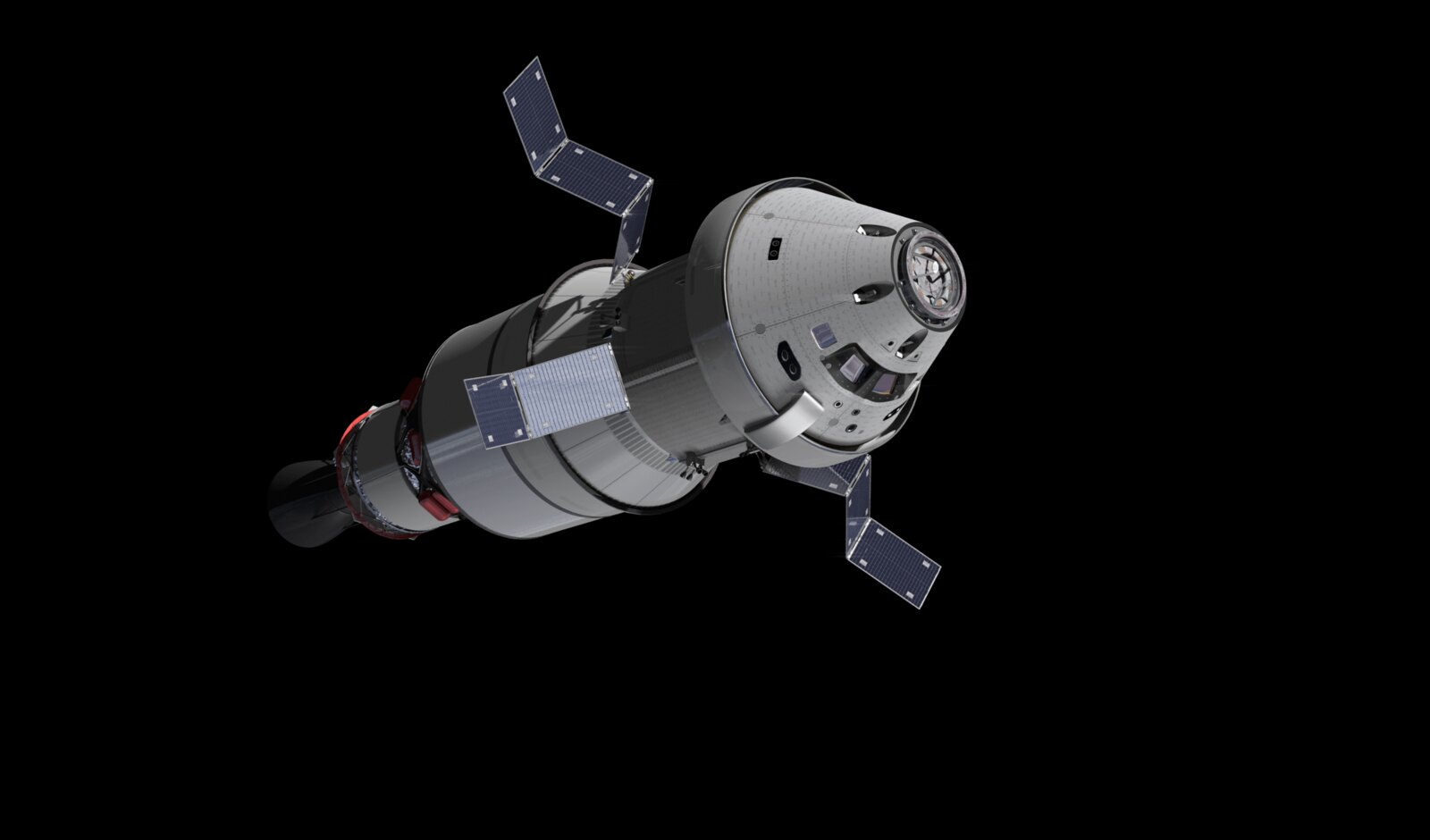
With the announcement of the ATV-based Service Module for NASA's Orion spacecraft, ATV's future is looking very good. The spacecraft's distinctive X-wing solar panels have managed to survive over the years and seem set to be part of the Orion MPCV in 2017.

Below is a scan from an ESA document from 1998 entitled European Participation in the International Space Station. At the time ESA's  Human Spaceflight & Operations directorate was called Manned Spaceflight & Microgravity while ATV was still in the so-called B2 phase of development – nothing had been built yet.

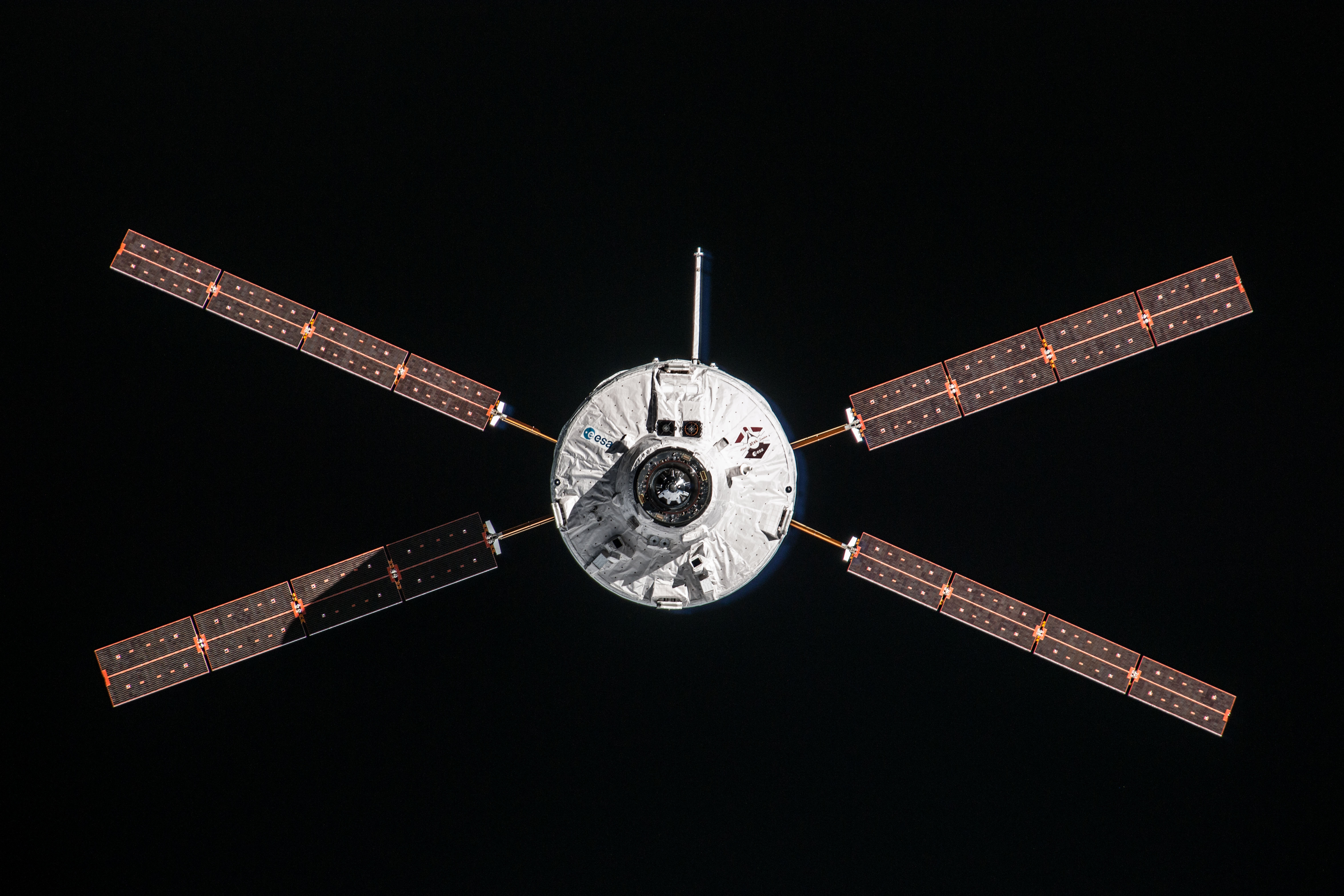
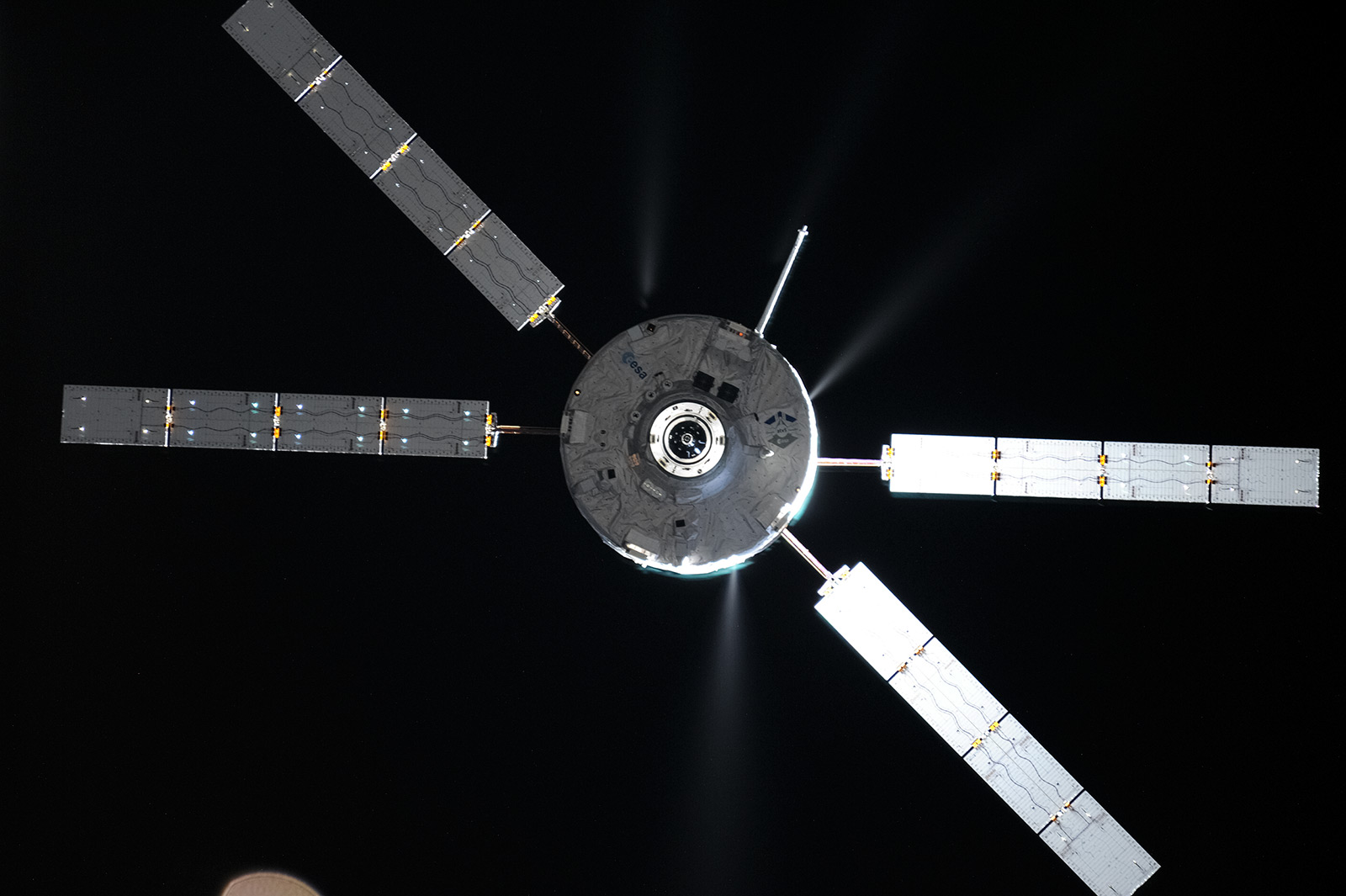
Spot the differences between one of the original concepts, a real ATV and the latest Orion concept art below.

Past... Credits: ESA


Present... Credits: ESA


And future. Credits: ESA-D. Ducros (flipped for better comparison)


Seen from ISS: ATV-3 disappears in smoke and dust

A stunning, first-ever photo showing smoke and dust from the burn up of an ATV – evidence of the fiery plunge through Earth’s atmosphere and the destructive re-entry of Edoardo Amaldi. This image was taken by Expedition 33 crew members aboard the International Space Station on 3 October 2012.

3 Oct 2012 --- This still photo taken by the Expedition 33 crew members aboard the International Space Station shows evidence of the fiery plunge through Earth’s atmosphere and the destructive re-entry of the European Automated Transfer Vehicle-3 (ATV-3) spacecraft, also known as “Edoardo Amaldi.” Credit: NASA

3 Oct 2012 --- This still photo taken by the Expedition 33 crew members aboard the International Space Station shows evidence of the fiery plunge through Earth’s atmosphere and the destructive re-entry of the European Automated Transfer Vehicle-3 (ATV-3) spacecraft, also known as “Edoardo Amaldi.” Credit: NASA

Ghostly images of a departed spaceship

Well, perhaps the title's a bit melodramatic... but these are 'ghostly' images as ATV-3 is now longer in existence! These are a selection of images taken by the ISS crew during hatch closure last week, when the placement and location of stowed waste and trash was documented prior to departure (this infro needed to verify centre-of-gravity calculations).

They are some of the last ever photos of the inside of ATV Edoardo Amaldi.

ATV-3 close-out photos Credit: NASA

ATV-3 close-out photos Credit: NASA


ATV-3 close-out photos Credit: NASA

ATV-3 close-out photos Credit: NASA


ATV-3 close-out photos Credit: NASA

ATV-3 close-out photos Credit: NASA


ATV-3 close-out photos Credit: NASA

ATV-3 close-out photos Credit: NASA


ATV-3 close-out photos Credit: NASA

ATV-3 close-out photos Credit: NASA


ATV-3 close-out photos Credit: NASA

ATV-3 close-out photos Credit: NASA

Thanks to Colleen Boggs, ESA's ATV Cargo Operations Engineer, for sharing!


ATV-3 seen against deep blue dawn sky

Another terrific photo from Japan! This one taken at 04:30 JST 3 October - 21:00 CEST on Tuesday, 2 October, over Chiba, not too far from Tokyo by Yujiro Suzuki (@mossch).

ATV-3 & ISS seen in orbit 2 October 2012 over Chiba, Japan. Credit/Copyright: Y. Suzuki

ATV-3 & ISS seen in orbit 2 October 2012 over Chiba, Japan. Credit/Copyright: Y. Suzuki

Suzuki-san writes:

I took a photo of ATV-3 and ISS together in orbit. Both are seen on 2 October at around 4:30 (JST) above Chiba, Japan. ATV-3 passed at 4:26 and the ISS passed at 4:33 at maximum altitude. ATV-3 flies in around seven minutes after the ISS. The background is the Big Dipper. Thanks!

ATV-3 seen in orbit late on Tuesday

A very nice view – Possibly the last one! – of ATV-3 (and the ISS) in orbit just a couple hours ago at 22:20 CEST, 2 October, which was 05:20 JST, 3 October, in Japan. Thanks to Taichi Iwamoto, Osaka, for a lovely final look at Edoardo Amaldi.

ATV-3 seen in orbit from Osaka, Japan, 3 October 2012. Credit/Copyright: T. Iwamoto

ATV-3 seen in orbit from Osaka, Japan, 3 October 2012. Credit/Copyright: T. Iwamoto

Iwamoto-san wrote:

10/3 05:11 (JST) ATV-3 max elevation 60 deg / 10/3 05:20 (JST) ISS Max elevation 80 deg. I failed in rendezvousing observation of separated HTV-3, so I wanted to observe ATV-3. I'm happy because it succeeds! Bon voyage, Edoardo!

Double-spacecraft composite: ISS & ATV-3 seen in orbit

An excellent double image (superimposed) of two images of the ISS and ATV-3 taken on 28 September 2012 at 19:45 BRT - 22:45 UTC - 00:45 CEST on 29 September by Meire Ruiz in Sao Paulo, Brazil. The images of each vessel were acquired about two minutes apart. 15-second exposure, ISO 800, Canon SX 40HS (there's a time-lapse video here in YT).

ATV-3 and ISS seen in orbit on 28 September 2012 from Brazil. Credit/Copyright: M. Ruiz. Used by permission.

ATV-3 and ISS seen in orbit on 28 September 2012 from Brazil. Credit/Copyright: M. Ruiz. Used by permission.

Thanks to ESA/ESOC B. Sousa for quick translation assistance!

Last view of ATV-3 seen from Russian Service Module

A lovely if somewhat melancholy photo: final view of ATV-3 seen just after undocking on 28 September from the camera screen inside the Russian Service Module:

ATV-3 1 October 2012: Mission is almost over

Latest instalment from Charlotte Beskow, deputy ATV mission manager, in her mission diary is live below - Ed.

28 September 2012 - Friday

The actual undocking and separation boost went like clockwork... almost.  The automatic undocking command sequence we had loaded on board stopped at one point, waiting for a command that nominally would have been sent by one of the on-board units once it had confirmed that the ATV had separated from ISS. After a very short exchange on the voice loop (quick because at that time we had the video image from the ISS showing ATV moving away) this foreseen situation was handled speedily, i.e. by the ATV-CC ground controllers.

ATV fired its thrusters and gently departed the vicinity of the ISS. This concluded another important step in this mission.

ATV-3 seen shortly after undocking on 28 September 2012. Credit: NASA TV

ATV-3 seen shortly after undocking on 28 September 2012. Credit: NASA TV

Half of the Engineering Support Team (EST) worked the complete night shift and the other half went to bed around 3:00 AM.

29 September 2012 - Saturday

I was on the late shift and so went to bed at 9:00 AM. At noon I woke up. The sky was overcast but I decided to go for a walk. After 45 min I had reached my intended goal, the stadium where a rugby match was to be played that evening (Toulouse home team against Toulon). Watching rugby is fun and I would like to see at least one match, in-situ, i.e. in the rugby crazy city of Toulouse.

By this time it was 14:00, and the sky opened. Having neglected to bring an umbrella  (I was in southern France after all...) I got totally soaked. One hour later I got back to my studio and spent the rest of the evening drying my clothes. Toulouse won.

(more...)