Category Archives: Cargo

Into space with ATV – Back to Earth with Dragon

L'apprenti sage DVD

L'apprenti sage DVD

Students send 'Message to Earth' into space via ESA's ATV and back home via the US Dragon capsule - scroll down for link to complete DVD in YT

We have a great little story to share with you today on the completion of an imaginative journey taken by a group of young people from the local community youth group (MJC) in Elbeuf, France, 120km north-west of Paris.

The nine students, aged 9-16, sent a DVD to the ISS on board ATV Eduardo Amaldi, which launched from Kourou, French Guiana, on board Ariane flight VA205 on 23 March 2012. The disc was stored, of course, on board Europe's Columbus science module.

Youth team from MJC Elbeuf

Youth team from MJC Elbeuf

The DVD contained a video, "L'Apprenti sage," produced by the students that spotlighted their vision of our future, how society should develop and their hopes and dreams; environmental issues and the future of our planet were main themes.


L'apprenti sage - Un message à la Terre. Teaser

The group was also invited by ESA and CNES, the French space agency, to visit Europe's Spaceport at Kourou to watch the ATV-3 launch in person during 9-13 March last year.

DVD packed in ATV CTB cargo bag

DVD packed in ATV CTB cargo bag

The launch was, unfortunately, delayed, but the students had an excellent tour of the Arianespace launch facilities as well as the surrounding tropical ecosystem in French Guiana.

The closing link in this tremendous space voyage was provided by SpaceX, when the well-travelled DVD was returned to Earth via the Dragon capsule's CRS-1 mission, 8-28 October 2012. The DVD was then shipped back to Europe via Bremen and returned to the young producers in Elbeuf.

L'Apprenti sage - packing bag

L'Apprenti sage - packing bag

"It's important for all of us who work in space to ensure that young people are given opportunities to develop their interest and passion toward careers in science, technology, engineering and math," says Jean-Michel Bois, Head of the ATV Operations Division at the ATV Control Centre in Toulouse.

"This is especially crucial with young people who may not otherwise be exposed to role models or experience inspirational events related to STEM. For youth, participating in a real space adventure can change lives."

The youth were presented with certificates to mark the tremendous voyage taken by their video DVD and to offer congratulations from the managers at ATV-CC and Col-CC.

Best wishes to everyone at MJC Elbeuf!

The full DVD is now available in YT!

Certificate presented to Elbeuf MJC and the DVD Team

Certificate presented to Elbeuf MJC and the DVD Team

More details (in French) via here and here.


For ATV-4: Things are progressing well

ATV 4 launch 5 June 2013: L - 1 month

ATV transfer to BAF: 6 May (postponed to Tuesday, 7 May)

Note: The latest update from Charlotte Beskow's mission diary from ESTEC and Kourou – Ed.

11-12 April - Thursday-Friday - Kourou-Paris-Toulouse

Time flies... I left French Guiana on 11 April just as the final step of fuelling the Russian tanks got under way. If felt a bit like leaving a race mid way. You stop and everyone else keeps running, cheerily waving as they speed by.

Rain clouds gathering over French Guyana as we lift off Credit: ESA/C. Beskow

Rain clouds gathering over French Guyana as we lift off Credit: ESA/C. Beskow

I headed back to Europe and to ATV-CC, Toulouse, where a multi-day simulation was scheduled for the following week. Like many of my colleagues, I have multiple roles. One role is to manage the day-to-day business of the launch campaign in Kourou, while another is to set up the Engineering Support Team (EST) in ATV-CC.

Upon arrival in a chilly, but sunny, Europe on Friday morning, I headed for the office in Toulouse where a Joint Control Board meeting was taking place. These serve to iron out the multitude of interface issues between what we call the ground segment, that is:

  • The ATV Control Centre and all the communications infrastructure across the US and Europe and up to the ISS
  • The flight control team (who operate the ATV once it is in orbit)

and the flight segment (who produce, assemble and launch the ATV). We hold these boards on a regular basis and people participate in person or via telephone depending on where they are.

(more...)

Complete: ATV-4 gas & propellant loading

Just in this morning from Charlotte, who was updated last week by Mark Kelly, the Astrium Test Director, on ATV-4 filling operations.

Fuelling ATV-3 with NTO. Credit: ESA/C. Beskow

Fuelling ATV-3 with NTO. Credit: ESA/C. Beskow

After:

  • 14 Procedures
  • 18 Meetings
  • 22 Transports
  • 31 Hazardous Operations
  • 249 hours in SCAPE
  • 2160 litres of Liquid Nitrogen
  • 505,000 litres of gas

I am happy to announce that the ATV-4 propellant and gas loading operations are now complete!

Could we use ATV to build and supply a real Death Star?

By Rhett Allain

(Today's post is in honour of International Star Wars Day: May the 4th be with you!)

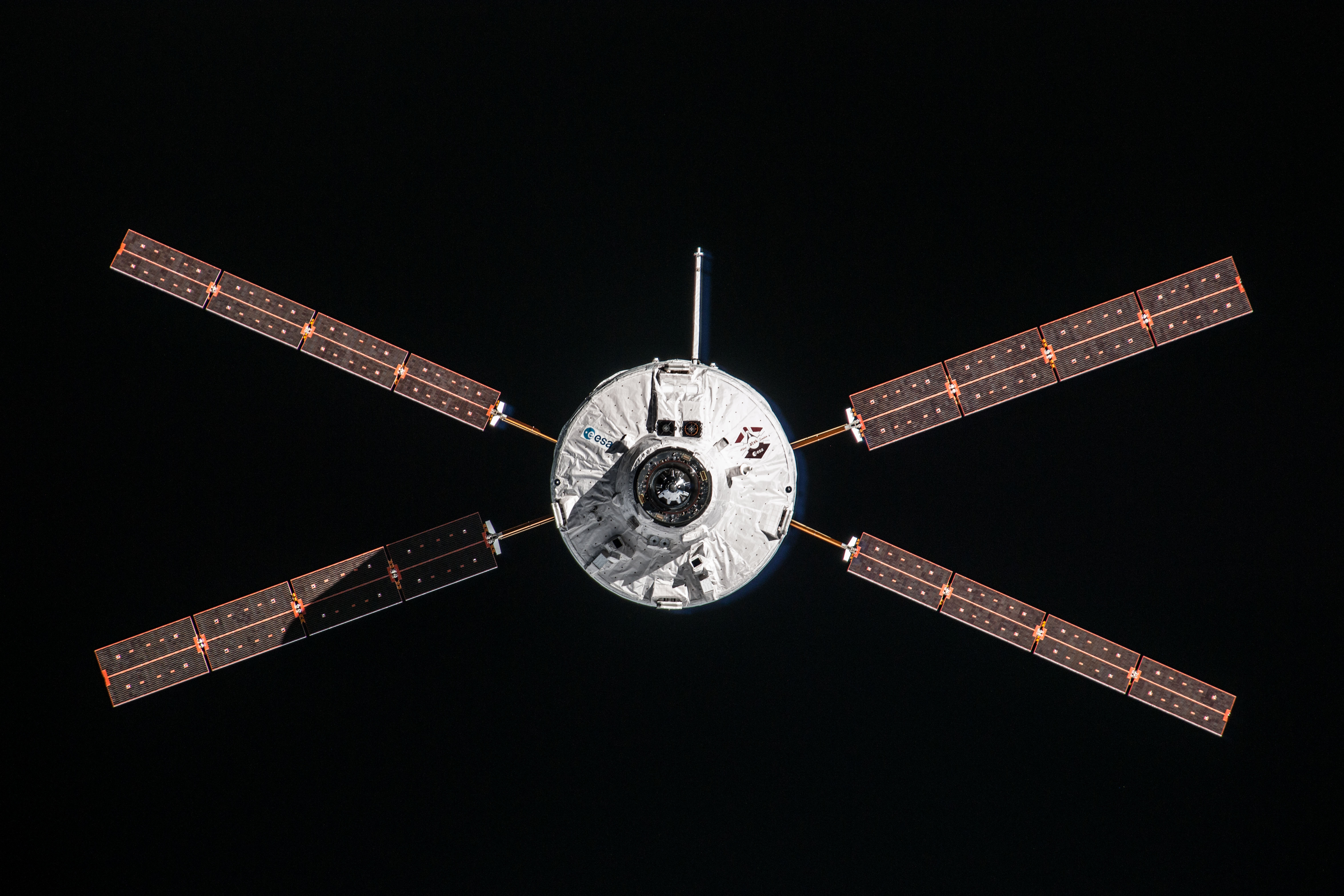
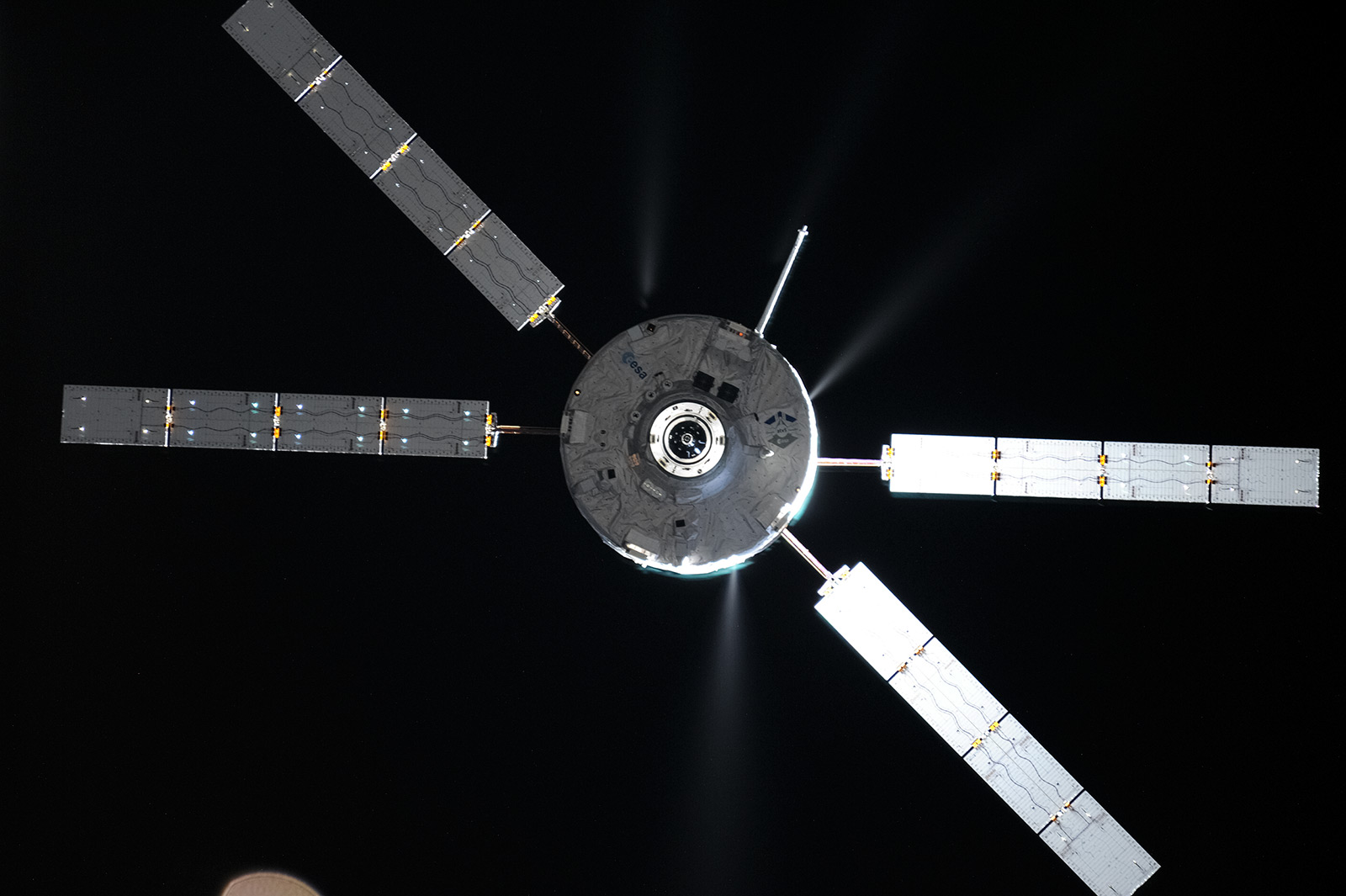
Recently, the US government declined an online petition to build an actual Death Star. (The answer is brilliant and well worth reading! – Ed.) Yes, it’s a shocking decision in many ways, but let’s pretend for a moment that someone did want to build a Death Star. Could you use ESA's Automated Transfer Vehicle to do this? Well, of course you could – but what would that be like?

ATV nearing the Death Star! Image credits - Death Star: Lucasfilm Ltd. & TM. © All Rights Reserved. - ATV: ESA

ATV nearing the Death Star! Image credits - Death Star: Lucasfilm Ltd. © & TM. All Rights Reserved. ATV: ESA

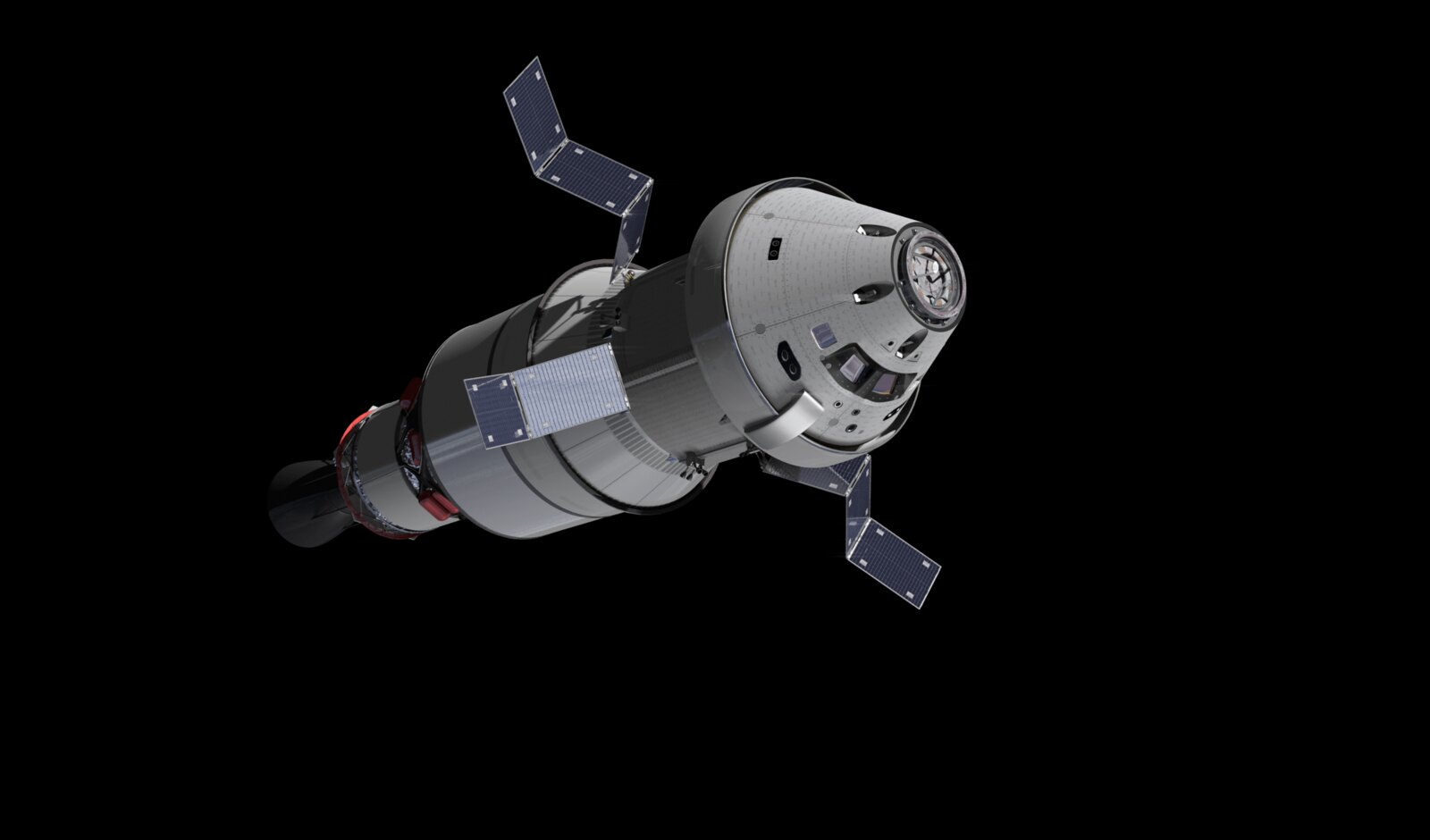
Editor's note: In addition to having a knack for science communication, Rhett Allain is Associate Professor of Physics at Southeastern Louisiana University. He writes regularly for Wired's Dot Physics blog and is a bit of a physics fanatic who spends more time than many pondering how daily life intersects with science. With the recently announced development of ATV in cooperation with NASA for Orion, we're delighted to feature a few posts from the far side of the Atlantic. Enjoy!


If you want to estimate how many ATV launches it would take to build or supply the Death Star, you first need to know something about a Death Star. I could just make some wild estimates about the Death Star, but I won’t.  Instead I will look at two interesting estimations. 

(more...)

Albert Einstein mission fact sheet

Fact sheet for the ATV Albert Einstein mission to the ISS. Lift off is planned for 5 June 2013.

ATV-4 will carry the most dry cargo ever launched in any European spacecraft (2501 kg) and the most diverse cargo mix of any ATV mission (1400 different items).

It will be the heaviest spacecraft ever lifted by any Ariane rocket (20 235 kg).

Mission quiz: Answer 1 – Where does that water come from?

Here's the correct answer to yesterday's first question in our Mission Quiz ("Name the two European sources of the two different types of H2O that ATV transports to the ISS") courtesy of the ATV Cargo specialists:

  1. For American water, we use the Pian Della mussa source that is a lighter water with a mountain source
  2. For the Russian water, we use the Regina Margherita source that is close to Turin (Grugliasco/Collegno) and contains more natural minerals.

Here an abstract (in Italian, only):

L'acqua destinata agli astronauti è la stessa che bevono i cittadini torinesi solo che quella inviata agli americani è estratta dal Pian della Mussa e raccolta dalla centrale di Venaria, ed è quindi un'acqua montana molto leggera. Quella dei russi proviene invece da pozzi dal contenuto minerale naturale situati nei pressi di Collegno.

Details (also in Italian) via SlideShare


Herewith, we're delighted to present the results of judging of the submissions sent in via Twitter and the blog! (Note that our judges felt that it was important to be a fully accurate as possible in the answer...)

Congratulations to the winner, Georg Balmer, with the the first, best response:

Posted in ATV blog 15:58 15.04 by Georg Balmer

The water that ATV delivers to the ISS is delivered by the "Società Metropolinata Acque Torino", the Metropolitan Water Company of Torino, and comes from two different sources near the Italian city of Torino: spring water from "Pian della Mussa", meeting the American standards, and water with higher mineral content, as required by the Russian standard, from wells in the region of Collegno.

(more...)

ATV-4: Things are moving forward

Quick overview: ATV-4 cargo for the International Space Station

  • Fuel for the Russian engines: 860 kg (loading 2 & 11 April)
  • (Russian) Water for the Crew: 570 kg loaded
  • Air and O2: 66kg & 33kg, respectively (loading 13 & 15 April)
  • Fuel for boosting ISS orbit: 2235kg (loading 19/20 & 25/26 April)
  • Dry cargo: 2501kg (partly complete; late load cargo loaded in May)

Next milestone: ATV transfer to BAF (Batiment d'Assemblage Finale) at Kourou - May 6

Note: Today's post provides the latest update from Charlotte Beskow's mission diary from Kourou, where she is serving as the Launch Campaign Manager – Ed.

Prior to 28 March (i.e. before ATV transfer to S5B)

Fuel loading is a complex operation that needs careful planning. Some tasks are 'high-tech' while others are more mundane, although no less important.

Preparing to set up the fluid ground support equipment (FGSE). All the necessary equipment is checked and sorted before Albert leaves S5C. Credit: ESA/C. Beskow

Preparing to set up the fluid ground support equipment (FGSE). All the necessary equipment is checked and sorted before Albert leaves S5C. Credit: ESA/C. Beskow

With ATV still in the S5C hall at Kourou, the very first task was to pressurize the He (Helium) system of both the Russian Fuel System (RFS) and the ATV propulsion system (PRSS). This was done already 23 March (RFS compensators), 25-26 March (RFS He loading) and 26 March(PRSS He loading); in other words, we finished before Albert was carted off to S5B.

In parallel, the UDMH fuel was being prepared in S5B for loading. It underwent a process called degassing.

28 March – ATV Albert Einstein transferred S5B

ATV 4, Albert Einstein, was finally transferred through the long corridor to S5B. How many people does it take to move a 12-tonne space vehicle?

Albert slowly glides away from the TAM (scaffolding). Credit: ESA/C. Beskow

Albert slowly glides away from the TAM (scaffolding). Credit: ESA/C. Beskow

Only a few people could watch it 'in-situ'. The rest of us followed this important event via the video screen in the Safety Room.

As soon as Albert had entered the corridor, we all crowded into the Visitor's Room from where we had an excellent view as it glided down the corridor.

And turns gently towards the exit... Credit: ESA/C. Beskow

And turns gently towards the exit... Credit: ESA/C. Beskow

No worries... it will fit! The building was designed with ATV in mind!

As soon as Albert had entered the corridor we all crowded into the visitor’s room from where we had an excellent view as it glided down the corridor. Credit: ESA/C. Beskow

As soon as Albert had entered the corridor we all crowded into the visitor’s room from where we had an excellent view as it glided down the corridor. Credit: ESA/C. Beskow


As soon as Albert had entered the corridor we all crowded into the visitor’s room from where we had an excellent view as it glided down the corridor. Credit: ESA/C. Beskow

As soon as Albert had entered the corridor we all crowded into the visitor’s room from where we had an excellent view as it glided down the corridor. Credit: ESA/C. Beskow

If all goes according to plan, then Albert will not come back to S5C; teams can start to pack up. Some equipment goes back to Europe and other items go into temporary storage here at CSG... waiting for the last of the vessels to arrive (that would be ATV-5 later this year).

29 March – Propellant loading

Friday: The work to prepare for propellant loading has been going on for quite some time, so as soon as Albert is secure on the stand in S5B the teams 'roll up their sleeves' (read: 'get into their clean room clothes') and get going. We are loading four types of propellant and two types of gas, so there are a number of activities to be carried out, many of them rated as hazardous.

(more...)

Exciting ATV days ahead

Latest instalment of the mission diary from Charlotte Beskow, deputy ATV mission manager. Note the timeline of this post begins back in February and runs until last week – Ed.

ATV-4 launch:  June 2013
i.e. we are still at roughly L - 3 months
ATV-5 launch: Early 2014
We are at less than L - 12 months!

14 March 2013 - On board AF 3508 over the Atlantic on my way to Kourou! Here comes a smattering of details and updates, showing you what daily life can be like in this most fascinating of all worlds!

ATV-4 is transporting cargo to the International Space Station!

  • Fuel for the Russian engines - 860 kg
  • (Russian) Water for the crew - 570 kg
  • Air (66 kg) and Oxygen (33 kg) - 99 kg
  • Fuel for maintaining ISS orbit/reboosts - 2,235 kg
  • Dry Cargo - 2,506 kg

4 Feb 2013 - Simulation of of mission period launch to docking (LEDOWK)

This was an intensive week. It consisted of a full-scale simulation of launch to docking (LEDOWK, which normally takes ca. 8 days) at ATV-CC in Toulouse, involving the complete flight control team including the technical experts of the EST (Engineering Support Team) from ESTEC. To make it more interesting – and to make sure we are prepared for what might come during the real flight – the trainers worked overtime to put together various contingencies. These were selected based on previous flight experience, known weaknesses in the systems, and the sheer (evil? - Ed) inventiveness of the simulator experts.

Some of the Engineering Support Team (EST) members before the simulation started Credit: ESA/C. Beskow

Some of the Engineering Support Team (EST) members before the simulation started Credit: ESA/C. Beskow

As a consequence, LEDOWK is not the time to fine-tune your procedures, beef up you knowledge of ATV-CC nor develop working routines for the team. All this is either in place or will have to be dealt with some other time.

The EST are, by definition, called when problems arise. For us it was therefore a bit tricky to prepare a staffing plan that would not give away the planned failures. At the same time, we had to respect working-hour regulations and 'normal manning for the flight'. This led to some bizarre shifts, in which people had to turn up more than once in a given 24-hour period. Some were also on call – no sooner had they dropped into bed than the phone would ring with a call from a colleague in need of some vital info.

In terms of failures, we were not disappointed. The sim team kept us on our toes 24h/24 from Monday afternoon until Friday lunch time. The flight control team next door run regular shifts, whereas our hours changed daily. Add to this the use of simulated ISS time (covering 12 March 08:00 to 17 March 23:00 – with a few gaps – and local time being 2 hours behind (which of course had no relation to the real Toulouse local time) and, in the end, we had little idea of what day or what time it really was.  

This is exhausting!

(more...)

ATV disinfection: a video tutorial

Not your average spring cleaning

When ATV Albert Einstein docks with the International Space Station, it will bring fresh food and water and then serve as a habitable module for the astronauts aboard. Nobody wants to bring fungi or bacteria to Station, so guidelines have been set on the level of cleanliness expected on all equipment used in human spaceflight.

The task of scrubbing ATV clean has gone to ESA's Life and Physical Sciences Instrumentation and Life Support team since the launch of the first ATV vessel, ATV Jules Verne, in 2008.

The team is part of a multidisciplinary group based at ESA's European Space Research and Technology Centre (ESTEC) who regularly work on developing a closed Life Support System, MELiSSA.

MELiSSA intends to produce oxygen, water and food by recycling mission waste. Knowledge gained from understanding, running and controlling microbiological processes as part of this project is used to ensure ATV'sPressurised Module reaches the necessary level of microbial cleanliness.

Scroll down (after the jump) for a fabulous behind-the-scenes video tour of the disinfection process of ATV Albert Einstein.

Super duper preview... more after the jump!

(more...)

How many calories does it take to bring a calorie to the ISS?

By Rhett Allain

The primary role of the Automated Transfer Vehicle is to bring supplies to the International Space Station. Supplies include food, water, oxygen, scientific equipment and candy bars. Yes, I listed food twice. Candy is food, but I listed it separately so that we could look at candy in space.

Here is the question: Suppose an astronaut requests an extra candy bar to be sent up on the ATV. How much extra energy is required to get this candy into orbit? That is the question.


Rhett Allain

Rhett Allain

Editor's note: In addition to having a knack for science communication, Rhett Allain is Associate Professor of Physics at Southeastern Louisiana University. He writes regularly for Wired's Dot Physics blog and is a bit of a physics fanatic who spends more time than many pondering how daily life intersects with science. His recent posts have looked at the physics of a (fake) broken swing image, why doesn’t the Moon crash into Earth (gravity's involved!), Star Wars blaster speeds (answer: 34.9 m/s) and how well-made are Lego blocks (really well made). With the recently announced development of ATV in cooperation with NASA for Orion, we're delighted to feature a few posts from the far side of the Atlantic. Enjoy! – DGS


To start, let’s get some initial values. Some of these will be estimates. What about the ISS? It has an orbit that is about 420 km above the surface of the Earth and it moves with a speed of 7,700 m/s. Both the altitude and speed are important in the calculation of the energy needed to get supplies there.

Got the goodies from ATV-2! Credit: ESA/NASA/P. Nespoli

Got the goodies from ATV-2. What, no pizza for me? I guess rehydrated macaroni & cheese will have to do for next few months! Presi i pacchi doni. Cosa? Non c’è pizza per me? Accidenti, dovrò acconterntarmi di pasta reidratata per i prossimi mesi! Credit: ESA/NASA/P. Nespoli

There really is just one other important piece of information. We need the location of the ATV launch pad, which is in Kourou, French Guiana. In case you aren’t familiar with the location, here it is in Google Earth.

Kourou in Google Earth

Kourou in Google Earth

Kourou is only 5 degrees above the equator. There is a reason for this as we will soon see.

Oh, we need one more thing. What about the mass of a candy bar? I don't wish to single out any particular brand of candy, so I will just assume an average chocolate candy bar. Let's say it has a mass of 50 grams with 250 calories (that's food calories, which are different than chemistry calories – just to be clear).

Physics and Energy

Now for a little bit of physics. Why does it even take energy to get anything to the ISS? Well, there are two things you need to do to a candy bar in order for an astronaut in space to eat it. First you have to lift the candy up to the height of the ISS. Second, you have to increase the speed of the candy bar so that it is going at the same speed as the ISS. Let me look at these two things separately.

Suppose you find this 50-gram candy bar on the ground and you lift it about 1 meter up to place it on a table. This requires that you do some work on the candy to change its energy. But how much energy would it take? One way to look at this is via the change in gravitational potential energy. On the surface of the Earth, the change in gravitational potential can be calculated as:

Here, g is the local gravitational constant with a value of 9.8 Newtons/kg. Increasing the height of a candy bar by 1 meter would take 0.49 Joules of energy. That's not too much.

Liftoff of Ariane 5 VA205 with ATV-3 Credit: ESA - S. Corvaja, 2012

How the candy bar gets its kinetic energy: Liftoff of Ariane 5 VA205 with ATV-3 Credit: ESA - S. Corvaja, 2012

Now, what if I want to increase the height of the candy bar all the way up to the ISS? Can I just do the same calculation but change the height from 1 meter to 420 km? No, I can’t. The above model for gravitational potential energy assumes that the gravitational force on the object is constant. This is a good assumption near the surface of the Earth, but not so good as you get higher (though at the ISS height it isn't the worst approximation you could ever make).

If we use a better model for the change in gravitational potential, it would be this:

Here, G is the universal gravitational constant. The two masses in the expression are the mass of the candy bar and the mass of the Earth. The values on the bottom of the expression are the distances from the centre of the Earth. So, the candy bars ends at the altitude of the ISS (I call this h) and starts at the radius of the Earth.

If you put in the values for G and the radius and mass of the Earth, you would find that it takes 1.93 x 10⁵ Joules of energy to get that candy bar up to the right altitude.

But that’s not all of the energy for the candy bar. If you put that much energy into the candy and let it go, it would just fall back to the Earth. The other kind of energy the candy needs is kinetic, i.e. moving, energy. This has an expression of:

Since we know the speed of the ISS, shouldn’t this be easy to calculate? If I put in the mass of candy (0.05 kg) and the speed of 7,700 m/s, I get a kinetic energy of 1.48 million Joules. Actually, this is the wrong answer. Why? It assumes that we took that candy and increased its speed starting from rest.  The only problem is that before the launch, the candy is already moving. It is moving because it is on a rotating Earth.  

Let's say the Earth rotates once every 24 hours (which it doesn’t actually – that is the time for the Sun to get back into the same position but this value is close enough for us). This means that the speed of the candy before launch can be calculated as:

But what is r in this expression? It is the radius of circle in which the object moves due to the rotation of the Earth. At the equator, r is the radius of the Earth. At the North pole, the radius would be zero. If I put in the radius of the Earth (and convert hours to seconds), I get a starting candy bar speed of 464 m/s. That might be small compared to the ISS speed, but every little bit helps. And this is why ESA launches the ATV from Kourou. It is very close to the equator.

OK, so what about the new change in kinetic energy of the candy? Launching from the equator, you would need about 1.47 million Joules.  

Got the goodies from ATV-2! Candy bar detail. Credit: ESA/NASA/P. Nespoli

Candy bars? What candy bars? Credit: ESA/NASA/P. Nespoli

The total energy to get this candy bar to the ISS is just the sum of the two values we've now calculated: the change in kinetic and change in gravitational potential energy. This works out to 1.66 million Joules. That is over a million Joules of energy for just that one tiny candy bar and it assumes a perfectly efficient method for getting things into orbit without any energy losses. This is why we don’t all live in space. It's just expensive.

Energy to orbit using candy

It's pretty hard to get a feeling for an energy of 1 million Joules. What about a comparison to the energy in the candy bar? If you consume this candy, it can produce 250 food calories. One food calorie is 1000 calories which is 4,180 Joules.

Let’s go backwards. If it takes 1.66 million Joules to get candy into orbit, how many food calories is that? This is a pretty straight-forward unit conversion problem. Remember that the trick to unit conversions is to always multiply by a fraction that is equivalent to 1.

Well, that's not so bad. It takes a little  more than 1 candy bar of energy to get a candy bar to the ISS! 

OK, one more thing: What if we wanted to get all of the ATV cargo to the ISS just using candy as energy? The ATV can carry a payload of about 20 tonnes, or 20,000 kilograms. If this payload comprised just candy bars, that would be 400 thousand bars of candy; the energy needed to get into orbit is the same energy you would get from consuming 640,000 candy bars.