Monthly Archives: November 2011

Advice from an ATV expert

Debriefing with Volkov, still in quartine.

Debriefing with Volkov, still in quarantine!

André Kuipers, Oleg Kononenko and their back-up crew passed the ATV exam yesterday with flying [orbiting? - Ed.] colours. They had to prove through six challenging scenarios that they can handle all aspects of ATV docking – including contingencies and off-nominal situations – to dock successfully to the ISS.

After passing the exam, they had an opportunity to debrief and chat with the only person who has been present for two ATVs in flight: Russian cosmonaut Sergei Volkov, who just landed on Tuesday and is still in post-flight quarantine.

Sergei participated in two ATV undockings and performed many operations on board both ATV Jules Verne and Johannes Kepler.

He remained on board the ISS from April to October 2008 and from June to November this year. His valuable reports will not only help the new ISS crews to know what to expect for ATV training and operations, but also help perfect and update attached-phase operational procedures and provide practical information for future missions.

Thanks to Lionel Ferra at the European Astronaut Centre for this excellent report.

Editor’s note: Access the full image gallery via Flickr.

Tension, expertise as ESA, Russian and JAXA astros ace ATV exam

The crews had to manage six complex scenarios.

The crews had to manage six complex scenarios.

Thursday, 24 November, was a great day for the ATV program. The prime crew, André Kuipers and Oleg Kononenko, and the backup crew, Yuri Malenchenko and Aki Hoshide, passed their ATV-3 final exams at Russia's Gagarin Cosmonaut Training Centre (GCTC).

A thin snow-blanketed exam day at GCTC started off with the backup crew Yuri Malenchenko and Aki Hoshide. Since ATV-3 docking is planned during the regular crew handover on the station, André and Oleg should have an ATV backup crew available. This backup crew should be fully trained on ATV matters and especially on technical details of rendezvous. Yuri and Aki drew their fate out of a set of envelopes: Run through six complex scenarios. Yuri was the prime operator when ATV Jules Verne docked to the Russian service module (SM) in 2008, so thanks to his experience and lots of training hours they were able to perform very well in the exam.

They draw their fate out of a set of envelopes to go through 6 complex scenarios.

Teams draw their 'fate' from a set of envelopes: Yuri & Aki 'won' 6 complex scenarios...

After the two successfully completed their test, the prime crew arrived all suited up and drew again one of the envelopes to determine their test fate.

A commission composed of ESA experts, experts from RSCE-Energia, senior representatives of GCTC and former cosmonauts observed, took notes, and carefully followed all actions, reports and even gestures of the crew throughout their exam.

You could really feel the tension within the thick and steamy atmosphere of the room as ATV wandered outside of its preplanned docking corridor, approached too fast or even 'escaped' back into space after mechanical docking was complete (these were all simulated, of course - but realistically so).

Representatives of GCTC and former cosmonauts observed even gestures of the crew.

Representatives of GCTC and former cosmonauts observed even the smallest gestures of the crews

Despite these surprise malfunctions and many side discussions about usage of the range ruler (which the astros use inside the ISS as a simple way to visually confirm ATV's approach), KURS accuracy (KURS is the radio measurement system indicating the range rate*) and other rendezvous deeply technical ATV topics swirling within the commission room, the crew carried on - just like they're supposed to.

The exam concluded flawlessly with the highest attainable grade. Once the debriefing was finished, the entire commission congratulated the crew, cementing their successful exam results as an additional milestone for Expedition 30 / PromISSe mission to soar to Station.

Note*: The range to ATV during docking is also given by KURS - but this is only used by crew when ATV is farther than 100m; closer than 100m, they use the range rulers.

The ATV final exam is part of full sequence of a half-dozen main exams before flight for the prime and backup crew.

Thanks to Lionel Ferra at the European Astronaut Centre for this excellent report.

Editor’s note: Access the full image gallery via Flickr.

ATV Exam passed: Congratulations to André and Oleg!

André Kuipers and Oleg Kononenko passed the ATV-Exam.

André Kuipers and Oleg Kononenko passed the ATV-Exam.

They trained hard and for a long time: With the help of an ATV mock up, ESA astronaut André Kuipers and Roscosmos astronaut Oleg Kononenko went through every little step over and over again until everything was correct. Today, they passed the ATV Exam, which means that they are fully prepared to handle ATV docking to the ISS.

Many Twitter user congratualted André and Oleg, amongst them Samantha Cristoforet, ESA astronaut.

They are going to practice what they trained for in reality soon: They lift off for the ISS  on 21 December and ATV docking is set for March.

Editor’s note: Access the full image gallery via Flickr.

ATV launch and docking sim: This is a weird week

Tuesday, 05:47 in the ATV-CC Engineering Support Team room

Update from Charlotte Beskow on this week's simulation at ATV-CC - Ed.

Launch simulation 27 January at ESA's ATV-CC

Launch simulation during ATV-2

This is a weird week! Weird because the timing is completely 'off' - we are in Day 2 of a 5-day simulation with operations running 24h/24h and I am doing the night shifts. The clock on the wall tells me it is Thursday, 3 March 2012, at 04:48, but the lights are the same as if it was 10:00 in the morning and the people around me are pretty much the same that I meet during a 'normal' day.

Yesterday, Monday, we simulated launch and the initial steps of ATV's Launch and Early Operations Phase (the famous 'LEOP'). The simulation people - the trainers who pace us, the team, through a complete preplanned scenario - must have been preparing for this week for some time because they had certainly come up with an imaginative series of failures for us to handle.

Personally, I had not sat in front of the consoles since June 2011 when we deorbited ATV Johannes Kepler and so my reflexes were a bit rusty. In addition, the difference between simulated time and ground time necessitates some mental acrobatics when making data requests, etc. Things like passwords, log-in addresses, etc., are usually memorised in the fingertips, rather than the brain, but over five months, this capability disappears. Consequently, I was looking forward to a quiet simulation of ATV's phasing orbits (the ones after launch but before docking) in order to ease back in and refresh my memory.

Yesterday's shifts proved to be anything but quiet.

(more...)

Preparing for ATV mission simulation

ATV-3 launch minus 4 months. Day 79 of the campaign – Thursday, 17 November

The latest update from ESA’s Charlotte Beskow in Kourou – Ed.

The Engineering Support Team (EST) is busy preparing for the full-scale mission simulation to be held 21-25 November. Several new team members have joined, replacing those that have moved on, and they are busy familiarising themselves with the ATV-CC tools and facilities.

Editor's note: The EST comprises experts from the ATV project as well as industry. They work in a dedicated control room at ATV-CC and are the vehicle engineering and technology experts; they monitor every aspect of the flight during critical phases (launch, docking, etc.) and are available on the voice loop (or in person, of course) to provide assistance to the Mission Director.

In one corner, we have the newcomers to the GNC/GMS section (looking after ATV's Guidance & Navigation System and the GNC Measurement System) being coached under the watchful eye of an experienced team mate...

ATV Engineering Support Team - GNC - in simulation at ATV-CC, 17 Nov 2011 Credit: ESA/C. Beskow

ATV Engineering Support Team - GNC - in simulation at ATV-CC, 17 Nov 2011 Credit: ESA/C. Beskow

... while, squeezed in close by, is the rest of their group...

ATV Engineering Support Team - GNC - in simulation at ATV-CC, 17 Nov 2011 Credit: ESA/C. Beskow

ATV Engineering Support Team - GNC - in simulation at ATV-CC, 17 Nov 2011 Credit: ESA/C. Beskow

And, in another corner, sit the Propulsion & Thermal experts.

ATV Engineering Support Team - Thermal & Propulsion - in simulation at ATV-CC, 17 Nov 2011 Credit: ESA/C. Beskow

ATV Engineering Support Team - Thermal & Propulsion - in simulation at ATV-CC, 17 Nov 2011 Credit: ESA/C. Beskow

As can be seen in these live-action, if a little 'back of the head'-ish, photos, everyone is intensely focused on preparing for the week-long simulation. Shown here is a preview using a replay of (actual) ATV-2 mission data.

These are the experts who know the ATV vessel's innards and technology, and now must master the control centre equipment so they can effectively help manage the actual mission.

We are four months away from launch and from Monday, 21 November to Friday, 25 November, ATV-CC in Toulouse is running a full-scale simulation covering the mission from countdown (before launch) up to docking. All teams will be present and seated 'on console' working 24h/24h - just like we will when ATV Edoardo Amaldi is launched in March 2012.

(more...)

Mission-X: train like an astronaut in 2012

ESA astronaut André Kuipers is inviting thousands of schoolchildren to perform physical activities and to learn about healthy nutrition to compete with teams from around the world to become as fit as astronauts. Mission-X kicks off again in February 2012!

Full details via ESA web and TrainLikeAnAstronaut.org

PromISSe mission website live

The countdown for the PromISSe mission has begun! With only five weeks to go until his planned 21 December launch, you can learn all about ESA astronaut André Kuipers' tasks in space and stay tuned for the latest information on the new PromISSE website.

As flight engineer on the station, André will have several assignments, ranging from maintenance to payload operations. He will be the prime crew member overseeing the rendezvous and docking operations of ESA's third Automated Transfer Vehicle, Edoardo Amaldi, (ATV-3), together with Expedition 30 Flight Engineer Oleg Kononenko.

Side note: Kononenko performed two spacewalks during his first spaceflight in 2008. The maiden flight of ATV Jules Verne took place during that mission and now he will assist André Kuipers during the docking manoeuvres of ATV Edoardo Amaldi.

PromISSe website esa.int/promisse

PromISSe website esa.int/promisse

ATV-3 launch preparations ongoing

The Ariane 5 ES launcher for the ATV Eduardo Amaldi is taking shape at Europe's Spaceport in Kourou as the cryogenic main stage, with its Vulcain 2 engine, was hoisted to the vertical position inside the Launcher Integration Building.

More photos via ESA's multimedia gallery!

Dry cargo for ATV

ATV-3 Launch minus 4 months. Day 72 of the campaign - Tuesday, 8 November

The latest update from ESA’s Charlotte Beskow in Kourou – Ed.

2,450 kg of dry cargo arrived in French Guyana. Credtis: ESA/C. Beskow

For the past few weeks we have been doing basically two things: Solar Array Integration on the Space Craft (S/C) and Leak Checks on the Integrated Cargo Carrier (ICC). These are two activities which take quite some time.

In parallel we have been preparing for the arrival of the cargo. Cargo is, after all, the main purpose of ATV. ATV Cargo comes in several forms. Water for the astronoauts, air to breathe, fuel to keep ISS in orbit and dry cargo. The last item encompasses various items needed for ISS to function as a laboratory as well as tems the crew needs for their daily lives.

ATV can carry:

  • up to 4,000 kg of propellant (for its own engines)
  • up to 860 kg of Russian propellant for the ISS engines
  • up to 860 kg of water (Russian or American and yes, they are different)
  • up to 102 kg of gas (air, oxygen and/ or nitrogen)
  • up to 5,500 kg of dry cargo.

Racks, space qualified shelves, for dry cargo. Credits: Esa/C. Beskow

These are max loads. For each ATV the actual cargo mix is defined according to the ISS needs at that time. For ATV-3 this means that Edoardo Amaldi will carry

  • 2.900 kg of prop for our engines
  • 860 kg of Russian propellant 285 kg of Russian water
  • 102 kg of gas
  • 2,450 kg of dry cargo

In other words, a total of 6,960 kg of cargo for the ISS.

The pressurised part of ATV is equipped with racks, you can think of this as space qualified  shelves. Dry cargo is stored on these shelves and secured by belts. Monday and Tuesday this week the first two batches of dry cargo arrived.The state of each crates is inspected, and once opened, the state of the contents is checked as well.


Carefully wrapped special cargo bags. Credits: ESA/C. Beskow

Inside the crates are the carefully wrapped special cargo bags. Each bag carries labels which allow the handlers to identify which bag it is and what it contains. There are also labels on the side which describe the contents in order to make it simpler for Crew to find what they are looking for.

The bags are stored in a dedicated room until it is time to load the cargo into ATV. Credits: ESA/C. Beskow

The cargo team have carefully calculated where to optimally store the bag inside ATV. This is required to calculate the center of mass. It is of course also very important for the crew to know where each item is located. It’s  a bit like being on  a ship. There is not much free space so each item has a specific place.

The bags contain food, clothing, paper, spare parts etc. for the ISS. Credits: ESA/C. Beskow

So,  what do the bags contain?   Food clothing, paper, spare parts etc. These items will certainly be welcome on the ISS. So far 9 pallets have arrived. Another 10 are arriving today which will keep us busy most of the evening…more arrive next week and cargo loading starts end of November.

– Charlotte

Editor’s note: Access the full image gallery via Flickr

Edoardo Amaldi is spreading its wings

ATV-3 solar panel deployed

ATV-3 solar panel deployed

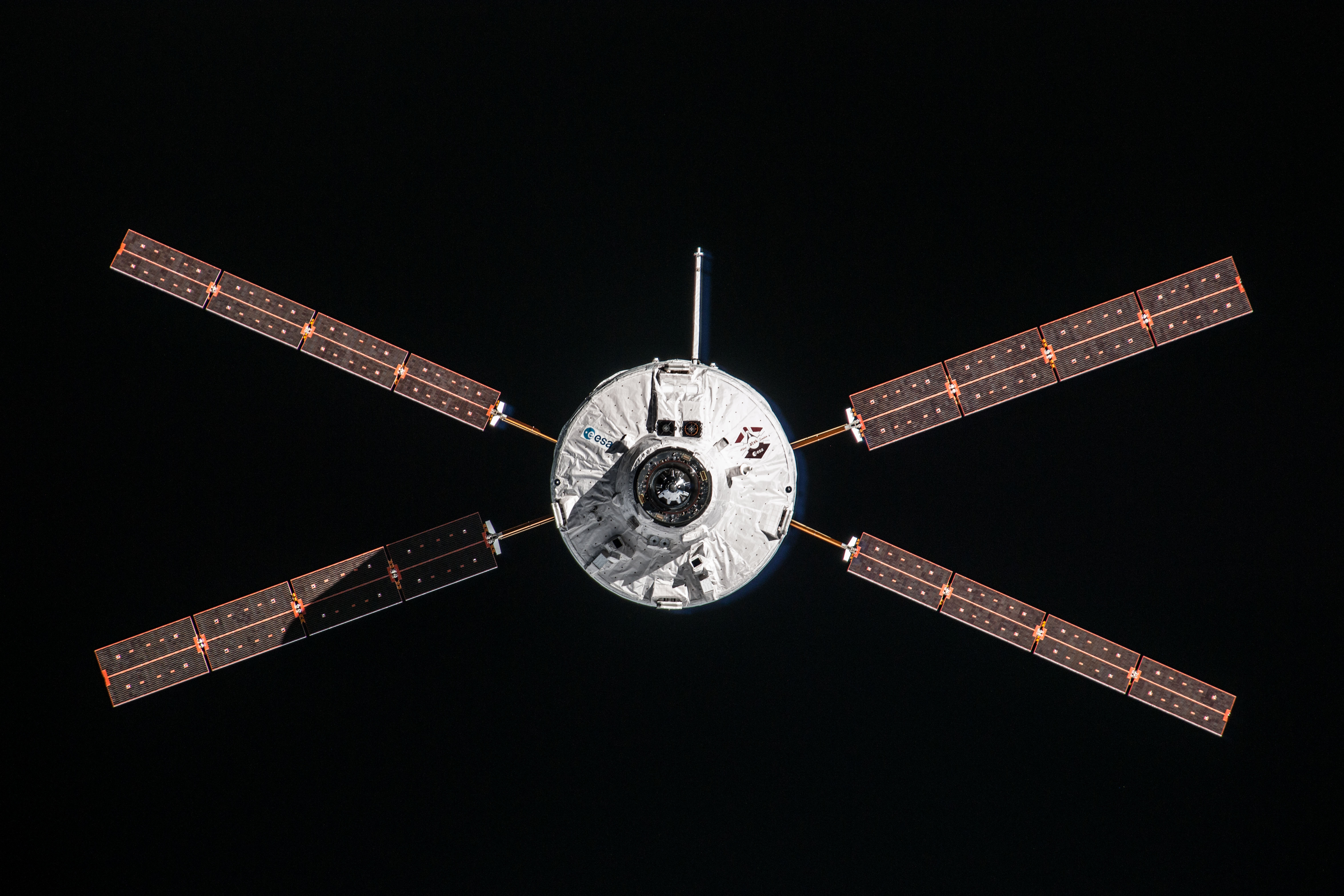
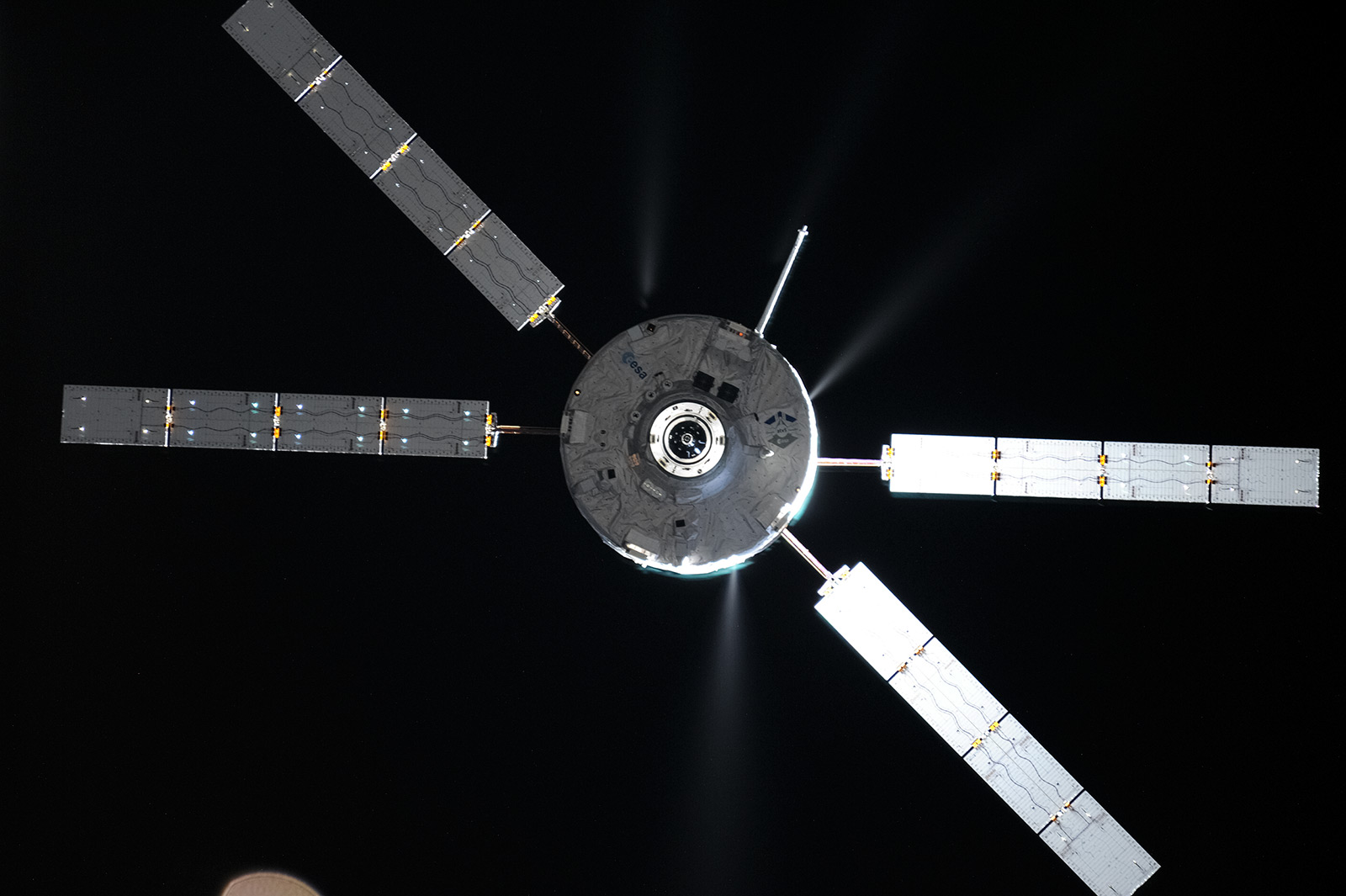
New photos from Kourou! The solar panels of ATV-3 are being checked out in Europe's Spaceport in French Guiana, where the third European unmanned space ferry is being prepared for launch to the International Space Station early next year.  

ATV-3 solar panel being deployed

ATV-3 solar panel being deployed. Note the device from where the panels are hanging; this compensates for gravity and helps the panels open as they do in space.

Edoardo Amaldi, named after the Italian physicist, will carry about two tonnes of dry cargo, 285 kg of water and more than three tonnes of propellants.