Monthly Archives: April 2011

ATV rotates the ISS for Progress docking

A quick note from ESA's Charlotte Beskow, watching today's Progress 42P docking to the ISS:

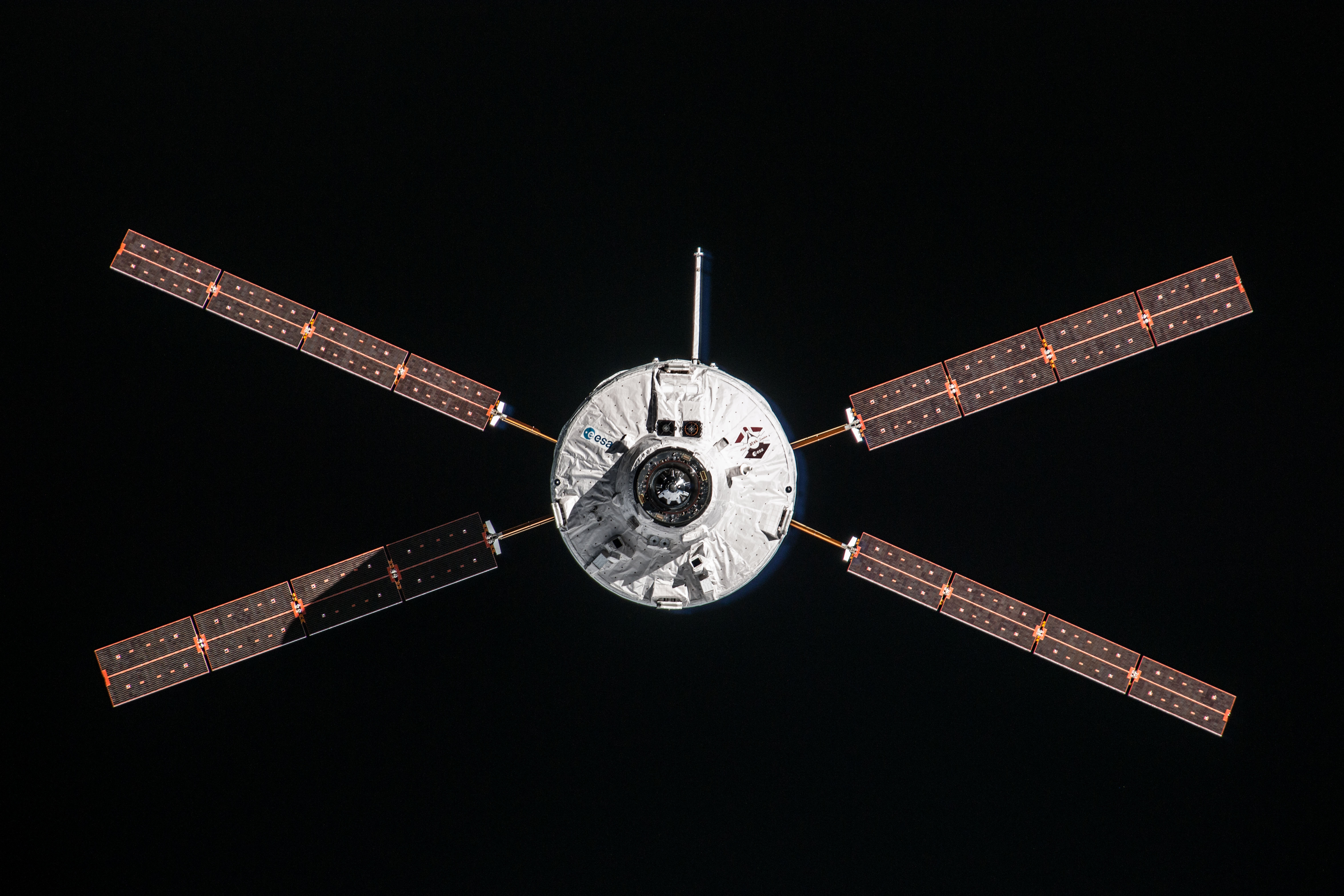
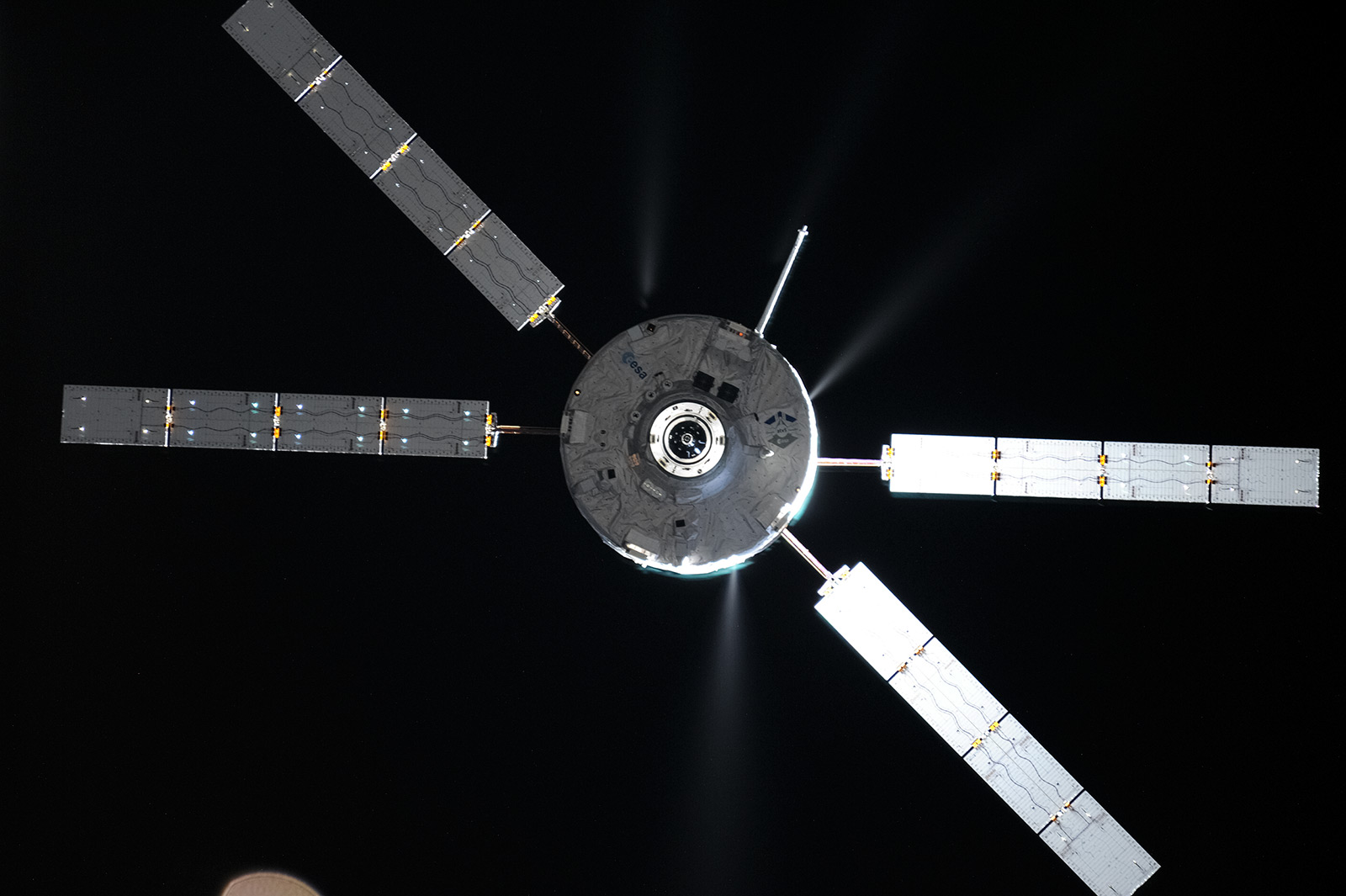
We are in the control room watching our screens, and on the main screen above us we see the black and white image of the ISS seen through the Progress camera. We can clearly see ATV with its solar arrays facing towards us - showing the classic 'X' configuration. Earlier today, ATV was used to turn the ISS around so that we are now flying at the 'head of the stack' - i.e. the ISS is flying backwards compared with its normal attitude. Docking is planned for 14:29.

ATV-2 performs ISS attitude control

Editor's Note: Progress M-09M/41P undocked nominally today at 13:41 CEST. An automated 15-second separation burn with the vessel's DPO-K2 thrusters followed at 13:44 CEST, followed by a retrograde phasing burn with the SKD engine at 16:48 CEST. The cargo ship, loaded with trash, is now continuing to phase away from the ISS. It will perform two retrograde burns on 23 April, one on 24 April, one on 25 April and a last one on 26 April - the 67.4 metres/second 'deorbit' burn for destructive reentry. A few hours ago, we received an email from ESA's Charlotte Beskow, Deputy Head of ATV Production Programme, reporting the details of ATV's crucial role for today's undocking.

Charlotte writes:

We just performed attitude control for the ISS to prepare for a Russian Vehicle undocking. Normally, we are only supposed to fly the ISS level to the Earth - but for today's operation, a completely different attitude was requested: The ISS flew upside down and back-to-front!

In the first picture (see animation above) you see ATV. It is at the rear of the ISS (in the middle, lower part of the first picture, with X-shaped solar panels). Then, in the following pictures you see the entire station first skewing, then flipping - all powered by ATV.

After a short time in this position we performed an inverse manoeuvre, to bring the ISS back to a nominal attitude.

We had a computer model up and running that took the actual ISS coordinates and visualised the station's orientation using a computerised model; I attach the pictures here - pretty impressive!! [We included them as an animation - Ed.]

All the calculations of thruster impulses were done by our Russian colleagues; Russian computers commanded the ATV thrusters as if it were their own. We were basically spectators down here at ATV-CC in Toulouse (at least when we had communications, which was most of the time, despite our funny attitude).

ATV undocking set for 20 June

ATV Kepler photos from docking day 24-02-2011ATV Johannes Kepler is set to undock from the ISS on 20 June 2011, giving the resupply vessel a longer docked phase than originally foreseen. We spoke with ESA's Nico Dettmann by email earlier today, who told us:

"Our new undock date is mainly due to the change in launch date for NASA's Shuttle mission STS-134, now set for lift-off on 29 April. That launch in turn had been shifted to 29 April from the initially planned 19 April due to the requirement to launch the Russian Progress M-10M cargo vessel on 27 April. Also, the later-than-expected arrival of Shuttle STS-134 affected later planned Russian arrivals, meaning that Soyuz TMA-02M/27S will now arrive a bit later, so ATV can stay attached until the 20th."

Nico said the extension to the ATV attached phase means the European resupply vessel will provide additional reboost capacity to the ISS, with four reboosts now planned from end-May to early June. "It's not a big change in the mission plan - we had extensions also on the first ATV mission in 2008," he added.

At ATV-CC in Toulouse, the extension will mean that mission controllers will shift dates for the undocking readiness review and rearrange some shift plans. The extension will also not substantially affect plans for deorbiting ATV, with reentry now also happening within just a day or two of undocking.

Watching the Sun over ATV

There is a very nice report in the CNES ATV blog profiling the little-known work being done to protect ATV from space weather - solar radiation and especially energetic protons that can be emitted during solar events. Our quick and dirty translation is below - and when you've read today's update read more on space weather and ESA's Space Situational Awareness Programme here.- DGS

Each day, CLS undertakes a solar flare risk assessment for ATV-CC. Credit: NASA/SDO, 2011

ATV-CC keeps a close watch on solar activity each day, as certain components of ATV Johannes Kepler are extremely sensitive to particles emitted during solar eruptions, or flares. Information on solar activity is taken into account by the flight procedures as a factor in delaying or postponing certain operations.

Who said that ATV was a simple mission?

European space expertise has proven itself capable - in the past with ATV Jules Verne and today with Kepler – of mastering complex mission requirements. ESA and CNES take into account, each day, a large number of parameters affecting flight operations – and monitoring solar activity is critical.

(more...)

Nespoli performs hot-swap of faulty valve on Columbus

Nice update today in the main ESA website on the 27 February in-orbit replacement of a faulty water valve in the Columbus lab's Thermal Control System, which cools all the equipment and scientific payloads in the orbiting research module:

ESA astronaut Paolo Nespoli removes failed valve in Columbus 27 February 2011

ESA astronaut Paolo Nespoli removes failed valve in Columbus 27 February 2011

A joint effort is combining sophisticated engineering analysis on the ground with old-fashioned hands-on work in space after ESA astronaut Paolo Nespoli undertook the complex installation of a replacement water valve in ESA's Columbus science laboratory.

Full article via ESA

ISS Crew Talks with Media about Gagarin and STS-1 Anniversaries

Orbiting 220 miles above the Earth's surface, Expedition 27 crew members speak with the New York Times and CNN's "American Morning" about the historic exploration milestones reached on this day.

At about the 8:04 time mark into this video ESA astronaut Paolo Nespoli @astro_paolo has a great time playins around with a nifty little ATV model... how did that get up into orbit? :-)

50 years of humans in space

A wonderful little video from ESA to pay tribute to five decades of human spaceflight! 50 years of Humans in Space was produced at the European Astronaut Centre and commemorates Yuri Gagarin's historic flight 50 years ago tomorrow - 12 April 1961. Yuri Gagarin was the first to see Earth from space and his legacy has motivated many young people to follow careers in science and engineering - and, of course, to become astronauts. More information at www.esa.int/Gagarin

3D photo: @Astro_Paolo & Alex practice for ATV docking

With Alex, rehearsing ATV-2 docking procedures in Zvezda - taken 21 February 2011, just a few days before docking (click for large size original in Flickr).

3D: With Alex, rehearsing ATV-2 docking procedures in Zvezda

3D: With Alex, rehearsing ATV-2 docking procedures in Zvezda

Space debris no threat to Station

The Expedition 27 crew members aboard the International Space Station did not need to take shelter in their Soyuz spacecraft when a piece of debris from a Chinese satellite made its closest pass at 22:21CEST Tuesday, at least 6 kms from the station.

The ISS Mission Control Center Houston (MCC-H) gave the crew the all-clear at 20:41CEST as the space station orbited above eastern Asia. Flight controllers had been monitoring the debris from the Chinese FENGYUN 1C satellite since early Tuesday morning. Because there was not enough time to steer the station out of the way, as was done Friday for a different piece of debris, the crew would have been asked to shelter inside the Soyuz TMA-20 that brought them up to the station in December had it become necessary.

Listen to mission control give the all-clear here:

More information from NASA on how the International Space Station team tracks and responds to threats here.

via NASA

NASA retargets shuttle launch for 29 April

Following discussions among the International Space Station partners on Sunday, NASA has targeted the launch of space shuttle Endeavour's STS-134 mission for 3:47 p.m. EDT on Friday, April 29. The delay removes a scheduling conflict with a Russian Progress supply vehicle scheduled to launch April 27 and arrive at the station April 29.

Via NASA